Skipper Limited
- Skipper Limited
- Chapter 1 – The Beginning of a Quality-Driven Journey
- Chapter 2 – Building Quality into Manufacturing
- Chapter 3 – The Promoter’s Vision and the Expansion of Skipper
- Chapter 4 – From Products to a Diversified Industrial Portfolio
- Chapter 5 – Entering Wider Markets and Strengthening Customer Confidence
- Chapter 6 – Technology, Capacity and the Search for Greater Efficiency
- Chapter 7 – From Manufacturing to Engineering and EPC
- Chapter 8 – Quality, Safety, Environment and Integrated Management
- Chapter 9 – Innovation, Testing and Building Future-Ready Capabilities
- Chapter 10 – A Continuing Journey of Quality, Growth and Excellence
- Take the Next Step Today
Chapter 1 – The Beginning of a Quality-Driven Journey
Every successful industrial organisation has a story that begins long before its products reach customers. Behind every tower, pole, pipe, fastener, engineering project and infrastructure solution are years of experience, investment, technical knowledge, management decisions and the continuous efforts of employees. The story of Skipper Limited is a story of this kind—a journey that connects entrepreneurial vision, manufacturing capability, quality management and long-term industrial development.
Skipper Limited, headquartered at 3A, Loudon Street, 1st Floor, Kolkata – 700017, West Bengal, developed into a diversified engineering and manufacturing organisation with activities associated with transmission and distribution infrastructure, steel products, polymer products and engineering solutions. Its journey reflects the gradual transformation of a manufacturing business into a broader industrial organisation capable of serving customers across different sectors and geographical markets.
The company’s roots are associated with the Bansal family’s industrial activities and its long-standing connection with steel manufacturing. Over the years, the organisation developed capabilities in products such as steel poles, telecom structures, transmission towers, pipes, fittings, fasteners and other engineered products. Each stage of development required new investment, new technical skills and stronger systems for managing production and customer requirements.
As a manufacturing organisation grows, quality becomes increasingly important.
In the early stages of a business, quality may depend heavily on the experience and direct supervision of a small management team. However, as production volumes increase, product categories expand and customer requirements become more complex, an organisation needs systematic processes. Raw materials must be controlled. Production activities must follow defined procedures. Inspection and testing must be planned. Equipment must be maintained. Employees must be trained. Customer complaints must be analysed. Records must be maintained so that management can understand whether processes are performing as intended.
This was the environment in which the ISO 9001 quality-management approach became an important part of Skipper’s development.
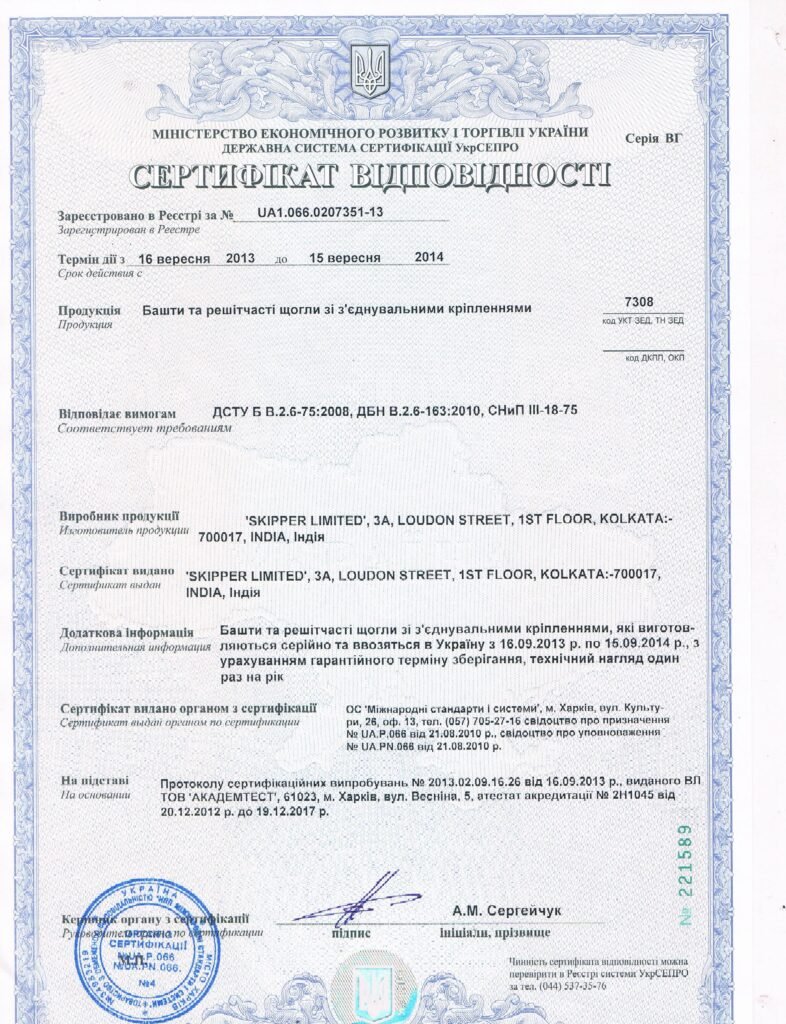
The company’s 2013–2014 certification period represents an important milestone in this journey. The certificate associated with the period was issued in 2013 and was valid through 2014. For an engineering and manufacturing company, such certification represented more than a formal recognition of a management system. It provided a structured framework for controlling processes and demonstrating a systematic commitment to customer requirements.
ISO 9001 focuses on managing quality through processes rather than relying only on final inspection. This principle is particularly relevant to products used in infrastructure.
For example, the quality of a transmission tower begins before fabrication starts. The raw material must conform to the required specification. Material identification must be maintained. Cutting and fabrication must be controlled. Dimensions and hole positions must be verified. Surface preparation and galvanizing must be appropriately controlled. Inspection results must be recorded. Finally, the finished product must be properly identified, preserved and dispatched.
A similar process exists for pipes, poles, fasteners and other manufactured products.
Every department therefore has a role in quality.
The purchasing department contributes by selecting and evaluating suppliers. Stores personnel contribute through proper identification and preservation of materials. Production employees contribute by following approved processes. Maintenance teams contribute by keeping equipment reliable. Quality personnel contribute through inspection and testing. Dispatch teams contribute by ensuring that the correct products reach the correct destination. Management contributes by reviewing performance and providing resources for improvement.
This integrated approach becomes especially valuable when a company is expanding.
Around the certification period, Skipper was already developing a broad industrial portfolio. Its annual reporting for 2013–2014 described products including transmission towers, fasteners, PVC pipes and fittings, MS and GI pipes, scaffolding, poles, high-mast poles and MS and HT angles. The company also reported exports to international markets.
International business creates additional expectations. Customers may require technical specifications, inspection documentation, product testing, certifications and evidence that the manufacturer operates through controlled processes.
A recognised Quality Management System can provide an important foundation for meeting such expectations.
However, certification should not be understood as the sole reason for business growth. Skipper’s development was influenced by many factors, including entrepreneurial leadership, market demand, infrastructure investment, manufacturing capacity, technology, product diversification, customer relationships and international opportunities.
The importance of ISO 9001 was that it formed part of the organisational infrastructure supporting this growth.
The period around 2013 was also significant for the company’s expansion. Skipper’s documented milestones include developments in international business and high-strength fastener manufacturing during this period. Such developments increased the importance of consistent processes and reliable quality controls.
The company was therefore entering a stage where manufacturing capability and management systems needed to develop together.
The certification provided a framework.
Employees provided the execution.
Management provided direction.
Technology provided manufacturing capability.
Customers provided requirements and feedback.
Together, these elements formed the foundation for the next stage of the company’s journey.
The story of Skipper Limited after 2013 is consequently not simply a story about obtaining a certificate. It is a story about how an organisation continued to develop its capabilities after establishing a structured quality-management foundation.
The certificate represented a particular point in time.
The larger journey was continuous.
As Skipper expanded its product portfolio, entered new markets, increased manufacturing capacity and developed engineering capabilities, the principles of quality management remained relevant. Processes needed to become more consistent. Customer requirements needed to be understood. Problems needed to be investigated. Employees needed to learn. Management needed reliable information for decision-making.
This created the foundation for the chapters that followed.
The beginning of the story was therefore not defined only by a certificate.
It was defined by a commitment to building an organisation in which quality, manufacturing discipline, customer requirements and continuous improvement could work together.
That foundation would become increasingly important as Skipper Limited moved toward greater diversification, wider markets and larger engineering opportunities in the years ahead.
#SkipperLimited
Chapter 2 – Building Quality into Manufacturing
When an organisation receives a quality-management certification, the real work begins after the certificate is issued. A certificate can formally recognise a management system, but its practical value depends on how effectively the organisation applies its principles in everyday operations. For a manufacturing company such as Skipper Limited, quality could not remain the responsibility of one department. It had to become part of purchasing, production, inspection, maintenance, stores, dispatch, engineering and management.
The period following the 2013 certification therefore represented an opportunity to strengthen the connection between quality systems and manufacturing performance.
Skipper had already developed considerable experience in steel and engineering products. Its portfolio included transmission towers, poles, pipes, fittings, fasteners, scaffolding and other products associated with infrastructure and industrial applications. Each product required different manufacturing operations, but all shared a fundamental requirement: the finished product had to meet defined customer and technical requirements.
This made process control essential.
A manufacturing process begins long before the final inspection. It starts with understanding what the customer requires. Specifications, drawings, purchase orders and applicable standards establish the requirements that the organisation must fulfil. These requirements then have to be communicated to the appropriate departments.
For the procurement team, this means identifying suitable raw materials and suppliers.
For stores, it means receiving and identifying materials correctly.
For production, it means converting raw material into finished products according to approved processes.
For quality personnel, it means verifying conformity through appropriate inspection and testing.
For dispatch, it means ensuring that the correct product is protected and delivered according to customer requirements.
Management provides the resources and direction required to make the entire process function.
This interconnected structure is one of the important principles behind ISO 9001.
For Skipper, this approach was particularly relevant to the manufacture of steel infrastructure products.
Consider the production of a transmission tower. The process involves several stages. Steel material must be received according to specification. Material identification needs to be maintained. Cutting and punching operations must be controlled. Components must conform to drawings. Fabricated parts need appropriate inspection. Surface preparation and galvanizing require process control. Final inspection must confirm that the assembled or packaged components meet requirements before dispatch.
An error at an early stage can affect every subsequent stage.
If the wrong material is purchased, production may be affected.
If dimensions are incorrect during fabrication, assembly may become difficult.
If holes are incorrectly positioned, components may not fit as intended.
If galvanizing is not properly controlled, surface protection may be affected.
If inspection records are incomplete, the organisation may have difficulty demonstrating conformity.
Quality management therefore helps create a chain of responsibility.
The same philosophy applies to pipes, poles and fasteners.
In fastener manufacturing, for example, dimensions, material characteristics, thread quality and finishing can all be important. In pipe manufacturing, dimensions, material properties, surface condition and testing may be relevant. In poles and towers, structural requirements and fabrication accuracy become particularly important.
Different products require different technical controls, but the underlying management principle remains the same: define the requirement, control the process, verify the result and improve when problems are identified.
This process-oriented approach also changes the way organisations respond to failures.
Without a structured quality system, a rejected product may simply be repaired or discarded.
With a more mature system, the organisation can ask why the problem occurred.
Was the work instruction clear?
Was the employee trained?
Was the equipment functioning correctly?
Was the raw material within specification?
Was the inspection performed at the right stage?
Was there a communication gap between departments?
Was the customer requirement correctly understood?
These questions encourage corrective action rather than repeated correction.
The distinction is important.
Correction addresses the immediate problem.
Corrective action attempts to address the cause so that the problem does not recur.
Over time, this approach can reduce repeated defects and improve process stability.
Internal audits can also contribute to this process. Audits provide an opportunity to compare documented procedures with actual practices. They can identify gaps, inconsistencies and opportunities for improvement.
For employees, internal audits can initially appear to be an additional responsibility. However, when properly implemented, they can become a learning mechanism. Employees begin to understand why procedures exist and how their activities affect other departments.
Training is another important element.
A quality system cannot function effectively if employees do not understand their responsibilities. Operators need to understand processes. Inspectors need appropriate technical knowledge. Supervisors need to understand production controls. Managers need to understand performance information.
As Skipper expanded its manufacturing activities, employee competence became increasingly important.
Technology and machinery could improve production capability, but skilled people were needed to operate and maintain those systems.
The role of documentation also became important.
Records provide evidence of what happened during a process. Inspection reports, material records, test results, calibration records, training records, non-conformity reports and corrective-action records can help management understand performance.
Documentation also creates organisational memory.
An experienced employee may know how a problem was solved several years ago. But if that knowledge remains only with the individual, it can be lost when the employee leaves. Documented procedures and records help preserve organisational knowledge.
This becomes especially valuable as companies grow.
Skipper’s expansion required the organisation to operate beyond the direct supervision of its founders and senior management. Systems allowed responsibilities to be distributed while maintaining common expectations.
Quality therefore became a shared responsibility.
The purchasing team influenced quality.
Production influenced quality.
Maintenance influenced quality.
Engineering influenced quality.
Quality assurance verified quality.
Management reviewed quality.
Customers ultimately experienced the result.
The 2013–2014 certification period can therefore be understood as part of this larger movement toward structured manufacturing management.
The certificate itself represented formal recognition.
The real achievement was embedding the principles behind it into everyday work.
As Skipper continued to diversify its product portfolio and expand into new markets, the need for such systems became even greater. More products meant more processes. More customers meant more requirements. More facilities meant more coordination. More markets meant greater expectations.
A strong quality-management foundation could help the organisation manage this increasing complexity.
The journey was not about eliminating every problem. No manufacturing organisation can achieve that.
Instead, it was about developing the ability to identify problems, control processes, learn from experience and continuously improve.
This became one of the foundations upon which Skipper Limited could build its subsequent growth.
Quality was no longer simply something checked at the end of production.
It increasingly became something designed into the way the organisation worked.
#ISO9001Certification
Chapter 3 – The Promoter’s Vision and the Expansion of Skipper
Behind every successful industrial organisation is a combination of vision, perseverance and the willingness to invest in the future. Factories, machines and products are important, but they do not create long-term growth by themselves. Strategic decisions made by promoters and management determine where a company invests, which markets it enters, how it develops its people and how it responds to changing customer expectations.
The story of Skipper Limited reflects this relationship between entrepreneurial vision and organisational development.
The company’s history is associated with the Bansal family, whose industrial activities developed around steel and manufacturing. The foundation established by the earlier generation created an environment in which subsequent leadership could pursue diversification and expansion. Over time, the organisation moved beyond its initial product categories and developed capabilities across several areas of engineering and infrastructure.
A significant figure in this development was Sajan Kumar Bansal, who became closely associated with the expansion of the Skipper business. Under his leadership, the company developed from a relatively focused manufacturing operation into a diversified organisation serving transmission and distribution, engineering, polymer and infrastructure-related markets.
Such transformation does not happen overnight.
It requires a long-term approach to investment.
A promoter must consider not only what the company can manufacture today, but also what customers may require tomorrow. This means investing in machinery before demand reaches its highest point, developing employees before new projects begin, establishing quality systems before entering demanding markets and creating manufacturing capacity that can support future opportunities.
This approach was particularly relevant during the period surrounding the company’s 2013–2014 quality certification.
By that time, Skipper had already developed a range of engineering products and was increasing its presence in infrastructure markets. The organisation had experience in manufacturing poles, towers, pipes, fasteners and other steel products. The next challenge was to strengthen the systems required to manage greater scale.
ISO 9001 provided one part of that foundation.
A quality-management system gives management a framework for establishing responsibilities, monitoring processes, reviewing performance and addressing non-conformities. For a growing organisation, these systems can help convert individual experience into organisational processes.
This is important because an expanding company cannot depend entirely on direct supervision by the promoter.
When an organisation is small, senior management may be able to personally review many activities.
As the company grows, this becomes impossible.
More employees are involved.
More departments are created.
More factories become operational.
More customers are served.
More suppliers become part of the supply chain.
More products require different technical controls.
At this stage, systems become essential.
The promoter’s role gradually changes from direct supervision toward strategic leadership.
Instead of personally controlling every production activity, management establishes policies, objectives and processes through which the organisation operates.
This transition can be seen in Skipper’s diversification.
The company did not remain dependent on a single product.
Its activities expanded into transmission towers, telecom structures, steel tubes, galvanizing, pipes and fittings, fasteners, poles and other engineered products.
Diversification created additional opportunities but also increased organisational complexity.
Each new product required technical knowledge.
Each new customer brought additional requirements.
Each new market created commercial and regulatory considerations.
Quality management helped provide a common framework across these different activities.
The same basic principles could be applied to different products:
Understand customer requirements.
Select appropriate materials.
Control production.
Inspect and test.
Record results.
Address non-conformities.
Review performance.
Improve processes.
This common structure allowed the organisation to diversify without abandoning process discipline.
The promoter’s vision was also connected with geographical expansion.
Skipper’s 2013–2014 annual reporting described exports to international markets, demonstrating that the company was already developing a presence beyond India.
International business presents different challenges from domestic business.
Customers may require different technical standards.
Project documentation may need to meet specific formats.
Product specifications can vary.
Inspection requirements can be more detailed.
Delivery schedules can be more demanding.
Communication across geographical boundaries requires greater organisational discipline.
A recognised quality-management system can support confidence in such relationships by demonstrating that the organisation has established processes for managing quality.
The company’s international activities also encouraged greater technical learning.
When a manufacturer works with customers from different markets, it encounters different expectations and engineering practices. This can encourage investment in technical capabilities and process improvements.
Diversification therefore became more than a strategy for increasing revenue.
It became a mechanism for developing organisational knowledge.
Experience in steel manufacturing supported tower production.
Tower manufacturing experience supported transmission projects.
Engineering knowledge supported EPC activities.
Polymer manufacturing opened opportunities in different infrastructure markets.
International customers encouraged stronger technical and quality systems.
Each capability contributed to the next.
This cumulative development is an important part of Skipper’s story.
The company also recognised the importance of value addition.
Instead of limiting its activities to basic steel processing, it developed capabilities in more specialised products and processes. High-strength fasteners, transmission structures, galvanizing and engineering services allowed the company to participate in higher-value segments of the infrastructure supply chain.
Value addition requires quality.
Customers purchasing specialised products generally expect consistency and technical reliability. A manufacturer must be able to demonstrate that it understands the specifications and can repeatedly meet them.
This is where the relationship between the promoter’s business strategy and ISO 9001 becomes clear.
The promoter’s vision creates the direction.
Investment creates capacity.
Employees create execution.
Technology creates efficiency.
Quality systems create process discipline.
Customers create market opportunity.
Growth occurs when these elements work together.
It would not be accurate to attribute Skipper’s later expansion to ISO 9001 certification alone. Industrial growth is influenced by many factors, including infrastructure demand, government and private-sector investment, technology, capital expenditure, market conditions, customer relationships and management strategy.
However, quality management can support growth by creating a more structured environment in which expansion can occur.
This became increasingly important as Skipper entered more sophisticated engineering markets.
The company’s later history included additional product development, larger infrastructure projects, polymer expansion and EPC capabilities. Each new stage required stronger systems than the previous one.
The promoter’s vision therefore had to be supported by organisational maturity.
The lesson from this period is clear: entrepreneurial vision creates opportunities, but systems and people determine how effectively those opportunities can be converted into sustainable business performance.
For Skipper Limited, the 2013–2014 certification period formed part of this transition.
The company was moving from a manufacturing organisation with growing capabilities toward a diversified engineering business with broader ambitions.
The promoter’s vision was not limited to producing more products.
It was about building an organisation capable of serving larger customers, entering new markets, developing new technologies and creating long-term industrial capabilities.
The quality-management system became one of the tools supporting that ambition.
As the company entered the next phase of its journey, the combination of leadership, manufacturing experience, diversification and quality discipline created a foundation for continued growth.
The next chapter would bring greater emphasis on product diversification, manufacturing integration and the development of a broader industrial portfolio.
#QualityManagement
Chapter 4 – From Products to a Diversified Industrial Portfolio
Growth in the manufacturing sector is rarely achieved simply by producing larger quantities of the same product. As markets evolve, successful industrial organisations often expand their product range, develop additional technical capabilities and create stronger control over their manufacturing processes. For Skipper Limited, diversification became an important part of its long-term development.
The years surrounding the 2013–2014 certification period were part of a much longer industrial journey. Skipper had already developed experience in steel products, poles, telecom structures, transmission towers, pipes and other engineered products. Over time, the company continued adding capabilities that allowed it to participate in a wider range of infrastructure and industrial applications.
This diversification created both opportunity and responsibility.
A company manufacturing one product can concentrate its resources around a relatively limited set of processes. A diversified manufacturer has to manage many different technologies, raw materials, production methods, inspection requirements and customer expectations.
Quality management therefore becomes increasingly important as product diversity increases.
For Skipper, steel and engineering products represented an important foundation. The organisation developed capabilities involving steel processing, fabrication and galvanizing. These capabilities were valuable because several products required related manufacturing processes.
A transmission tower, for example, requires steel sections that are cut, punched, fabricated, inspected and protected against corrosion. Poles may require different fabrication methods but still depend on material quality, dimensional accuracy and surface protection. Fasteners require another set of specialised manufacturing and inspection controls.
Although the products are different, the underlying quality principles remain connected.
Materials must be correctly identified.
Production parameters must be controlled.
Equipment must be maintained.
Employees must understand their responsibilities.
Inspection and testing must be performed at appropriate stages.
Non-conforming products must be identified and controlled.
Records must provide evidence of conformity.
These principles help a diversified company maintain consistency.
Skipper’s manufacturing development also involved greater integration.
Backward integration can provide an organisation with greater control over important parts of its supply chain. Instead of relying entirely on external suppliers for every stage, a company can develop internal capabilities for selected processes.
This can support better control over material flow, production planning and product consistency.
The company’s history records developments in steel processing, galvanizing, tube manufacturing and related areas before the 2013 certification period. These capabilities provided a foundation for later expansion.
By strengthening manufacturing integration, Skipper could develop a more connected production system.
Raw materials could be processed into intermediate products.
Intermediate products could be converted into finished components.
Components could be fabricated into larger structures.
Structures could be inspected, tested and dispatched according to customer requirements.
This type of integration is particularly useful in infrastructure manufacturing because customers often require large volumes of products with consistent technical characteristics.
The company also expanded its product portfolio beyond traditional steel infrastructure.
Pipes and fittings became an important part of the business. Polymer products opened opportunities in applications different from conventional steel manufacturing. This diversification allowed the organisation to participate in additional markets.
The development of polymer products also required a different manufacturing knowledge base.
Materials behave differently from steel.
Production equipment differs.
Quality parameters differ.
Testing requirements differ.
Customer applications differ.
Therefore, diversification required the organisation to develop new technical skills rather than simply transferring existing processes to a new product.
This is one reason why organisational learning is so important in industrial growth.
When a company enters a new product category, employees have to learn.
Engineers need to understand new materials.
Production teams need to learn new machinery.
Quality teams need to understand new inspection methods.
Procurement teams need to identify suitable suppliers.
Sales teams need to understand new customer applications.
Management needs to understand the economics of the new business.
The quality-management framework can provide common principles while allowing individual product lines to maintain their specialised technical controls.
The result is a balance between standardisation and flexibility.
Standardisation ensures that fundamental management practices remain consistent.
Technical procedures allow individual products to be manufactured according to their specific requirements.
This balance became increasingly important as Skipper expanded.
Diversification also reduced dependence on a single market segment.
Infrastructure demand can change over time. Different industries experience different cycles. A company participating in multiple sectors can potentially create a more diversified business portfolio.
Skipper’s activities across transmission and distribution, steel products, polymer products and engineering services reflect this broader approach.
However, diversification also creates management challenges.
More products mean more inventories.
More processes mean more training requirements.
More facilities mean more coordination.
More customers mean more specifications.
More markets mean greater compliance requirements.
The organisation therefore needs strong communication.
This is where documented processes become valuable.
When responsibilities and procedures are clearly established, employees have a common reference point. When records are maintained, management can review performance. When audits are conducted, gaps can be identified. When corrective actions are implemented, recurring problems can be addressed.
The 2013–2014 quality certification period therefore became part of a larger organisational framework that supported this diversification.
The certificate itself did not create the company’s product portfolio. That portfolio resulted from years of strategic decisions and investments.
But the quality system provided a structured environment in which multiple product lines could be managed.
The same philosophy could be applied across different facilities and departments.
It also helped establish a culture in which customer requirements were treated as a central part of manufacturing.
This customer orientation became particularly important as Skipper increased its presence in infrastructure markets.
Infrastructure customers often require products that must perform reliably over long periods. A transmission tower or structural component is not an ordinary consumer product. Its performance can affect larger systems.
Therefore, manufacturing consistency matters.
The company’s continued investment in technology, testing and manufacturing capabilities reflected this requirement.
Over time, Skipper moved beyond simply manufacturing products to providing broader engineering and infrastructure solutions.
That transition was made possible by the accumulated capabilities developed through earlier stages.
Steel manufacturing created material knowledge.
Fabrication created structural expertise.
Galvanizing created corrosion-protection capability.
Tower manufacturing created infrastructure experience.
Polymer production created access to additional markets.
Quality systems created process discipline.
Engineering development connected these capabilities.
The result was an increasingly diversified industrial organisation.
The story of this period demonstrates that growth is not simply about expansion in size. It is also about expanding capability.
A company becomes stronger when it can manufacture more products, serve more customers, manage more complex processes and respond to changing market requirements without losing control over quality.
For Skipper Limited, diversification represented another major step in that direction.
The quality-management foundation established around the 2013–2014 period provided an important organisational framework as the company continued developing its portfolio.
The next stage of the journey would increasingly connect this manufacturing strength with wider domestic and international markets, customer confidence and new business opportunities.
#IndustrialGrowth
Chapter 5 – Entering Wider Markets and Strengthening Customer Confidence
As Skipper Limited continued developing its manufacturing capabilities, another important stage of its journey was the expansion of its presence across wider markets. Manufacturing capacity provides the foundation for growth, but a company must also be able to demonstrate that its products can satisfy the requirements of customers in different industries, regions and countries.
For Skipper, this meant combining manufacturing experience with quality management, technical capability, customer service and an understanding of changing infrastructure requirements.
The period around the 2013–2014 ISO 9001 certification was significant in this regard. The company was already producing a diversified range of engineering and infrastructure products, and its annual reporting for 2013–2014 recorded exports to international markets. This international exposure created new opportunities while also increasing expectations regarding quality, documentation and delivery.
An international customer does not necessarily evaluate a manufacturer only on price.
Technical capability matters.
Product conformity matters.
Delivery performance matters.
Documentation matters.
Certifications and approvals matter.
The ability to respond to customer requirements matters.
For an engineering manufacturer, these elements are interconnected.
A customer purchasing transmission towers, poles, pipes or fasteners needs confidence that the manufacturer understands the applicable specifications and has appropriate processes for controlling production.
This is one area where a Quality Management System can support commercial relationships.
ISO 9001 does not guarantee that every product manufactured by a certified organisation will be free from defects. Instead, it provides a framework for managing processes and demonstrating that the organisation has established methods for addressing customer requirements, controlling operations, monitoring performance and improving processes.
For Skipper, such a framework could support the company’s broader market ambitions.
As the organisation entered new markets, customer requirements could differ from those encountered previously.
An overseas customer might specify different technical standards.
A power-sector customer might require detailed inspection documentation.
A large infrastructure project might require stage-wise approvals.
A new product might require additional testing.
A new market might require specific certifications or regulatory compliance.
The organisation therefore needed the ability to manage variation without losing process control.
This required coordination between departments.
Sales and commercial teams needed to understand customer requirements before accepting orders.
Engineering teams needed to interpret technical specifications.
Procurement teams needed to identify appropriate materials and suppliers.
Production teams needed to manufacture according to approved requirements.
Quality teams needed to inspect and document conformity.
Logistics teams needed to ensure correct and timely delivery.
Management needed to monitor the overall process.
A failure at any stage could affect customer satisfaction.
This is why customer confidence is closely connected with internal process discipline.
The company’s diversification also helped create opportunities across different markets.
Transmission and distribution infrastructure represented one major area.
Power infrastructure requires towers, poles and other engineered structures that support the movement of electricity from generation facilities to distribution networks.
Water and plumbing applications provided opportunities for pipe and fitting products.
Polymer products created additional possibilities.
Fasteners supported structural and engineering applications.
Later engineering and EPC activities expanded the company’s role further.
Each market brought different customers and requirements.
The company’s ability to participate in these markets was supported by accumulated technical knowledge.
The development of manufacturing capabilities also strengthened its ability to compete.
A company with integrated manufacturing can have greater visibility into its production processes.
It can coordinate material movement more effectively.
It can develop specialised technical knowledge internally.
It can potentially respond more efficiently to customer requirements.
This is particularly valuable when dealing with large infrastructure projects where delivery schedules and product conformity are closely connected.
The international dimension of Skipper’s development also encouraged the organisation to think beyond local market requirements.
International business exposes companies to different standards, business practices and customer expectations.
For employees, this creates opportunities to develop new technical knowledge.
For management, it creates the need for stronger systems.
For engineering teams, it creates exposure to different design requirements.
For quality teams, it increases the importance of documentation and traceability.
For the promoter and leadership team, it creates the challenge of maintaining a consistent corporate standard while serving different markets.
The company’s later development of additional international certifications and technical approvals reflects this continuing process of adaptation.
Over time, Skipper developed relationships and capabilities extending beyond its original domestic manufacturing base. Its official history records international partnerships and supply relationships, including developments in South America during the 2013 period.
Such relationships demonstrate that industrial growth can involve both internal capability development and external collaboration.
Partnerships can provide access to markets, technology, knowledge or customer relationships.
At the same time, they require companies to maintain reliable processes.
A business partner must be able to depend on product quality and delivery.
This creates another connection between quality management and commercial growth.
Customer confidence is built gradually.
One successful delivery can create an opportunity for another order.
Repeated conformity can strengthen a relationship.
Reliable documentation can simplify project coordination.
Effective complaint handling can demonstrate responsiveness when problems occur.
Continual improvement can increase customer confidence over time.
None of these outcomes should be viewed as automatic results of certification. They depend on how the organisation actually operates.
The 2013–2014 certification therefore represented a foundation rather than a guarantee.
The real test was whether the company continued to apply quality principles as its business expanded.
Skipper’s subsequent development indicates that quality systems remained part of its broader organisational framework.
The company continued to invest in manufacturing capacity, product development, technology and engineering capabilities.
It expanded into additional markets.
It developed new partnerships.
It increased its involvement in infrastructure projects.
As these activities grew, the importance of process control also increased.
The company had to manage more information, more products, more suppliers and more customer requirements.
A structured management system helped provide a common framework for this complexity.
The journey also demonstrated that market expansion is closely linked with reputation.
An industrial company builds its reputation through repeated interactions with customers.
Quality is one part of that reputation.
Delivery is another.
Technical support is another.
Responsiveness is another.
Compliance is another.
Together, these factors shape how customers perceive a supplier.
For Skipper, the development from a steel and infrastructure manufacturer into a broader engineering organisation required continuous attention to all these areas.
The certification period of 2013–2014 can therefore be viewed as an important point within this broader journey.
It provided a formal quality-management foundation while the company was expanding its market presence.
The years that followed would bring further diversification, technological development and engineering growth.
The company’s journey demonstrated an important industrial principle:
Manufacturing capability creates the product, but consistent quality and customer confidence create the opportunity to take that product into wider markets.
For Skipper Limited, the combination of quality systems, technical experience, manufacturing capacity and market development became an important foundation for the next stage of growth.
#EngineeringExcellence
Chapter 6 – Technology, Capacity and the Search for Greater Efficiency
As Skipper Limited continued to expand its markets and product portfolio, the organisation faced a new challenge: how to increase manufacturing capability while maintaining consistency, efficiency and quality. Growth in an industrial business is not achieved simply by adding production volume. It requires investment in technology, equipment, testing, people, process control and infrastructure.
The years following the 2013–2014 quality certification period can therefore be viewed as another stage in Skipper’s continuing effort to strengthen its industrial capabilities.
Technology had already become part of the company’s development before the certification period. The organisation had invested in manufacturing facilities, galvanizing, tube production and automation. These earlier investments created a foundation for further growth.
Automation is particularly valuable in manufacturing because it can improve repeatability and productivity when properly designed and controlled.
However, automation does not eliminate the need for quality management.
A machine can produce thousands of components, but if the machine is incorrectly configured, the same error may be repeated thousands of times.
This makes process monitoring essential.
Manufacturing parameters need to be controlled.
Equipment needs to be maintained.
Measurement devices need appropriate control.
Employees need training.
Inspection needs to verify results.
When a deviation occurs, the organisation needs to determine its cause.
This is where technology and quality management work together.
For example, imagine that a production line begins producing components outside the required dimensions. Simply separating the defective components addresses the immediate problem, but it does not necessarily prevent recurrence.
A stronger approach would examine the reason.
Was the tooling worn?
Was the machine incorrectly adjusted?
Was the raw material outside specification?
Was the operator following the correct procedure?
Was maintenance overdue?
Was the measurement equipment functioning correctly?
The answers can lead to corrective action.
Such an approach reduces the risk of repeated defects and can improve manufacturing efficiency.
For a large industrial organisation, even a small reduction in recurring defects can have significant operational implications.
Less rework means fewer production hours lost.
Less scrap means better material utilisation.
Fewer complaints mean less administrative effort.
More stable production improves planning.
Reliable processes can support more predictable delivery.
These factors connect quality with business efficiency.
Skipper’s continued development of manufacturing facilities illustrates the importance of capacity.
Transmission and distribution infrastructure projects can involve substantial quantities of structural components. Meeting such demand requires manufacturing facilities capable of producing large volumes without compromising technical requirements.
The company therefore continued investing in its engineering and manufacturing capabilities.
Its later development also included specialised testing infrastructure.
Testing is particularly important for engineering products because the performance of a structure cannot always be established simply by visual inspection.
A transmission tower, monopole or structural component may need to be evaluated under controlled conditions to demonstrate its behaviour against defined requirements.
Skipper’s official history records the commissioning of a major Tower and Monopole Load Testing Station in 2020, which was subsequently recognised by the Department of Scientific and Industrial Research as an in-house research and development centre.
This represented an important development in technical capability.
A testing facility can support several activities.
It can help validate designs.
It can provide engineering data.
It can support product development.
It can help investigate performance.
It can provide evidence for customers and project requirements.
It can contribute to research and development.
The development of such facilities reflects a shift from manufacturing according to established requirements toward greater participation in engineering and product development.
That transition is significant.
A manufacturer that develops stronger design and testing capabilities can contribute more extensively to a project’s technical requirements.
This can create opportunities for higher-value engineering work.
The company’s expansion into EPC activities reinforced this development.
EPC projects require more than production capacity.
They require engineering coordination, procurement management, construction planning, quality control, project documentation and customer communication.
Technology supports each of these areas.
Engineering software can assist design.
Manufacturing automation can improve production.
Testing equipment can support verification.
Digital systems can support documentation.
Project-management systems can coordinate activities.
But people remain central to the process.
Technology is only effective when employees understand how to use it.
Training therefore became an important part of organisational growth.
Engineers need to understand new technologies.
Operators need to understand machinery.
Quality professionals need to understand new inspection methods.
Maintenance teams need to understand increasingly sophisticated equipment.
Managers need to interpret production and quality data.
This creates a continuous learning cycle.
The more advanced the organisation becomes, the more important employee competence becomes.
Skipper’s growth therefore involved more than physical infrastructure.
It required the development of organisational knowledge.
This knowledge could be built through training, experience, technical partnerships, engineering projects, testing and continual improvement.
Another important aspect of efficiency was integration.
When different stages of manufacturing are coordinated internally, the company can have greater control over production planning.
Material movement can be better coordinated.
Production schedules can be aligned.
Quality information can be shared.
Engineering changes can be communicated.
This can reduce some of the uncertainty associated with fragmented supply chains.
Skipper’s development of integrated manufacturing capabilities supported this broader objective.
The organisation could build on knowledge accumulated across steel processing, fabrication, galvanizing, tower manufacturing, fasteners and other product categories.
Each new capability added another layer to the organisation’s technical knowledge.
The quality-management system helped connect these capabilities through common principles of process control, documentation, inspection and improvement.
The result was an organisation increasingly capable of handling complex manufacturing requirements.
This development also strengthened the company’s ability to serve infrastructure customers.
Infrastructure projects often require long-term reliability.
Customers need confidence that products have been manufactured according to specifications and tested appropriately.
A combination of manufacturing capability and technical verification can help provide that confidence.
The journey from certification to technological development therefore illustrates an important principle.
Quality management is not opposed to productivity or innovation. When properly integrated, quality systems can support both.
The purpose is not to create unnecessary paperwork.
The purpose is to create controlled processes that allow an organisation to innovate without losing visibility over quality.
For Skipper Limited, this became increasingly important as the company moved into larger projects, new products and more advanced engineering activities.
The 2013–2014 certification was one milestone in this evolution.
The subsequent investment in technology, testing, manufacturing capacity and employee capability represented the continuing development of that foundation.
As the organisation became more technically capable, its role in the infrastructure sector also expanded.
The next chapter would explore this important transition—from a strong manufacturing base toward engineering, EPC and broader infrastructure solutions.
#InfrastructureDevelopment
Chapter 7 – From Manufacturing to Engineering and EPC
The development of Skipper Limited did not stop with the expansion of manufacturing capacity. As the company’s technical capabilities increased, another opportunity emerged: to participate more deeply in infrastructure projects through engineering, procurement and construction activities.
This represented an important change in the nature of the business.
Manufacturing requires control over materials, machines, production processes, inspection and dispatch. Engineering and EPC activities require an additional layer of coordination. Design, procurement, manufacturing, logistics, construction, installation, testing, documentation and customer communication must work together.
For an organisation that had spent years developing manufacturing discipline, this transition created an opportunity to apply established quality principles to larger and more complex projects.
The company’s experience in transmission and distribution infrastructure provided an important foundation. Transmission towers, poles and associated structures are not isolated products. They form part of larger electrical infrastructure systems where technical specifications, structural requirements and project schedules are closely connected.
As Skipper expanded into engineering activities, quality therefore had to become part of the entire project lifecycle.
Engineering Before Production
A major difference between ordinary manufacturing and engineering-led projects is that quality begins before production starts.
A project can be affected by errors in design interpretation, drawings, specifications or material selection long before a product reaches the factory.
Engineering teams therefore need to review customer requirements carefully.
Drawings must be controlled.
Technical specifications must be understood.
Changes need to be communicated.
Calculations and design information need appropriate review.
When a project involves different stakeholders, communication becomes especially important.
A change requested by the customer may affect procurement, manufacturing and installation.
If that change is not communicated properly, different departments may work according to different requirements.
A structured quality-management approach helps reduce such risks by creating defined responsibilities and documented communication.
This was particularly relevant as Skipper moved toward larger infrastructure assignments.
The Development of EPC Capability
Skipper’s corporate development included its movement into engineering, procurement and construction activities. A significant milestone was the company’s first 400kV EPC project in 2016.
An EPC project involves much more than supplying a manufactured component.
The organisation has to coordinate multiple activities and ensure that each stage supports the next.
Engineering determines what needs to be built.
Procurement ensures that required materials and services are available.
Manufacturing produces components according to technical requirements.
Logistics moves those components to the project location.
Construction and installation convert the manufactured materials into an operational structure.
Testing and documentation provide evidence that the completed work meets applicable requirements.
Each stage depends on the quality of the previous stage.
A problem in procurement can affect manufacturing.
A manufacturing delay can affect construction.
A design change can affect procurement.
A construction issue can require engineering review.
Therefore, project quality is a connected system.
Quality on the Project Site
Once manufacturing becomes connected with field execution, the meaning of quality becomes broader.
At a factory, quality can be assessed through defined inspection points and controlled production conditions.
At a project site, however, environmental conditions, workforce coordination, transportation, installation methods and local circumstances can influence the work.
This makes site supervision important.
Installation teams must understand approved procedures.
Materials must be identified and protected.
Work must be carried out according to drawings and project requirements.
Inspection records need to be maintained.
Any deviation must be identified and addressed.
Safety also becomes an essential part of project execution.
As the organisation’s activities expanded, quality, safety and environmental considerations increasingly became interconnected rather than isolated responsibilities.
Railway Electrification and New Opportunities
Skipper’s involvement in railway electrification around 2018 further illustrated the company’s broader infrastructure direction.
Railway infrastructure presents its own technical and operational requirements. Projects need coordination between engineering, materials, installation and commissioning.
Entering such areas requires organisations to adapt their processes to different customer expectations and project environments.
The experience gained through transmission and distribution work could provide useful engineering knowledge, but each new sector still requires careful understanding of its own specifications.
This is where organisational learning becomes important.
Every project creates experience.
Successful practices can become standardised.
Problems can become lessons.
Customer feedback can become improvement opportunities.
Technical challenges can encourage new engineering solutions.
Over time, these experiences contribute to institutional knowledge.
The 800kV HVDC Milestone
Another important stage came in 2020, when Skipper undertook its first 800kV HVDC EPC project.
High-voltage direct-current infrastructure involves demanding technical requirements and requires strong coordination between engineering, manufacturing and project execution.
Such work demonstrates why a company’s capabilities cannot be viewed only through the products it manufactures.
The ability to participate in major infrastructure projects depends on a combination of technical knowledge, manufacturing capacity, testing capability, project management and quality assurance.
The earlier development of quality systems therefore had continuing relevance.
Procedures created for manufacturing could support project documentation.
Inspection practices could support field quality.
Corrective-action systems could help address recurring problems.
Training systems could support technical competence.
Management reviews could provide a mechanism for monitoring broader performance.
Quality management thus became increasingly integrated with business operations.
Promoter Vision and Organisational Growth
For the promoters and leadership of Skipper Limited, expansion into engineering and EPC represented more than a commercial opportunity.
It reflected the evolution of the organisation from a manufacturing-focused enterprise toward a broader infrastructure solutions business.
Leadership had to balance expansion with operational discipline.
New projects required investment.
New technologies required learning.
New markets required customer understanding.
New employees required training.
New responsibilities required stronger systems.
The company’s development therefore depended on the ability to grow without losing control over quality.
This is one of the central lessons of the Skipper story.
Growth creates complexity.
Complexity creates risk.
Systems help organisations manage that complexity.
The quality-management philosophy established around the certification period provided one of the frameworks through which processes could be documented, monitored and improved.
It would not be accurate to attribute every later achievement solely to ISO 9001 certification. Skipper’s development also reflected capital investment, engineering expertise, market opportunities, infrastructure demand, leadership decisions, technology and the capabilities of its workforce.
Nevertheless, the quality journey formed part of the broader organisational foundation.
A Broader Definition of Quality
By this stage, quality was no longer simply about whether a manufactured product passed inspection.
Quality meant whether engineering requirements were understood correctly.
It meant whether materials were controlled.
It meant whether production was consistent.
It meant whether projects were executed according to requirements.
It meant whether documentation could demonstrate compliance.
It meant whether customers received the expected product or service within the agreed framework.
Most importantly, it meant creating processes capable of supporting increasingly complex work.
The journey from manufacturing to EPC therefore marked another significant chapter in Skipper Limited’s development.
The company had moved from building products toward participating in the larger infrastructure systems in which those products were used.
With this expansion came new responsibilities related to safety, environment, sustainability and integrated management—areas that would become increasingly important in the next stage of the company’s quality journey.
#EPCProjects
Chapter 8 – Quality, Safety, Environment and Integrated Management
As Skipper Limited continued to expand its manufacturing and infrastructure activities, the meaning of organisational excellence became broader. Quality could no longer be considered only in terms of product conformity. A growing industrial organisation also had to consider environmental responsibilities, occupational health and safety, resource efficiency and the long-term sustainability of its operations.
This development was particularly important for a company operating across steel manufacturing, galvanizing, transmission structures, poles, pipes, fasteners and infrastructure projects. Each activity involved materials, energy, machinery, employees, transportation and interaction with customers and communities.
The quality journey that had gained greater structure through ISO 9001 therefore became part of a wider management approach.
Beyond Product Quality
ISO 9001 placed strong emphasis on consistent processes and customer requirements. As the organisation expanded, however, other questions became equally important.
How could workplace risks be controlled?
How could environmental impacts be reduced?
How could employees be protected while operating heavy machinery?
How could waste and resource consumption be monitored?
How could management ensure that improvements in one department did not create problems in another?
These questions encouraged a more integrated approach.
Skipper’s certification portfolio during this broader period included quality, environmental and occupational health and safety management standards. The combination reflected an understanding that manufacturing performance cannot be separated completely from workplace safety and environmental responsibility.
A good product produced through unsafe practices or uncontrolled environmental processes would not represent complete organisational excellence.
Building a Culture of Safety
Industrial manufacturing involves inherent risks.
Steel processing can involve heavy equipment, high temperatures, moving machinery, sharp materials and significant physical loads. Galvanizing operations involve specialized processes and chemicals. Construction and infrastructure projects introduce additional risks associated with lifting, transportation, working at height and site activities.
Consequently, occupational health and safety needed to become part of everyday operations.
Safety could not depend only on occasional instructions. It required procedures, training, protective equipment, supervision and awareness.
Employees needed to understand not only what they were expected to produce but also how work should be performed safely.
This created an important connection between quality and employee competence.
Training became more than technical education.
It also became a method of reducing operational risk.
Workers familiar with procedures could identify abnormal conditions earlier. Supervisors could monitor compliance. Corrective actions could address recurring problems rather than merely responding to individual incidents.
Over time, safety management could therefore become part of the organisational culture.
Environmental Responsibility
Environmental management became another important component of the company’s development.
Manufacturing facilities consume resources and generate environmental considerations that require systematic attention. Energy, water, raw materials, emissions, waste and process residues all need appropriate management.
An environmental management system provides a structured framework for identifying significant environmental aspects, establishing controls, monitoring performance and pursuing improvement.
For an industrial organisation, this approach is particularly valuable because environmental performance is closely connected with operational efficiency.
Reducing unnecessary material consumption can reduce waste.
Improving energy efficiency can lower resource consumption.
Better process control can reduce rejected products and rework.
Improved housekeeping can support both environmental and workplace safety objectives.
Thus, environmental responsibility and operational efficiency do not necessarily represent separate objectives.
They can reinforce each other when properly managed.
Integration Across Departments
As Skipper expanded, coordination between departments became increasingly important.
The purchase department had to understand technical requirements.
Production needed appropriate materials and controlled processes.
Quality teams needed inspection and testing information.
Maintenance needed to keep equipment reliable.
Human resources and training functions needed to support employee competence.
Project teams needed information from engineering and manufacturing.
Management needed reliable performance information to make decisions.
An integrated management philosophy could help connect these functions.
Instead of treating quality, safety and environmental matters as isolated activities, the organisation could view them as interconnected parts of business performance.
This approach also supported accountability.
When responsibilities are clearly defined, employees understand their roles.
When procedures are documented, activities become easier to monitor.
When records are maintained, management can evaluate performance.
When deviations are identified, corrective action can be initiated.
The objective is not documentation for its own sake. The objective is controlled and measurable improvement.
The Role of Audits
Internal and external audits also became important instruments in maintaining management systems.
An audit provides an opportunity to examine whether established procedures are actually being followed.
It can identify gaps between documented processes and actual practices.
It can also reveal opportunities for improvement.
For employees, audits can sometimes appear to be inspections of their work. But when approached constructively, they can become learning opportunities.
A finding can lead to investigation.
An investigation can reveal a root cause.
The root cause can lead to corrective action.
Corrective action can prevent recurrence.
This creates a continuous improvement cycle.
The same philosophy that supported quality improvement could therefore be applied to safety and environmental performance.
Leadership and Continual Improvement
The development of integrated management practices also required leadership commitment.
Policies and certificates alone cannot create organisational improvement.
Management must provide resources, establish objectives, review performance and encourage employees to participate.
Promoters and senior management have an especially important role because their decisions influence the priorities of the organisation.
When leadership treats quality, safety and environmental performance as business responsibilities rather than compliance activities, employees receive a stronger message about their importance.
For Skipper Limited, this approach became increasingly relevant as the scale and diversity of its operations increased.
The larger the organisation becomes, the more difficult it is to depend entirely on individual supervision.
Systems provide consistency.
Processes provide structure.
Records provide evidence.
Training provides competence.
Audits provide feedback.
Management reviews provide direction.
Together, these elements create an organisational mechanism for continual improvement.
Connecting Certification with Long-Term Growth
The period following the 2013–2014 certification milestone can therefore be understood as part of a larger evolution.
The certificate itself was one formal recognition of a management system.
The broader journey involved developing manufacturing capabilities, expanding product categories, entering infrastructure projects, strengthening engineering activities and progressively integrating quality, environmental and safety considerations.
This growth was influenced by many factors, including market demand, investment, technology, leadership, employees and customer relationships.
Quality management was one component within that larger business system.
Its value became more visible as the organisation became more complex.
A small operation can sometimes depend heavily on direct supervision and individual experience.
A larger organisation requires repeatable systems.
As Skipper grew, repeatability became increasingly important.
The company needed processes that could operate across different products, facilities, customers and projects.
That was the deeper significance of the quality journey.
It was not simply about obtaining a certificate.
It was about developing an organisation capable of managing increasing complexity.
Preparing for the Next Stage
By combining manufacturing expertise with engineering, project execution, safety and environmental management, Skipper continued developing a broader industrial identity.
The organisation’s growth increasingly involved advanced infrastructure requirements, new technologies and greater technical expectations from customers.
This created another challenge: how to strengthen innovation and technical capability while maintaining disciplined processes.
The next stage of the journey would therefore move beyond basic process control toward advanced engineering, testing, research, product development and technological capability.
The story of Skipper Limited was becoming not only a story about manufacturing growth, but also about how an established industrial organisation could continue learning, investing and adapting to changing infrastructure requirements.
#QualityAssurance
Chapter 9 – Innovation, Testing and Building Future-Ready Capabilities
As Skipper Limited moved deeper into infrastructure engineering, the company’s growth story entered another important phase. Manufacturing capacity and project execution remained essential, but the changing requirements of the infrastructure sector demanded something more: stronger engineering capability, advanced testing, innovation and the ability to develop solutions for increasingly complex applications.
The quality journey that had begun with process discipline therefore continued into a broader culture of technical development.
For an engineering organisation, innovation cannot exist separately from quality. A new design must perform reliably. A new product must meet technical requirements. A new manufacturing process must remain controlled. Before a structure can be supplied for a critical infrastructure project, its performance must be understood and demonstrated.
This created a strong connection between research, testing and quality management.
The Growing Importance of Engineering Knowledge
Transmission and distribution infrastructure operates under demanding conditions. Structures may need to withstand significant mechanical loads, environmental conditions and long service periods.
As project requirements became more sophisticated, engineering teams needed to understand not only how to manufacture structures but also how those structures would behave under actual operating conditions.
This increased the importance of design review, engineering calculations, technical documentation and testing.
The organisation’s experience accumulated over years of manufacturing could contribute significantly to this process.
Every production challenge created knowledge.
Every customer requirement created learning.
Every project provided experience.
Every test generated technical information.
When such knowledge is captured and applied systematically, it becomes part of organisational capability.
Testing as a Foundation for Confidence
Testing is one of the most important links between engineering design and real-world performance.
A drawing can communicate dimensions and specifications, but testing can provide evidence of how a structure performs under defined conditions.
For this reason, Skipper’s development of advanced testing infrastructure became an important part of its technical journey.
A major milestone came with the establishment of a Tower and Monopole Load Testing Station in 2020.
The facility strengthened the organisation’s ability to test transmission structures and monopoles under controlled conditions.
Such capability has value beyond a single project.
It allows engineering teams to validate designs.
It provides technical evidence.
It supports product development.
It helps identify potential weaknesses.
It creates opportunities for learning and improvement.
Testing can therefore become an important part of the product-development cycle rather than simply a final inspection activity.
From Inspection to Learning
Traditional quality thinking can sometimes focus heavily on finding defects after production.
A more mature approach attempts to prevent problems by understanding processes and validating designs before large-scale implementation.
Testing supports this preventive philosophy.
Suppose a new structure is being developed.
Engineering teams can evaluate the design.
Manufacturing teams can examine whether the design can be produced consistently.
Testing teams can evaluate performance.
The results can be communicated back to engineering.
If improvements are required, the design can be modified.
The revised design can then be evaluated again.
This creates a learning loop.
Design leads to testing.
Testing leads to information.
Information leads to improvement.
Improvement leads to stronger products.
Such a cycle is closely aligned with the continual-improvement principles associated with quality management.
Innovation and Product Diversification
Skipper’s product development also extended beyond traditional transmission towers.
The company’s portfolio included structures and products such as poles, high-mast poles, solar structures, crash barriers, fasteners and other steel products, while its polymer business expanded into pipes and related products.
Diversification requires more than adding a product to a catalogue.
Each product category may involve different materials, processes, standards, customer expectations and testing requirements.
The organisation therefore needed to develop knowledge across multiple technical areas.
This encouraged cross-functional learning.
Metallurgy, structural engineering, manufacturing, quality assurance, testing, procurement and project management could all contribute to product development.
The promoter and management team’s role was increasingly connected with deciding where the company should invest its technical resources and how those capabilities could support future growth.
Research and Organisational Capability
Over time, the company’s testing and engineering activities contributed to a stronger research-oriented environment.
The 2020 Tower and Monopole Load Testing Station later became associated with recognition of Skipper’s in-house research and development capability.
This represented an important evolution.
Research capability allows a company to investigate technical problems rather than simply respond to them.
It creates the possibility of developing new designs, improving existing products and adapting technologies to customer requirements.
For an infrastructure manufacturer, such capability can also help shorten the distance between an engineering idea and a validated product.
The organisation can design, manufacture, test, analyse and improve within a connected technical ecosystem.
Quality in Research and Development
Even innovation requires discipline.
Research activities involve experimentation, but experiments still need objectives, records and analysis.
Design changes need identification.
Test results need documentation.
Technical decisions need evidence.
Lessons learned need to be communicated.
This is where quality-management principles remain relevant even when the work is highly innovative.
Quality does not mean preventing change.
Instead, a well-managed quality system can help ensure that change is controlled and understood.
This distinction became increasingly important as Skipper developed more sophisticated engineering capabilities.
The objective was not simply to preserve existing processes.
It was to improve them.
The Role of Employees
Technology alone cannot create innovation.
Behind every testing facility, engineering system and manufacturing process are people.
Engineers interpret requirements.
Technicians operate equipment.
Quality professionals evaluate results.
Production teams manufacture components.
Project teams coordinate execution.
Managers make investment and strategic decisions.
Therefore, employee competence became an important part of the company’s long-term development.
Training, experience and knowledge sharing helped employees adapt as technology and project requirements changed.
An organisation that invests in technical infrastructure but does not develop the people operating that infrastructure cannot fully realise its potential.
Skipper’s broader growth therefore involved both physical capability and human capability.
Preparing for More Complex Infrastructure
The evolution from ISO 9001 certification toward advanced testing and engineering demonstrates how quality systems can develop alongside business capabilities.
The certification period established an important foundation of documented processes, customer focus and continual improvement.
Subsequent growth brought new products, new projects and new technical challenges.
Those challenges encouraged investment in engineering, testing and innovation.
The result was a broader understanding of what quality could mean within an infrastructure company.
Quality could mean accurate manufacturing.
It could mean reliable project execution.
It could mean safe operations.
It could mean environmental responsibility.
It could also mean proving that a new engineering solution performs as intended.
A Continuing Journey
By this stage, Skipper Limited’s development could no longer be described simply as the growth of a steel manufacturing company.
The organisation had developed capabilities spanning manufacturing, engineering, infrastructure projects, testing, product diversification and technical development.
The journey had moved from obtaining certification to building systems capable of supporting long-term organisational growth.
The 2013–2014 certification milestone remained one point in that larger history. It was not the sole explanation for the company’s later development, but it formed part of a broader commitment to structured processes and continual improvement.
The next and final chapter will bring these elements together, examining how quality, leadership, technology, diversification, infrastructure capability and continual improvement contributed to the continuing growth story of Skipper Limited and its promoter-led journey.
#ContinuousImprovement
Chapter 10 – A Continuing Journey of Quality, Growth and Excellence
Every organisation has milestones that can be identified by dates, certificates, projects and investments. But the deeper story of business growth is rarely contained in a single milestone. It is built gradually through decisions, learning, challenges, relationships, technology and the willingness to improve.
For Skipper Limited, the ISO 9001 certification milestone of 2013–2014 can be viewed as one important stage in a much longer journey.
The certificate represented recognition of a structured quality-management approach. More importantly, the principles behind that system could support the organisation as it entered increasingly complex areas of manufacturing and infrastructure.
The story that followed was therefore not simply about maintaining a certificate.
It was about building organisational capability.
From Manufacturing Discipline to Business Expansion
At the beginning of this journey, quality was closely associated with manufacturing consistency.
Raw materials needed to be controlled.
Production processes needed to be monitored.
Inspection and testing needed to be documented.
Nonconformities needed to be addressed.
Customer requirements needed to be understood.
As Skipper expanded, these principles became applicable to a much larger range of activities.
The company developed capabilities across transmission and distribution structures, towers, poles, fasteners, pipes, polymer products, solar structures, crash barriers and other industrial products.
Each new product brought new requirements.
Each new customer brought new expectations.
Each new market created new challenges.
The quality system therefore had to evolve alongside the business.
The Role of Leadership
The promoter-led nature of Skipper’s development is an important part of the company’s story.
The Bansal family’s association with the business extends across decades, while leadership under figures including Sajan Kumar Bansal was connected with the company’s transformation into a diversified industrial organisation.
Long-term growth requires decisions that may not produce immediate results.
Investment in machinery may take time to generate returns.
Developing employees requires continuous effort.
Building testing infrastructure requires substantial resources.
Entering new markets requires patience and technical preparation.
Developing new products involves experimentation.
Leadership therefore involves balancing immediate business requirements with long-term capability building.
For Skipper, the development of manufacturing, engineering and infrastructure capabilities reflected this broader approach.
Certification as a Foundation, Not an Endpoint
One of the most important lessons from the Skipper story is that certification should not be viewed as the end of improvement.
A certificate has value when the underlying management practices continue to operate after the audit.
The real challenge is maintaining discipline when production becomes busy.
It is maintaining documentation when projects become complex.
It is investigating problems instead of hiding them.
It is listening to customers even when the organisation is expanding rapidly.
It is training employees as processes change.
It is reviewing performance and asking what can be improved.
This is where the principles of ISO 9001 become relevant beyond the certification period.
The objective is not merely to demonstrate conformity during an audit.
The objective is to develop repeatable processes that support consistent performance.
Growth Through Diversification
Skipper’s later development demonstrated the importance of diversification.
The company did not remain dependent on one product category.
It expanded its capabilities across steel structures, transmission infrastructure, poles, pipes, fasteners, polymer products and other applications.
Diversification can reduce dependence on a single market, but it also increases organisational complexity.
Different products require different technical knowledge.
Different customers have different specifications.
Different industries have different regulatory expectations.
Therefore, diversification must be supported by systems.
Quality management helps provide that structure by encouraging defined processes, responsibilities, monitoring and continual improvement.
Infrastructure and EPC Capability
The movement into EPC and infrastructure projects added another dimension.
The company’s involvement in high-voltage transmission, railway electrification and other infrastructure activities required coordination across engineering, procurement, manufacturing, construction, testing and project management.
This was a natural progression from being only a component manufacturer toward becoming a broader infrastructure solutions provider.
The transition also increased the importance of project quality.
A product may be manufactured correctly but still require correct transportation, installation and testing.
Therefore, quality had to extend beyond the factory gate.
The project site became another important part of the quality chain.
Technology and Innovation
Technology became another important driver of the company’s development.
Automation, advanced manufacturing processes, engineering systems and testing infrastructure helped strengthen technical capability.
The establishment of the Tower and Monopole Load Testing Station in 2020 represented an important step in this direction.
Testing capability allowed engineering teams to obtain evidence about structural performance and supported the development and validation of products.
The later recognition of in-house research and development capability further demonstrated the importance of technical knowledge within the organisation.
This illustrates an important relationship between quality and innovation.
Innovation creates new possibilities.
Quality provides methods for controlling and validating those possibilities.
Together, they can support sustainable technical development.
People Behind the Systems
Machines, certificates and facilities are visible elements of a company.
People are less visible, but they are fundamental.
Engineers interpret requirements.
Operators run production equipment.
Quality professionals inspect and analyse.
Technicians maintain machines.
Project teams coordinate activities.
Managers make decisions.
Employees identify problems and suggest improvements.
Without competent people, even a sophisticated management system remains incomplete.
Therefore, training and employee development remain essential components of long-term growth.
As Skipper entered new markets and developed new technologies, employees also had to learn new processes and technical requirements.
Organisational growth consequently became a process of human development as well as physical expansion.
The Meaning of Sustainable Growth
The complete journey also demonstrates that growth should not be measured only through revenue or production capacity.
Sustainable growth involves building systems capable of supporting the next stage of development.
Quality contributes to this through process discipline.
Safety contributes through protection of employees.
Environmental management contributes through responsible resource use.
Technology contributes through efficiency and innovation.
Testing contributes through technical confidence.
Leadership contributes through direction and investment.
Customer relationships contribute through market understanding and trust.
Together, these elements create a broader foundation for organisational resilience.
The Continuing Journey
The story of Skipper Limited after the 2013–2014 certification milestone is therefore best understood as a continuing journey rather than a single success event.
The company developed from its manufacturing foundations toward a diversified industrial and infrastructure organisation.
Its journey included expansion into new products, wider markets, engineering and EPC activities, railway electrification, high-voltage infrastructure, advanced testing and research-oriented capabilities.
At every stage, new challenges required new forms of learning.
The original quality-management philosophy remained relevant because the fundamental objective remained the same: understand requirements, control processes, identify problems, improve performance and deliver value to customers.
The journey also demonstrates that certification by itself does not create business growth. Growth results from a combination of leadership, investment, people, technology, market opportunities, customer relationships and operational execution.
Certification can provide a structured foundation, but the organisation must continue building upon that foundation.
For Skipper Limited, the certificate issued in 2013 and valid through 2014 became one chapter in a much larger corporate story.
The continuing story is about quality becoming discipline, discipline becoming capability, capability supporting innovation, and innovation creating opportunities for growth.
From manufacturing floors to major infrastructure projects, from process control to advanced testing, and from traditional products to broader engineering solutions, the journey reflects an organisation continually adapting to the requirements of a changing industrial environment.
The future, like the past, will bring new technologies, customer expectations, infrastructure needs and competitive challenges.
The lasting strength of an organisation lies in its ability to learn from each stage and convert that learning into better systems, better products, stronger capabilities and greater value.
That is the continuing journey of Skipper Limited—a journey in which quality is not simply represented by a certificate on the wall, but by the ongoing commitment to improve the way the organisation works, serves its customers and prepares itself for tomorrow.
#BusinessGrowth
#TransmissionInfrastructure #SteelManufacturing #TechnicalInnovation #SustainableManufacturing #IndustrialEngineering
Take the Next Step Today
Don’t wait to enhance your business’s quality and efficiency. Partner with Mayu Group Global and experience the transformation that comes with expert consultancy and training. Contact us today to learn more about how we can help you achieve your business goals. Reach out via phone at
+91-9322728183, visit our website at www.mayugroup.com, or email us at investor@mayugroup.com Let us be your guide on the journey to excellence and innovation.