Vrindawan Computer Institute
- Vrindawan Computer Institute
- Chapter 1 – The Beginning of a Quality Journey
- Chapter 2 – Building a Structured Organization
- Chapter 3 – Strengthening IT Services and Technology Management
- Chapter 4 – Strengthening Information Security and Building Trust
- Chapter 5 – Developing a Culture of Compliance and Responsible Management
- Chapter 6 – Developing People, Leadership and a Culture of Continuous Improvement
- Chapter 7 – Customer Confidence, Service Quality and Organizational Reputation
- Chapter 8 – Managing Growth Across Multiple Locations
- Chapter 9 – From Certification to Continual Improvement
- Chapter 10 – A Foundation for the Future
- Take the Next Step Today
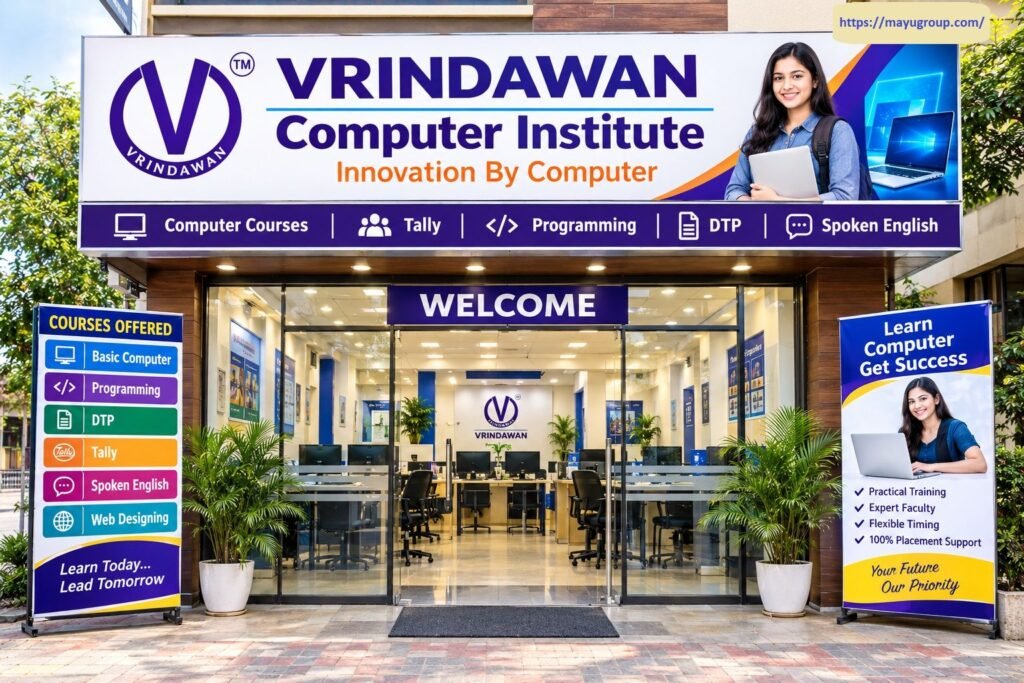
Chapter 1 – The Beginning of a Quality Journey
Vrindawan Computer Institute began its journey with a vision centered on education, technology, professional development, and accessible computer services. With its presence at Vrindawan House, Opposite Platform No. 5, Railway Colony, Asaoti, District Palwal, Haryana – 121102, Vrindawan House, Ganesh Nagar, Dhaniv Bag, Nallasopara East, District Palghar, Maharashtra – 401209, and Vrindawan House, Opposite National School, By-pass Road, SH-83, Warsaliganj, District Nawada, Bihar – 805130, the organization developed an operating structure that connected different communities with computer education and IT-oriented services.
Every organization reaches a stage where growth brings new responsibilities. In the early stages, many activities can be managed through direct communication, personal supervision, and the experience of the promoter. As the number of students, employees, services, locations, documents, and technology-related activities increases, however, informal management becomes more difficult. Consistency becomes important. Customers expect reliable services, employees require clear responsibilities, information needs protection, and management needs evidence that processes are working effectively.
For Vrindawan Computer Institute, this growing need for structure became an important part of its development journey. The organization began looking beyond individual activities and toward a systematic approach to management. Quality could no longer be considered only as the responsibility of one person or one department. It needed to become part of the organization’s overall working culture.
This thinking created the foundation for its certification journey.
In 2021, Vrindawan Computer Institute achieved a significant milestone through certification against multiple management-system standards. The certification portfolio included ISO 9001:2015 for Quality Management System, ISO 20000-1:2018 for IT Services Management System, ISO 27001:2018 for Information Security Management System, and ISO 37301:2021 for Compliance Management System. The stated validity period of these certifications extended to 2024.
The combination of these standards was particularly relevant to an organization operating in the computer and IT education environment. ISO 9001 focused attention on quality and customer requirements. ISO 20000-1 brought greater emphasis to systematic IT service management. ISO 27001 addressed information-security risks and the protection of information assets. ISO 37301 introduced a structured approach toward compliance management.
Together, these systems created a broader management framework.
For the promoter, the certification journey represented more than the achievement of certificates. It encouraged a different way of thinking about organizational growth. Instead of relying entirely on individual knowledge and instructions, the organization could establish documented processes, responsibilities, controls, records, monitoring activities, and improvement mechanisms.
Quality management became connected with everyday work.
A student approaching the institute, an employee managing records, a technical person handling IT services, or a manager reviewing organizational performance could all become part of the same management system. Each activity could be examined in terms of requirements, responsibilities, performance, and opportunities for improvement.
This process-oriented approach was particularly important because Vrindawan Computer Institute operated from multiple locations. Asaoti, Nallasopara East, and Warsaliganj are geographically different locations, and each location can have its own practical operating conditions. A common organizational framework could help establish consistent expectations while allowing individual locations to respond to their local requirements.
The quality journey also encouraged greater attention to documentation. Procedures, records, responsibilities, and work instructions help preserve organizational knowledge. When processes are documented, employees can understand what is expected from them, managers can monitor performance, and corrective actions can be followed more systematically.
The promoter’s role consequently became increasingly connected with leadership and continual improvement. Rather than concentrating only on immediate operational matters, management could examine broader questions: Are customers satisfied? Are processes consistent? Are employees properly trained? Are IT services being managed effectively? Is information adequately protected? Are applicable compliance requirements being monitored?
These questions helped transform certification from a one-time achievement into a management philosophy.
The beginning of this journey also reflected a broader reality of the computer education and IT sector. Technology changes quickly. Customer expectations evolve. Information moves through digital channels. Employees require updated skills. Organizations must respond to new risks and operational requirements. A management system provides a structured way to respond to these changes.
For Vrindawan Computer Institute, the year 2021 therefore represented an important point in its organizational story. The achievement of four certifications demonstrated an effort to organize quality, IT services, information security, and compliance within defined management frameworks.
The journey was not simply about placing certificates on an office wall. Its deeper significance lay in developing systems that could influence everyday behavior.
The promoter and employees could use the certification framework as a foundation for discipline, accountability, customer focus, risk awareness, and continual improvement. Every procedure followed correctly, every record maintained accurately, every issue investigated, and every improvement implemented could contribute to organizational maturity.
The story of Vrindawan Computer Institute’s growth after certification begins with this transformation: from managing activities individually to managing the organization through structured systems.
That transformation established the foundation for the chapters that followed—strengthening processes, improving IT services, protecting information, developing compliance awareness, empowering employees, improving customer confidence, and creating a more systematic approach to sustainable organizational growth.
#VrindawanComputerInstitute
Chapter 2 – Building a Structured Organization
The certification journey of Vrindawan Computer Institute did not end when the certificates were issued in 2021. In many ways, that milestone marked the beginning of a more organized phase of its development. The real challenge after certification was to ensure that the principles behind the management systems became part of everyday operations. For the promoter and employees, this meant moving from informal working practices toward processes that could be understood, documented, monitored, reviewed, and improved.
As an organization involved in computer education and IT-related activities, Vrindawan Computer Institute had to manage several interconnected areas. Students and customers expected dependable services. Employees needed clarity regarding their responsibilities. Technology required regular attention. Documents and information needed appropriate controls. Management needed visibility into operational performance. These requirements made systematic management increasingly important.
The ISO 9001:2015 Quality Management System provided an important foundation for this transition. Quality management encouraged the institute to look at its activities from the perspective of customer requirements and process effectiveness. Instead of viewing each activity independently, management could understand how one process affected another.
For example, customer interaction could influence service expectations, service delivery could affect customer satisfaction, and feedback could provide information for improvement. Employee performance could influence service quality, while training and clearly defined responsibilities could support better performance. Documentation could help maintain consistency, while internal monitoring could identify areas requiring corrective action.
This process-based approach encouraged the organization to become less dependent on individual memory or verbal instructions.
The promoter’s leadership became particularly important during this stage. Management-system implementation requires communication from the top. Employees need to understand why procedures are being introduced and how those procedures contribute to organizational objectives. When employees understand the purpose behind a process, they are more likely to participate in maintaining it.
The organization could therefore focus on creating awareness among employees regarding quality objectives, customer requirements, responsibilities, documentation, and continual improvement.
Another important development was the strengthening of organizational records. Records provide evidence that activities have been performed and allow management to review performance over time. Proper documentation can also help identify recurring issues and determine whether corrective actions have been effective.
For a multi-location organization such as Vrindawan Computer Institute, documentation could provide additional value. The Asaoti location in Haryana, the Nallasopara East location in Maharashtra, and the Warsaliganj location in Bihar could operate within a common management framework. While individual branches might have different local circumstances, common policies and procedures could help maintain organizational consistency.
The ISO 20000-1:2018 IT Services Management System added another layer to this structure. Since technology was central to the institute’s activities, IT services required planned and controlled management. Technical support, service availability, incident handling, maintenance, and communication could all be considered within a systematic framework.
This encouraged management to think about IT not merely as equipment or software, but as a service supporting the organization’s objectives.
Similarly, the ISO 27001:2018 Information Security Management System encouraged the organization to recognize information as an important asset. Computer institutes may handle student details, employee information, administrative records, business documents, credentials, and digital communications. Protecting such information requires awareness as well as technical and organizational controls.
The certification framework could encourage employees to become more careful about access permissions, passwords, data handling, document storage, and information sharing. Security could gradually become a shared responsibility rather than something left only to technical personnel.
The ISO 37301:2021 Compliance Management System contributed another important dimension. Compliance requires organizations to understand applicable obligations and establish methods for monitoring them. For Vrindawan Computer Institute, this approach encouraged management to consider compliance as an ongoing organizational responsibility rather than a one-time exercise.
The combination of four management systems created an integrated organizational perspective. Quality, IT services, information security, and compliance were different areas, but they were connected through common principles such as leadership, risk awareness, documentation, monitoring, corrective action, and continual improvement.
This integration also influenced the promoter’s approach to growth. Expansion is not simply about increasing activities; it requires the ability to control those activities effectively. As an organization grows, systems become increasingly important because they provide a framework within which employees can work consistently.
The certification journey therefore helped establish a foundation for greater organizational maturity. Employees could work with clearer responsibilities, managers could monitor processes more systematically, and leadership could use documented information to support decisions.
Another important change was the growing emphasis on prevention. Instead of waiting for problems to become serious, management could identify potential risks and consider preventive measures. This approach is particularly useful in technology-related operations, where service interruptions, information-security incidents, documentation errors, or communication failures can affect customers.
Continual improvement became a practical management principle. Small improvements in documentation, communication, service response, employee awareness, or information handling could collectively strengthen the organization.
The period following certification can therefore be viewed as a stage of organizational consolidation. The certificates provided formal recognition of management systems, but the greater objective was to create sustainable working practices.
For Vrindawan Computer Institute and its promoter, this was an important step toward building an organization where quality was not dependent solely on personal supervision. Instead, quality could be supported through processes, people, records, monitoring, and continual improvement.
This structured foundation would later support the institute’s efforts to strengthen IT services, improve information security, develop compliance awareness, and create greater confidence among students and customers. The journey from certification to sustainable growth had begun with one fundamental change: turning organizational activities into managed and measurable processes.
#ISO9001Certification
Chapter 3 – Strengthening IT Services and Technology Management
For Vrindawan Computer Institute, technology was never simply an additional facility. It was closely connected with the organization’s identity, daily operations, learning environment, and service delivery. Students depended on computers and digital resources for education, employees relied on technology for administrative activities, and the organization required IT systems for communication, documentation, and business operations. As the institute continued developing after its 2021 certification milestone, strengthening the management of IT services became an important part of its organizational journey.
The introduction of the ISO 20000-1:2018 IT Services Management System provided a structured framework for thinking about technology-related services. Instead of treating technical activities as isolated tasks, the organization could increasingly consider IT services as a complete system requiring planning, responsibility, monitoring, maintenance, and continual improvement.
This approach was significant because a technical problem can have consequences beyond the immediate equipment or software involved. A computer that does not function properly can interrupt training. A network problem can delay communication. A system failure can affect records or administrative activities. A delayed technical response can reduce customer satisfaction. Consequently, effective IT service management requires attention to both technology and people.
The certification journey encouraged Vrindawan Computer Institute to develop greater awareness of these connections.
One of the first areas of improvement was the identification of IT-related responsibilities. When responsibilities are clearly assigned, employees know who should respond to a problem, who should escalate an issue, who should maintain records, and who should review the effectiveness of corrective actions. This can reduce confusion and help the organization respond more systematically.
The promoter’s role was also important in creating this culture. Leadership could encourage employees to report problems instead of ignoring them. A small technical issue identified early can sometimes be easier to address than a larger problem that develops because nobody reported it.
Incident management therefore became an important concept. When an IT service interruption occurred, the organization could focus on recording the issue, understanding its impact, identifying the appropriate response, and learning from the incident. Over time, records of recurring incidents could reveal patterns that management could address through preventive measures.
Maintenance was another important aspect of IT service management. Computers, networks, software, storage systems, and other technology resources require attention to remain dependable. Planned maintenance can help reduce unexpected disruptions and support a more stable working environment.
For an educational organization, this stability has particular importance. Students often expect training sessions and computer-based activities to proceed according to schedule. When technology works reliably, trainers can focus more effectively on education rather than troubleshooting avoidable technical problems.
The IT service framework also encouraged greater attention to communication. When a service problem affects users, timely and understandable communication can be almost as important as the technical solution itself. Employees and customers need to know what has happened, what is being done, and when normal service is expected to resume, wherever such information is available.
This service-oriented mindset helped connect technical performance with customer experience.
The three locations of Vrindawan Computer Institute also made technology management more significant. The Asaoti center in Haryana, the Nallasopara East center in Maharashtra, and the Warsaliganj center in Bihar could benefit from common IT service principles. Standardized procedures could provide a consistent framework for handling technical issues while allowing local teams to manage practical requirements.
Another important development was the recognition that IT service management and information security are closely connected. Technology must not only be available; it must also be appropriately protected. A system that operates efficiently but exposes sensitive information creates a different type of organizational risk.
This connection made the ISO 27001:2018 Information Security Management System an important complement to ISO 20000-1. IT service management focused attention on dependable service delivery, while information security encouraged attention to confidentiality, integrity, and availability of information.
Employees could therefore become more aware of the importance of secure access, responsible password management, controlled information sharing, and appropriate use of organizational technology.
The promoter could also use management reviews and internal monitoring to understand whether IT-related processes were working as intended. Instead of waiting for a major failure, management could look for opportunities to improve infrastructure, employee awareness, documentation, and response procedures.
Technology also created opportunities for efficiency. Digital records, structured communication, and standardized processes could help reduce unnecessary duplication of work. When information is properly organized and accessible to authorized personnel, employees can spend more time on productive activities.
The development of IT service management consequently supported a broader organizational transformation. Technology became something to be managed strategically rather than simply maintained when problems occurred.
For the promoter, this was an important shift in leadership thinking. A growing organization needs reliable systems that continue functioning even when individual employees change roles or responsibilities. Documented IT processes provide institutional knowledge that can support continuity.
The certification framework also encouraged continual improvement. Every technical incident, user feedback, maintenance activity, and performance review could provide an opportunity to learn. The objective was not to claim that problems would never occur, but to develop the ability to respond effectively and reduce the possibility of repeated failures.
As Vrindawan Computer Institute continued its journey after certification, the management of IT services therefore became an important component of its growth story. The institute was developing an environment in which technology supported education, administration, communication, and customer service through increasingly structured practices.
The ISO 20000-1:2018 certification, together with the organization’s quality, information-security, and compliance systems, helped create a more integrated approach to technology management.
This chapter of the journey demonstrated an important lesson: modern organizational growth depends not only on having technology, but on managing technology as a reliable, secure, measurable, and continually improving service.
#ISO20000Certification
Chapter 4 – Strengthening Information Security and Building Trust
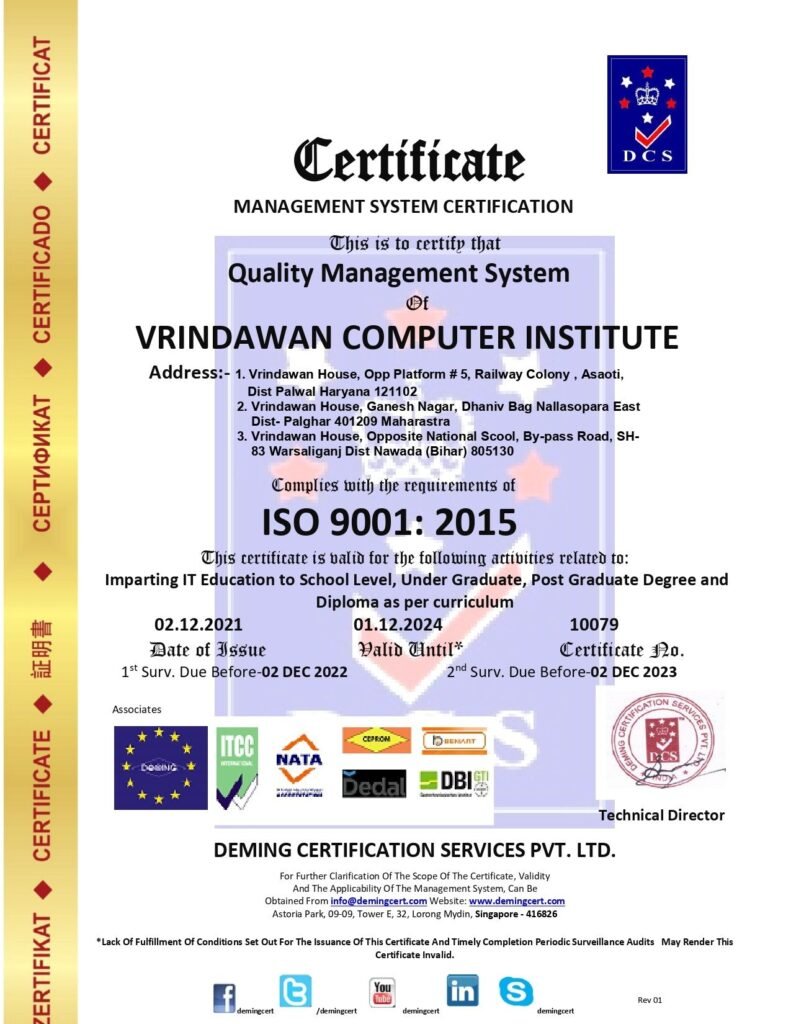
As Vrindawan Computer Institute continued developing its management systems after certification in 2021, information security became an increasingly important part of its organizational journey. A computer institute works with technology every day, and technology naturally involves information. Student details, employee records, training information, administrative documents, business correspondence, digital files, passwords, and other organizational information may all need to be created, stored, accessed, transferred, or protected.
The organization therefore had an important responsibility to develop an environment in which information was handled carefully and systematically. The ISO 27001:2018 Information Security Management System provided a structured framework for this purpose.
Information security is not limited to computers or cybersecurity software. It involves people, processes, technology, physical resources, and management decisions. An organization may have good technical infrastructure, but if employees share passwords carelessly or provide information to unauthorized persons, security can still be compromised. Similarly, strong policies have limited value if employees do not understand how to follow them.
For Vrindawan Computer Institute, the certification journey encouraged information security to become a shared organizational responsibility.
The first important change was awareness. Employees could be educated about the importance of protecting information and using organizational systems responsibly. Simple practices such as maintaining secure passwords, controlling access, protecting documents, avoiding unauthorized sharing, and reporting suspicious activity could become part of everyday work.
The promoter played an important role in establishing this culture. Leadership can communicate that information protection is not merely a technical requirement but an essential part of professional service delivery. When management demonstrates commitment to security, employees are more likely to understand its importance.
Another important aspect was access control. Not every employee requires access to every type of information. Assigning access according to job responsibilities can help reduce unnecessary exposure of sensitive information. A structured approach allows management to consider who needs access, why access is required, and how access should be managed when responsibilities change.
This was especially relevant to a multi-location organization such as Vrindawan Computer Institute. Its operations at Asaoti in Haryana, Nallasopara East in Maharashtra, and Warsaliganj in Bihar created the need for consistent information-handling practices across locations.
A common information-security framework could help establish organizational expectations while allowing individual locations to address their operational needs.
Document control was another important area. As the organization grew, the volume of digital and physical documents could also increase. Policies, records, training information, administrative documents, employee files, and customer-related information needed to be managed appropriately.
An organized approach could help prevent confusion between current and outdated documents. It could also make it easier for authorized employees to locate information when required.
Backup and recovery awareness was equally significant. Digital information can be affected by hardware failure, accidental deletion, software problems, or other incidents. Maintaining appropriate backup practices can support organizational continuity. The objective is not simply to store copies of information but to develop a planned approach for protecting and recovering important data.
The relationship between information security and IT service management also became clearer during this stage. The ISO 20000-1:2018 IT Services Management System focused on systematic IT service delivery, while ISO 27001 emphasized the protection of information. Reliable IT services must also be appropriately secured.
For example, an IT system that is available but poorly protected can create organizational risks. Conversely, extremely restrictive controls that prevent authorized employees from accessing necessary information can also affect service efficiency. A balanced management approach therefore requires organizations to consider availability, confidentiality, integrity, and business requirements together.
Risk awareness became another important component of the institute’s development. Instead of considering information-security incidents only after they occurred, management could identify potential risks in advance and consider appropriate controls.
Employees could be encouraged to report unusual situations or suspected security issues. This creates a culture in which early reporting is viewed as responsible behavior rather than something to be avoided.
Training also played a significant role. Technology changes rapidly, and information-security risks can change with it. Regular awareness can help employees understand that security responsibilities continue beyond the initial implementation of a management system.
For students and customers, responsible information handling can contribute to confidence in the organization. People expect educational and service organizations to treat their information appropriately. While certification itself does not eliminate every information-security risk, a systematic management framework demonstrates that security has been incorporated into organizational planning.
The promoter could also use internal reviews, risk assessments, monitoring activities, and corrective actions to evaluate the effectiveness of information-security practices. If an issue was identified, management could investigate its cause and determine whether changes were necessary.
This continual-improvement approach helped transform information security from a technical subject into a management responsibility.
The significance of the ISO 27001 journey also extended beyond individual systems. It encouraged the organization to consider the entire information lifecycle: how information is created, who can access it, where it is stored, how it is transferred, and when it should be retained or appropriately disposed of.
For Vrindawan Computer Institute, this was another step toward organizational maturity. Quality management established a foundation for consistent service. IT service management supported reliable technology operations. Information security added controls for protecting information and managing related risks.
Together, these systems supported a more disciplined approach to organizational growth.
The chapter of information security therefore became an important part of the institute’s post-certification development. It reinforced the understanding that technology creates opportunities, but responsible information management is essential for sustaining those opportunities.
The experience could be summarized through one central principle: trust in a modern organization is strengthened when information is treated as a valuable asset, protected through appropriate controls, and managed with awareness at every level of the organization.
#ISO27001Certification
Chapter 5 – Developing a Culture of Compliance and Responsible Management
As Vrindawan Computer Institute continued strengthening its management systems after the certification milestone of 2021, another important area of organizational development emerged: compliance management. Quality and technology could provide a strong foundation, but sustainable organizational growth also required the institute to understand and manage its applicable obligations in a systematic manner.
This became particularly relevant with the organization’s ISO 37301:2021 Compliance Management System. The standard provided a structured approach for developing awareness, assigning responsibilities, monitoring compliance, addressing issues, and encouraging continual improvement.
For Vrindawan Computer Institute, compliance could be viewed as more than completing formal requirements. It represented a management discipline that could influence everyday decisions. The organization operated through multiple locations, employees, students, technology resources, documents, service relationships, and administrative activities. Each area could involve different responsibilities and requirements.
The certification journey encouraged the promoter and management team to look at these responsibilities systematically.
Before a structured compliance approach is established, organizations can sometimes depend heavily on individual knowledge. One employee may understand a particular requirement while another may not. Information may be stored in different places, deadlines may depend on personal reminders, and evidence may not always be organized consistently. As an organization grows, such dependence can create unnecessary uncertainty.
A compliance management system helps address this challenge by introducing defined processes.
The first step in this journey was developing greater awareness. Employees could be informed about the requirements relevant to their responsibilities. Rather than assuming that compliance belonged only to senior management, the organization could communicate that every employee had a role in maintaining responsible operations.
For example, employees involved in administration needed to understand applicable organizational procedures. Employees handling information needed to follow information-security requirements. Technical personnel needed to operate according to established IT-service processes. Managers needed to monitor performance and address deviations.
This created a connection between compliance and daily work.
The promoter’s leadership was essential in developing this culture. A compliance system becomes meaningful when management demonstrates commitment through decisions and actions. Employees need to see that requirements are taken seriously and that identified gaps are addressed rather than ignored.
The organization could also establish clearer responsibilities for monitoring compliance. When ownership is defined, it becomes easier to identify who should review a requirement, maintain evidence, communicate changes, or initiate corrective action.
Documentation played an important role in this process. Records provide evidence of activities and can help management demonstrate that responsibilities have been performed. Properly maintained records can also make internal reviews more effective.
For Vrindawan Computer Institute, documentation could be particularly useful because of its three locations. The institute’s centers in Asaoti, Haryana; Nallasopara East, Maharashtra; and Warsaliganj, Bihar operated in different local environments. A common compliance framework could help maintain consistent organizational expectations while allowing individual locations to manage their specific operational circumstances.
Another important element was identifying changes. Requirements can evolve over time, and organizations need mechanisms to recognize relevant changes and determine whether existing processes remain appropriate. A structured compliance approach encourages management to avoid assuming that yesterday’s procedures will always be sufficient.
Risk management also became connected with compliance. Non-compliance can sometimes create operational, financial, contractual, reputational, or administrative consequences. By identifying potential risks in advance, management can consider suitable controls and preventive measures.
This approach also complements the organization’s other management systems.
The ISO 9001:2015 Quality Management System emphasizes meeting customer and applicable requirements. The ISO 20000-1:2018 IT Services Management System supports systematic management of IT services. The ISO 27001:2018 Information Security Management System addresses information-security risks and controls. ISO 37301 adds a structured compliance perspective that can connect these areas with broader organizational obligations.
Together, these systems encourage management to consider not only whether an activity is being performed, but whether it is being performed responsibly and consistently.
Internal review and monitoring could help identify gaps. When an issue was found, the organization could investigate its cause and determine appropriate corrective action. This encouraged a learning-oriented approach rather than simply treating compliance as a checklist.
The promoter could also use management reviews to understand broader organizational performance. Questions such as whether responsibilities were clearly assigned, whether employees understood relevant requirements, whether corrective actions were effective, and whether emerging risks had been considered could support better decision-making.
Compliance awareness also influenced organizational culture. When employees understand the reasons behind requirements, compliance becomes less about following instructions mechanically and more about responsible professional behavior.
For an educational and IT-oriented organization, this was especially valuable. Students and customers interact with the organization expecting professional conduct, dependable services, and appropriate handling of information. A structured compliance framework supports the internal discipline required to meet those expectations.
The journey also demonstrated that compliance and growth do not have to be separate concepts. A growing organization needs systems that can support expansion without losing control. Clearly defined responsibilities, documented procedures, monitoring mechanisms, and corrective actions can provide a foundation for controlled growth.
For Vrindawan Computer Institute, ISO 37301 therefore represented an important part of its broader management-system journey. It encouraged the organization to look beyond immediate operations and consider the responsibilities associated with sustainable management.
The period following certification could consequently be viewed as a time when compliance became more integrated into organizational thinking. The promoter and employees were encouraged to recognize that responsible growth depends on understanding obligations, maintaining evidence, monitoring performance, and continually improving processes.
The central lesson of this chapter is clear: compliance is most effective when it becomes part of everyday management rather than remaining a separate administrative activity. Through systematic awareness, responsibility, monitoring, and improvement, Vrindawan Computer Institute could build a stronger foundation for disciplined and sustainable organizational development.
#ISO37301Certification
Chapter 6 – Developing People, Leadership and a Culture of Continuous Improvement
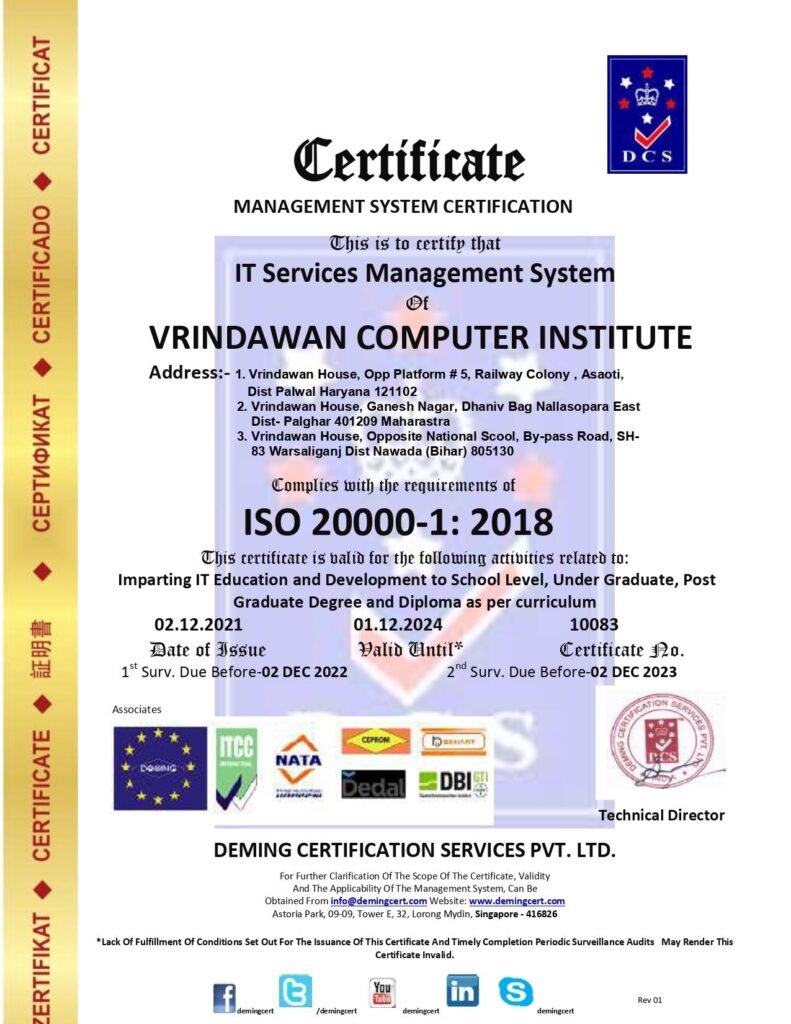
The growth of Vrindawan Computer Institute after its 2021 certification was not dependent only on documented procedures, technology, or management systems. At the center of every successful management system are people. Employees, trainers, technical personnel, administrators, managers, and leadership all contribute to the effectiveness of an organization. For Vrindawan Computer Institute, developing people and creating greater awareness of quality became an important stage in its journey.
The four management systems—ISO 9001:2015, ISO 20000-1:2018, ISO 27001:2018, and ISO 37301:2021—provided frameworks, but employees were responsible for converting those frameworks into everyday practices. A procedure becomes meaningful only when people understand it, follow it, and contribute suggestions for improving it.
This created a new responsibility for the promoter and management team: building awareness throughout the organization.
In a computer and IT-oriented institute, employee responsibilities can vary significantly. Trainers focus on education and student interaction. Technical personnel work with computer systems and IT services. Administrative employees manage records and communication. Managers coordinate operations and monitor performance. Each function has different responsibilities, yet all are connected to organizational quality.
The quality-management approach encouraged the organization to clarify these connections.
Employees could understand how their individual activities affected the larger service process. A trainer’s preparation could influence student satisfaction. Administrative accuracy could affect records and communication. Technical support could influence service continuity. Proper information handling could protect organizational and customer data. Compliance awareness could help ensure that established requirements were followed.
This understanding encouraged a culture in which quality was treated as everyone’s responsibility.
Leadership played a particularly important role. The promoter could communicate organizational objectives, establish expectations, review performance, and encourage employees to identify improvement opportunities. Effective leadership in a management system is not limited to giving instructions. It also involves listening to employees, understanding operational difficulties, allocating appropriate resources, and encouraging responsible decision-making.
One important change was the growing importance of communication.
Employees need to know not only what they are expected to do but also why particular procedures exist. For example, information-security controls may sometimes appear inconvenient if their purpose is not understood. Once employees recognize that these controls protect important information, they are more likely to follow them consistently.
Similarly, documentation requirements become more meaningful when employees understand that records provide evidence, support continuity, and help management identify areas for improvement.
Training and awareness could therefore become important tools for organizational development. Employees could be introduced to quality objectives, IT service responsibilities, information-security principles, and compliance expectations. Refresher awareness could help reinforce these concepts as employees gained experience.
The multi-location structure of Vrindawan Computer Institute made employee alignment particularly important. The organization had locations in Asaoti, Haryana; Nallasopara East, Maharashtra; and Warsaliganj, Bihar. Although local operations could have different requirements, a common organizational culture could help maintain consistent expectations.
This did not necessarily mean that every location needed to operate identically. Instead, the management framework could provide common principles while allowing local teams to address practical conditions.
Another important element was employee participation in improvement.
People who perform a process regularly often understand its practical difficulties better than someone who only reviews it occasionally. Employees may notice unnecessary duplication, communication gaps, recurring technical problems, documentation difficulties, or customer concerns.
Encouraging employees to report such issues can provide valuable information to management.
The ISO 9001:2015 approach to continual improvement supported this philosophy. Problems could be analyzed rather than simply corrected temporarily. When an issue occurred, the organization could ask why it happened, whether it might happen again, and what changes could reduce the possibility of recurrence.
This encouraged a more mature approach to mistakes. The objective was not simply to identify who was responsible, but to understand the process and determine whether improvements were required.
The same philosophy could be applied to IT services and information security. A recurring technical incident could indicate a maintenance or infrastructure issue. An information-security concern could reveal a weakness in employee awareness or access controls. A compliance gap could indicate that responsibilities were unclear.
In each case, the problem could become an opportunity for organizational learning.
Leadership reviews were another important part of this process. Management could examine performance information, audit observations, feedback, incidents, risks, objectives, and improvement activities. Such reviews helped connect daily operations with strategic organizational goals.
For the promoter, this created an opportunity to move beyond immediate problem-solving and focus on long-term organizational capability.
An organization becomes stronger when its systems continue functioning even when individual employees change. Documented processes, employee training, role clarity, and shared knowledge reduce dependence on one person’s memory or experience.
This was especially valuable for an organization seeking sustainable growth across multiple locations.
Employee development also contributed to professionalism. When people understand their responsibilities and receive appropriate awareness, they can perform their work with greater confidence. Clear procedures can reduce uncertainty, while feedback mechanisms can encourage learning.
Over time, these practices can create a culture where employees see quality, security, IT service reliability, and compliance as connected elements of their professional responsibilities.
For Vrindawan Computer Institute, the post-certification journey was therefore not simply about maintaining four certificates. It was about developing the people and organizational culture required to sustain the systems represented by those certificates.
The promoter’s leadership, employee participation, communication, awareness, training, monitoring, and continual improvement all became part of the broader growth story.
The central lesson of this chapter is that management systems are sustained by people. Procedures provide direction, technology provides tools, and standards provide frameworks—but committed employees and responsible leadership turn these elements into an effective organizational culture.
For Vrindawan Computer Institute, developing such a culture created an important foundation for improving services, strengthening customer relationships, managing risks, and supporting future organizational growth.
#QualityManagementSystem
Chapter 7 – Customer Confidence, Service Quality and Organizational Reputation
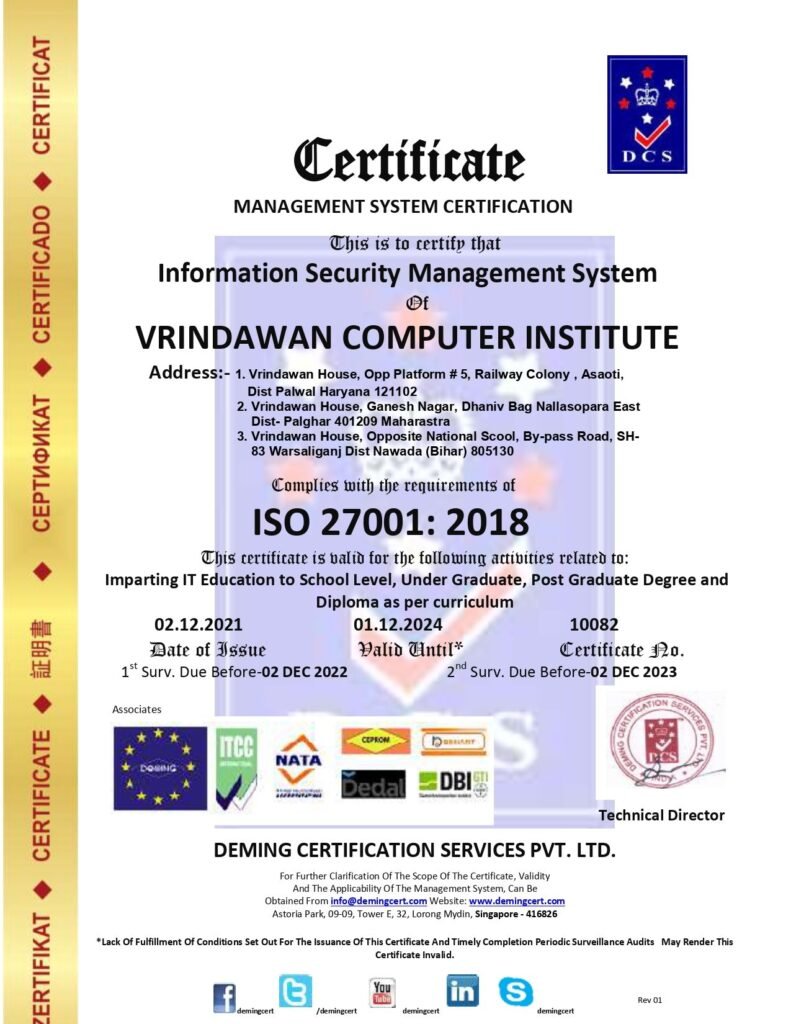
The growth journey of Vrindawan Computer Institute after its certification in 2021 was closely connected with another important objective: creating a more consistent and dependable experience for students, customers, employees, and other stakeholders. An organization may establish sophisticated internal systems, but its long-term development also depends on how effectively those systems support the people who interact with it.
For Vrindawan Computer Institute, the ISO 9001:2015 Quality Management System provided an important framework for strengthening customer-focused practices. Quality management encouraged the organization to understand requirements, monitor service performance, respond to feedback, address problems, and identify opportunities for continual improvement.
This represented a gradual shift in perspective. Instead of viewing quality simply as the successful completion of an activity, the organization could consider the complete experience surrounding that activity.
For a computer institute, customer experience can begin before a student formally joins a course. Communication, information provided about services, registration processes, scheduling, training arrangements, technical facilities, trainer interaction, documentation, and post-training support can all influence perceptions of service quality.
A systematic management approach encouraged these activities to be viewed as interconnected processes.
The promoter and management team could therefore focus on establishing clearer processes for customer interaction. Employees could understand what information needs to be communicated, how requests should be handled, and how issues should be escalated when necessary.
Clear communication is particularly important in education and IT services. Customers often have questions about training, schedules, facilities, technical support, documentation, and other services. When communication is organized and consistent, misunderstandings can be reduced.
Customer feedback also became an important source of information.
Feedback can reveal areas that management may not notice through internal monitoring alone. A student may identify a communication issue, a technical problem, a scheduling difficulty, or an area where additional support would be useful. Instead of treating such feedback simply as a complaint, the organization could examine it as information about the effectiveness of its processes.
This approach connects directly with continual improvement.
When a recurring issue was identified, management could investigate its underlying cause. If the issue resulted from unclear instructions, the communication process could be improved. If it was related to technology, IT-service procedures could be reviewed. If it involved information handling, security controls could be examined. If it related to an organizational requirement, compliance processes could be considered.
The four management systems therefore worked together around the customer experience.
ISO 9001:2015 supported quality and customer focus. ISO 20000-1:2018 supported systematic IT service management. ISO 27001:2018 encouraged responsible protection of information. ISO 37301:2021 provided a framework for compliance management. Although each standard addressed a different area, their combined application could support a more organized service environment.
For the promoter, this integrated approach created an opportunity to strengthen organizational reputation through consistent practices.
Reputation is built gradually. It is influenced by how an organization communicates, responds to problems, delivers services, manages information, and treats its customers. A certificate can demonstrate that a management system has been assessed against a standard, but the organization’s day-to-day behavior determines how that system is experienced.
This distinction was important in the post-certification period.
The institute could use the certification framework as a foundation for improving internal discipline and customer service. Employees could be encouraged to understand that every interaction contributes to the organization’s reputation.
A receptionist or administrative employee may be the first person a customer encounters. A trainer may represent the organization during an entire educational program. A technical employee may determine how quickly an IT issue is resolved. A manager may handle an important complaint or request. Every role can therefore influence customer confidence.
The promoter could reinforce this understanding through communication and leadership.
Another important factor was consistency across locations. Vrindawan Computer Institute operated at three stated locations: Asaoti in Haryana, Nallasopara East in Maharashtra, and Warsaliganj in Bihar. Customers interacting with different locations could benefit from common organizational standards.
A shared management framework could help establish consistent expectations for service quality, information handling, IT support, documentation, and compliance.
At the same time, local employees could provide feedback about location-specific challenges. This created a two-way relationship between central management and individual operating locations.
Customer confidence can also be influenced by an organization’s approach to information security. In a digital environment, customers increasingly expect organizations to handle information responsibly. The institute’s information-security management framework could therefore complement its quality-management efforts.
When customers see that an organization takes service quality and information protection seriously, it can contribute to a professional service environment.
The IT service-management framework also supported customer confidence indirectly. Reliable technology allows training and administrative activities to proceed with fewer interruptions. Systematic incident management and maintenance can help employees respond more effectively when technical problems occur.
Importantly, continual improvement does not mean that an organization will never experience problems. Every organization can face complaints, technical failures, delays, or unexpected situations. A mature management approach focuses on how effectively the organization learns from those experiences.
For Vrindawan Computer Institute, this meant developing mechanisms through which customer feedback, internal observations, technical incidents, and compliance findings could contribute to improvement.
The promoter’s role was to maintain this culture over time. Certification could provide a starting point, but maintaining customer-focused systems required ongoing leadership attention.
As the organization continued its development, the goal was to create a cycle in which service delivery generated feedback, feedback generated learning, learning produced improvements, and improvements strengthened future service delivery.
This cycle supported the broader growth story of Vrindawan Computer Institute.
The organization was not simply developing its internal processes; it was creating a framework through which those processes could contribute to customer confidence and organizational reputation.
The experience of the post-certification period therefore demonstrated an important principle: quality becomes visible when internal management systems translate into consistent service, responsible communication, reliable technology, secure information handling, and meaningful responses to customer needs.
For Vrindawan Computer Institute, this customer-focused approach became another important building block in its journey toward structured and sustainable organizational development.
#ITServiceManagement
Chapter 8 – Managing Growth Across Multiple Locations
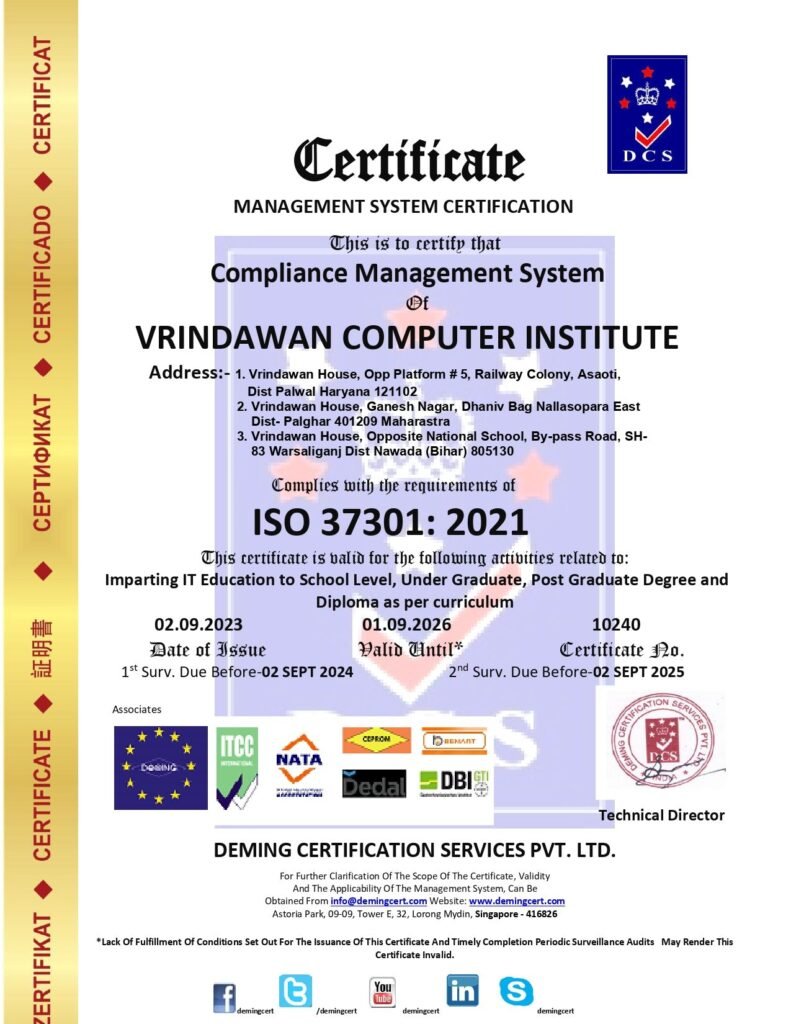
The journey of Vrindawan Computer Institute after its certification in 2021 was not limited to improving individual processes. An important part of its organizational development was the challenge of managing activities across multiple locations. With its stated centers at Asaoti, District Palwal, Haryana; Nallasopara East, District Palghar, Maharashtra; and Warsaliganj, District Nawada, Bihar, the organization had to think about how common standards, procedures, and organizational expectations could be maintained across geographically separated operations.
Operating from multiple locations can create opportunities for wider reach and service delivery. At the same time, it can make consistency more challenging. Employees may have different levels of experience, customers may have different expectations, and local operating conditions can vary. Without a structured framework, the quality of service can become dependent on individual practices.
The management systems adopted by Vrindawan Computer Institute provided a foundation for addressing this challenge.
The ISO 9001:2015 Quality Management System encouraged a process-based approach. Instead of allowing every location to develop completely separate working methods, the organization could establish common procedures and expectations for important activities.
This did not mean that every branch had to operate in exactly the same way. Local circumstances could require practical adjustments. However, common quality objectives, documentation practices, responsibilities, and monitoring mechanisms could help maintain organizational consistency.
For the promoter, this created an important management advantage. When operations are spread across locations, leadership cannot personally supervise every activity every day. A well-defined management system can provide a structure through which responsibilities are delegated while organizational expectations remain clear.
Delegation therefore became connected with accountability.
Managers and employees at each location could understand what they were responsible for, what records needed to be maintained, and when issues needed to be communicated to higher management. This helped create a clearer relationship between local decision-making and overall organizational governance.
Documentation became particularly important in this environment.
A procedure that exists only as verbal knowledge may be difficult to reproduce consistently at different locations. Written processes, forms, records, instructions, and defined responsibilities can help transfer organizational knowledge from one location to another.
For Vrindawan Computer Institute, this could support consistency in activities related to quality, IT services, information security, and compliance.
The ISO 20000-1:2018 IT Services Management System added another dimension to multi-location management. Each center could depend on computers, communication systems, digital resources, and technical support. Establishing common principles for IT service management could help create greater consistency in how technical issues were reported, addressed, documented, and reviewed.
If a particular IT problem occurred repeatedly at one location, management could investigate whether the cause was local or whether a similar risk existed elsewhere. This created an opportunity for organizational learning.
An improvement developed at one center could potentially be considered for adoption at another.
Information security was equally important across locations. The ISO 27001:2018 Information Security Management System encouraged a consistent approach to protecting organizational information. Physical distance between branches should not result in different standards for handling sensitive information.
Employees at different locations could therefore receive common awareness regarding password management, access control, information sharing, document handling, and security incident reporting.
This consistency could be especially useful when employees communicate or exchange information across locations.
The ISO 37301:2021 Compliance Management System also supported multi-location governance. Compliance responsibilities may involve both organization-wide requirements and location-specific obligations. A structured compliance framework could help management assign responsibilities, monitor requirements, maintain evidence, and address gaps.
The promoter could therefore establish a system in which individual locations contributed information while central management maintained an overall view of organizational performance.
Regular communication became essential.
Meetings, reporting mechanisms, internal reviews, training sessions, and management discussions could help maintain alignment. Employees could share operational challenges and improvement suggestions. Management could communicate changes in policies, procedures, objectives, or requirements.
Such communication also helped prevent individual locations from becoming isolated from the larger organization.
Another important aspect was employee development. When employees across locations receive appropriate awareness and understand common organizational expectations, it becomes easier to maintain a shared culture.
The organization could use training and awareness activities to reinforce principles of quality, IT service management, information security, and compliance.
This was especially relevant when new employees joined. Organizational growth often brings new people into the system, and onboarding becomes important for transferring organizational knowledge.
A structured management framework could help ensure that new employees were introduced to relevant responsibilities rather than relying entirely on informal guidance from colleagues.
Multi-location management also encouraged greater use of performance monitoring.
Management could review information from different locations and identify patterns. One location might demonstrate a process that works particularly well, while another might experience recurring difficulties. Comparing such experiences could help identify opportunities for improvement.
The objective would not necessarily be to compare locations competitively, but to learn from operational experience.
For the promoter, this represented a shift from branch-by-branch thinking toward organization-wide management.
The three locations could be viewed as parts of one larger system rather than completely separate operations. Shared objectives, common procedures, consistent awareness, and centralized learning could strengthen organizational unity.
The certification framework provided a useful structure for this approach.
Quality management helped maintain service expectations. IT service management supported technology-related consistency. Information security encouraged common protection practices. Compliance management created a framework for responsible organizational governance.
Together, these systems helped create conditions in which growth could be managed more systematically.
The journey across multiple locations also demonstrated an important principle of organizational development: expansion creates value only when the organization can maintain control over its processes while adapting to local requirements.
For Vrindawan Computer Institute, the post-certification period offered an opportunity to strengthen this capability. The institute could build a common organizational culture while allowing each location to respond to its practical environment.
The result was a more structured approach to managing geographically distributed activities.
Ultimately, the multi-location chapter of Vrindawan Computer Institute’s story reflects the importance of consistency, communication, delegation, documentation, accountability, and shared learning. These elements can help an organization move from managing individual centers to managing a connected network of operations.
For the promoter, this represented another stage of growth: building systems capable of supporting organizational development beyond the limits of direct personal supervision.
#InformationSecurity
Chapter 9 – From Certification to Continual Improvement
The certification achieved by Vrindawan Computer Institute in 2021 represented an important milestone, but the real value of a management system becomes visible through what an organization does after certification. A certificate can recognize that a management system has been established and assessed, while continual improvement depends on how consistently the organization maintains, reviews, and develops that system.
For Vrindawan Computer Institute, this principle became an important part of its organizational journey. The institute had established management systems covering quality, IT services, information security, and compliance. The next challenge was to ensure that these systems remained active and useful in everyday operations.
The ISO 9001:2015 Quality Management System provided an important foundation for continual improvement. Quality was not treated as a fixed condition. Customer expectations could change, technology could develop, employees could change, and operational requirements could evolve. Therefore, processes also needed to be reviewed periodically.
This encouraged management to look at performance as an ongoing cycle.
An issue could be identified through customer feedback, employee observations, internal reviews, service incidents, or management monitoring. Once identified, the issue could be analyzed to understand its cause. Appropriate corrective action could then be introduced, followed by monitoring to determine whether the action had been effective.
This approach was different from simply correcting an immediate problem.
For example, if a recurring operational error occurred, management could ask why it was happening repeatedly. Perhaps employees needed additional training. Perhaps an instruction was unclear. Perhaps responsibilities had not been defined properly. Perhaps a form or process needed modification. By identifying the underlying cause, the organization could work toward preventing recurrence.
This problem-solving approach could gradually improve organizational maturity.
The ISO 20000-1:2018 IT Services Management System supported a similar philosophy for technology-related activities. Technical incidents could provide valuable information about the performance of IT services. Recurring incidents could indicate the need for maintenance, infrastructure improvements, process changes, or employee awareness.
Instead of viewing an IT problem as an isolated event, management could consider what the incident revealed about the overall service system.
This created an opportunity for continual improvement in areas such as technical response, service availability, maintenance, communication, and documentation.
The information-security system also required ongoing attention. The ISO 27001:2018 Information Security Management System encouraged the organization to consider changing risks and the effectiveness of existing controls.
Information-security threats can evolve with technology and employee behavior. New software, new devices, digital communication methods, and changing operational practices can introduce new risks. Therefore, information-security management needs to remain dynamic.
Vrindawan Computer Institute could use awareness activities, internal reviews, risk assessments, access controls, incident reporting, and corrective actions to maintain this focus.
Similarly, the ISO 37301:2021 Compliance Management System supported continual review of compliance responsibilities. Requirements may change, organizational activities may expand, and new responsibilities may emerge. A structured compliance system helps management identify such changes and determine appropriate action.
The four management systems therefore shared a common principle: improvement should be systematic rather than accidental.
Management reviews could play an important role in connecting these systems. The promoter and management team could examine objectives, performance information, audit observations, feedback, incidents, risks, corrective actions, and improvement opportunities.
Such reviews could help leadership move beyond individual problems and consider broader organizational trends.
For example, if several departments experienced similar documentation difficulties, management might consider whether a common procedure needed improvement. If technical incidents increased, infrastructure or maintenance processes might require attention. If employees repeatedly raised questions about a particular requirement, additional awareness or training might be appropriate.
This type of analysis allowed management to make decisions based on organizational information rather than assumptions alone.
Employee involvement remained important throughout this process. Employees who work directly with customers, technology, records, and administrative activities often observe problems before management does. Encouraging employees to report concerns and suggest improvements can therefore strengthen the management system.
For the promoter, this created a leadership environment in which improvement became a shared responsibility.
Another important concept was learning from successful practices. Continual improvement does not only mean fixing problems. It can also involve identifying what works well and determining whether the same approach could benefit another department or location.
For a multi-location organization such as Vrindawan Computer Institute, this could be particularly useful. An effective practice developed at Asaoti could potentially provide learning for Nallasopara East or Warsaliganj, subject to local suitability. Similarly, an operational improvement from one location could be evaluated for wider application.
This created an internal learning cycle.
The organization could also use objectives to give direction to improvement activities. Quality objectives, service objectives, security objectives, and compliance objectives can help management determine what it wants to improve and how progress will be monitored.
Measurement provides another important element. Without appropriate information, management may find it difficult to determine whether an improvement has actually produced the desired result.
Therefore, records, performance indicators, customer feedback, incident information, audit findings, and management-review outputs can all contribute to informed decision-making.
The post-certification journey was consequently a process of organizational learning. The institute could move from simply implementing management systems to using them as tools for understanding performance.
For the promoter, this represented an important evolution in leadership. Sustainable growth requires more than immediate solutions. It requires the ability to recognize patterns, anticipate risks, listen to employees and customers, and continuously improve organizational processes.
The certification period from 2021 to 2024, as stated for the institute’s certificates, can therefore be viewed as an important chapter in this broader journey. It provided an established framework within which the organization could practice disciplined management and continual improvement.
The lasting lesson from this chapter is that certification is a milestone, while improvement is a continuing journey. For Vrindawan Computer Institute, the real organizational value of its management systems depended on how effectively quality, IT services, information security, and compliance were incorporated into everyday decision-making.
Through review, learning, corrective action, employee participation, and leadership commitment, the institute could continue strengthening the foundation created by its certification journey.
#ComplianceManagement
Chapter 10 – A Foundation for the Future
The journey of Vrindawan Computer Institute after its certification in 2021 represents a broader story of organizational development, systematic management, leadership, and continual improvement. What began as an effort to establish recognized management systems developed into an opportunity to strengthen the way the organization approached quality, IT services, information security, compliance, employees, customers, and multi-location operations.
The institute’s stated locations at Asaoti, District Palwal, Haryana; Nallasopara East, District Palghar, Maharashtra; and Warsaliganj, District Nawada, Bihar reflect an organization operating across different regions. Managing activities across such locations requires more than individual effort. It requires processes that provide direction while allowing employees and managers to respond to practical operating conditions.
The certifications obtained in 2021, with stated validity through 2024, created an important framework for this development. The certification portfolio included ISO 9001:2015 Quality Management System, ISO 20000-1:2018 IT Services Management System, ISO 27001:2018 Information Security Management System, and ISO 37301:2021 Compliance Management System.
Each standard addressed a different organizational requirement, but together they provided a broad management perspective.
ISO 9001 encouraged the institute to focus on consistent quality and customer requirements. It supported a process-based approach in which activities could be planned, monitored, evaluated, and improved.
ISO 20000-1 strengthened the organization’s approach to IT service management. For a computer institute, reliable technology is closely connected with effective training, communication, administration, and customer service.
ISO 27001 encouraged systematic attention to information security. As digital information became increasingly important, protecting organizational and customer information became an important management responsibility.
ISO 37301 added a structured approach to compliance. It encouraged the organization to understand applicable obligations, assign responsibilities, monitor requirements, maintain evidence, and address identified gaps.
The combined effect of these systems was the development of a more integrated organizational mindset.
For the promoter, this journey could represent a transition from direct operational management toward systems-oriented leadership. In a small organization, many decisions can be made through personal supervision. As activities grow and become more complex, however, leadership increasingly requires delegation, process control, performance monitoring, and organizational learning.
The management systems supported this transition by creating defined responsibilities and documented approaches.
Employees also became an important part of the organization’s future. A management system cannot remain effective without people who understand their responsibilities and participate in improvement. Training, awareness, communication, feedback, and leadership therefore remained essential.
The organization could use the lessons learned during its certification journey to continue developing employee capabilities. Every employee who understands quality, service management, information security, and compliance contributes to organizational resilience.
Customer relationships were another important part of the future.
The long-term reputation of an educational and IT-oriented organization depends on how consistently it serves its stakeholders. Reliable services, clear communication, appropriate information handling, responsive support, and attention to feedback can all contribute to customer confidence.
The quality-management framework encouraged the organization to treat customer feedback as a source of learning. Complaints and observations could be investigated, corrective actions could be introduced, and successful improvements could become part of future processes.
The same philosophy could be applied to technology and information security. An IT incident could become an opportunity to strengthen service management. A security concern could lead to better awareness or controls. A compliance observation could lead to clearer responsibilities.
In this way, challenges could become sources of organizational learning.
The multi-location structure also created opportunities for knowledge sharing. Practices developed in one center could be evaluated for possible application elsewhere. Employees could share experiences, management could identify recurring issues, and common procedures could help maintain consistency.
Such collaboration can reduce dependence on isolated knowledge and strengthen the organization as a whole.
The future growth of Vrindawan Computer Institute could therefore be supported by continuing to view management systems as living frameworks rather than static documentation. Procedures need to remain relevant. Risks need to be reviewed. Employee awareness needs to be refreshed. Customer expectations need to be understood. Technology needs to evolve. Compliance responsibilities need to be monitored.
Continual improvement provides the connecting principle among all these activities.
For the promoter, the most important lesson may be that organizational growth is not simply measured through expansion in locations, activities, customers, or services. Sustainable growth also involves developing the ability to manage increasing complexity responsibly.
A strong organization needs systems that can continue functioning when circumstances change.
The certification journey provided Vrindawan Computer Institute with a foundation for this approach. It encouraged the organization to establish documented processes, clarify responsibilities, strengthen IT services, protect information, develop compliance awareness, and create mechanisms for monitoring and improvement.
The certificates themselves represented an important milestone, but the greater story lies in what the organization could build around them.
The period from 2021 to 2024 therefore forms an important chapter in the institute’s documented management-system journey. It reflects an effort to bring multiple dimensions of organizational performance under structured management principles.
Looking ahead, the institute can draw upon these experiences to continue strengthening its processes and organizational culture. The lessons of quality management can guide service improvement. IT service management can support technology reliability. Information security can protect valuable information. Compliance management can encourage responsible governance. Employee participation can support innovation and learning.
Ultimately, the story of Vrindawan Computer Institute is not only about obtaining four certifications. It is about the transformation that structured management can encourage within an organization.
The promoter’s journey is connected with leadership, responsibility, learning, and the ability to create systems that support people. The company’s journey is connected with quality, technology, security, compliance, customer focus, and continual improvement.
The lasting message of this ten-chapter story can be expressed simply:
Certification can provide a framework, but people create the culture, processes create consistency, leadership creates direction, and continual improvement creates sustainable progress.
For Vrindawan Computer Institute, the certification journey established a foundation upon which future organizational development could be built. Its experience demonstrates how a structured approach to quality, IT services, information security, and compliance can become part of a wider journey toward professionalism, accountability, and responsible growth.
#BusinessGrowth
#ISOManagementSystem #DigitalQualityManagement #ITQualityServices #CertifiedOrganization #ContinuousImprovement
Take the Next Step Today
Don’t wait to enhance your business’s quality and efficiency. Partner with Mayu Group Global and experience the transformation that comes with expert consultancy and training. Contact us today to learn more about how we can help you achieve your business goals. Reach out via phone at
+91-9322728183, visit our website at www.mayugroup.com, or email us at investor@mayugroup.com Let us be your guide on the journey to excellence and innovation.