Rajasthan Decorators
- Rajasthan Decorators
- Chapter 1 – The Beginning of a Quality Journey
- Chapter 2 – Building a Structured Management System
- Chapter 3 – Expanding Beyond Quality
- Chapter 4 – Furniture as a Complete Customer Experience
- Chapter 5 – Ergonomics and Workplace Design
- Chapter 6 – Environmental Responsibility and Green Products
- Chapter 7 – Safety as a Business Responsibility
- Chapter 8 – Recognition Through Multiple Certifications
- Chapter 9 – From Certification to Sustainable Growth
- Chapter 10 – A Continuing Journey of Improvement
- Take the Next Step Today
Chapter 1 – The Beginning of a Quality Journey
Rajasthan Decorators, located at B-93, WHS, Kirti Nagar, New Delhi – 110015, India, represents a journey of business development shaped by furniture, interior solutions, customer requirements, and a growing focus on systematic quality management. Operating in a competitive market where design, functionality, durability, service, and timely execution are important, the organization gradually recognized that sustainable growth requires more than producing attractive products. It requires processes that can consistently deliver what customers expect.
The company’s scope of work covers a wide range of products and services, including office modular furniture, home furniture, modular kitchen furniture, institutional furniture, hospital furniture, chairs, almirahs, interior designing, workstations, wall paneling, and similar products. Such a diverse scope means that every project can involve different customer requirements, dimensions, materials, designs, applications, and installation conditions. Managing this variety effectively requires coordination between people, processes, suppliers, designers, production activities, quality checks, and customers.
For the promoter of Rajasthan Decorators, the development of the organization was therefore closely connected with the need to establish a more disciplined approach to business operations. As the company continued to serve customers and handle different types of furniture and interior requirements, quality could no longer be considered only as a final inspection performed after a product was completed. Quality needed to become part of the complete business process.
This thinking created the foundation for the organization’s ISO 9001:2015 Quality Management System journey.
ISO 9001:2015 provided a structured framework through which Rajasthan Decorators could examine how its activities were planned, performed, monitored, and improved. The emphasis on customer focus, process management, risk-based thinking, documented information, leadership, performance evaluation, and continual improvement offered a practical foundation for developing a more organized management system.
The certification journey was significant because it encouraged the organization to look at quality from the customer’s perspective. A customer purchasing office furniture may expect appropriate dimensions, reliable construction, suitable finishes, functional design, timely delivery, and professional installation. A customer ordering home furniture may have different expectations concerning appearance, comfort, customization, and space utilization. Institutional and hospital projects may involve additional functional and application-specific requirements.
Understanding these expectations and converting them into clearly defined processes became increasingly important.
The promoter’s role also evolved during this period. Business leadership was not limited to acquiring orders or supervising individual projects. It involved creating an environment where employees understood their responsibilities and where organizational objectives were connected with customer satisfaction. Quality became a management responsibility as well as an operational responsibility.
The implementation of a Quality Management System could help bring greater consistency to activities such as reviewing customer requirements, planning projects, controlling materials, monitoring production, inspecting finished products, handling nonconformities, maintaining records, and responding to customer feedback. These practices provided a framework through which problems could be identified and addressed systematically instead of depending entirely on individual judgment.
The certification journey also supported a broader vision for the organization. Rajasthan Decorators was not limited to a single furniture category. Its scope included office environments, residential furniture, kitchens, institutional applications, hospital furniture, chairs, storage systems, workstations, wall paneling, and interior design. This diversity created opportunities for growth while simultaneously increasing the importance of process discipline.
The supplied certification records indicate an ISO 9001:2015 Certificate, along with other certifications and credentials associated with the organization’s broader management and product-development journey. The certification information provided records an issue date in 2022 and validity through 2025.
The certification period can be viewed as an important stage in the organization’s development. It provided an opportunity to formalize practices that may previously have been handled through experience and day-to-day management. Procedures, responsibilities, records, monitoring, and review mechanisms could become more clearly established.
For the promoter, this was also a shift in mindset—from simply managing a furniture and interior business to developing an organization supported by a recognizable management framework.
The journey did not end with receiving a certificate. Certification represented the beginning of a continuing process of maintaining and improving the system. Employees needed awareness, processes needed monitoring, customer expectations needed review, and opportunities for improvement needed to be identified.
This approach created the foundation for Rajasthan Decorators’ subsequent expansion into areas such as environmental management, occupational health and safety, ergonomic design, and product-related certifications.
The story of Rajasthan Decorators therefore begins with a simple but important principle: quality must be built into the way an organization works. The ISO 9001:2015 journey provided a structured platform for translating that principle into everyday business practices.
From its Kirti Nagar location in New Delhi, the organization continued its journey with an ambition to strengthen its processes, understand its customers, improve its products and services, and create a more systematic foundation for future development. The certification became not merely a recognition of conformity, but a milestone in the organization’s continuing pursuit of professionalism, consistency, and customer-focused growth.
#RajasthanDecorators
Chapter 2 – Building a Structured Management System
After beginning its quality journey with ISO 9001:2015, Rajasthan Decorators entered an important stage of organizational development: converting quality principles into practical systems and everyday working methods. For a furniture and interior solutions organization operating from B-93, WHS, Kirti Nagar, New Delhi, this was particularly significant because the company’s activities covered a wide variety of products and services.
The organization’s scope included office modular furniture, home furniture, modular kitchen furniture, institutional furniture, hospital furniture, chairs, almirahs, workstations, wall paneling, interior designing, and similar products. Each category could involve different specifications, designs, materials, dimensions, finishes, and customer expectations. A structured management system therefore became an important tool for maintaining consistency.
The ISO 9001:2015 Quality Management System encouraged Rajasthan Decorators to examine its operations as a series of connected processes. An order was not simply an order. It could begin with an enquiry, continue through customer requirement review and design discussions, proceed to material selection and procurement, move into manufacturing or preparation, and finally reach delivery, installation, inspection, and customer feedback.
Understanding these connections helped the organization establish clearer responsibilities.
One of the important changes associated with a structured management approach was the greater emphasis on defining who was responsible for particular activities. When responsibilities are clear, employees can better understand what is expected from them and how their work contributes to the overall project. In a furniture and interior business, coordination between design, procurement, production, quality, installation, administration, and customer communication is particularly important.
The promoter’s leadership played a central role in developing this culture. A management system becomes effective only when leadership supports its implementation. The promoter and management therefore had an important responsibility to communicate quality objectives, encourage employee participation, review organizational performance, and ensure that customer requirements remained central to business activities.
Documentation was another important element. Records and documented information can provide evidence of what was planned, what was completed, what was inspected, and what action was taken when an issue occurred. Instead of depending exclusively on memory or verbal instructions, systematic records can help an organization maintain continuity.
For Rajasthan Decorators, this could be particularly useful when handling customized furniture and interior projects. A customer requirement involving a specific workstation configuration, modular kitchen layout, storage system, chair specification, or wall-paneling design needs to be communicated accurately throughout the process. Proper documentation can reduce the possibility of misunderstandings and provide a reference for subsequent activities.
Supplier and material management also became an important consideration. Furniture quality is influenced by the materials and components used in manufacturing and installation. Boards, hardware, fittings, upholstery, accessories, finishes, and other inputs need to meet the applicable requirements of the project.
A structured quality-management system encourages organizations to establish suitable controls over externally provided products and services. For Rajasthan Decorators, this approach could help strengthen consistency in procurement and ensure that purchased materials were evaluated against relevant requirements.
Inspection and verification represented another important part of the quality journey. Quality should not be left entirely until the final stage. Checks can be performed at appropriate points during the process so that potential problems are identified earlier. Dimensions, workmanship, finishing, assembly, functionality, and other applicable requirements can be verified according to the product or project.
When an issue is discovered, the management system also provides a framework for corrective action. Rather than simply correcting one defective item, the organization can examine why the problem occurred and consider whether changes are necessary to prevent recurrence.
This concept of continual improvement became an important part of the organization’s development.
Customer feedback provided another source of improvement. Every completed project could provide information about what worked effectively and what could be improved. Feedback relating to design, delivery, installation, product performance, service, or communication could be considered as part of the organization’s effort to strengthen customer satisfaction.
The ISO 9001:2015 approach therefore helped Rajasthan Decorators view customer satisfaction as an outcome of many interconnected activities rather than as something determined solely by the appearance of the final product.
The management system also created a foundation for future certification development. Once quality processes were being managed systematically, the organization could consider additional dimensions of performance, including environmental management and occupational health and safety.
This broader direction would eventually become part of Rajasthan Decorators’ certification portfolio, which, according to the supplied information, included ISO 14001:2015, ISO 45001:2018, BIFMA, AIOTA, and Green Guard credentials alongside ISO 9001:2015.
For the promoter, the significance of this stage went beyond certification documentation. The development of a structured management system represented an investment in organizational maturity. It encouraged the company to move from informal management practices toward defined processes, measurable objectives, controlled operations, documented responsibilities, and continual improvement.
The transformation was gradual. Management systems are not created overnight, and certification is not the end of improvement. Employees need to understand the system, processes need to be implemented consistently, records need to remain meaningful, and management needs to review whether the system is actually delivering value.
For Rajasthan Decorators, this stage established the foundation for the next chapter of its development. Quality became increasingly integrated into the organization’s approach to furniture, interior design, customer service, and project execution.
The company’s growth story consequently began to move beyond individual products and projects toward a broader organizational philosophy: build reliable processes, involve people, understand customer requirements, monitor performance, correct problems, and continually improve.
That philosophy would provide the groundwork for Rajasthan Decorators to expand its management-system focus beyond quality and toward environmental responsibility, occupational safety, ergonomics, and broader product performance.
#ISO9001Certification
Chapter 3 – Expanding Beyond Quality
The implementation of ISO 9001:2015 gave Rajasthan Decorators a structured foundation for managing quality, but the organization’s development did not stop with product conformity and customer satisfaction. As its scope continued to encompass office furniture, residential furniture, modular kitchens, institutional furniture, hospital furniture, chairs, almirahs, workstations, wall paneling, and interior designing, the organization increasingly encountered a wider range of expectations from customers and other stakeholders.
Modern businesses are evaluated through several dimensions. Customers may consider product quality, service reliability, workplace safety, environmental responsibility, ergonomics, and professional management when selecting a supplier. For Rajasthan Decorators, this created an opportunity to expand its management-system approach and consider quality as one part of a larger organizational framework.
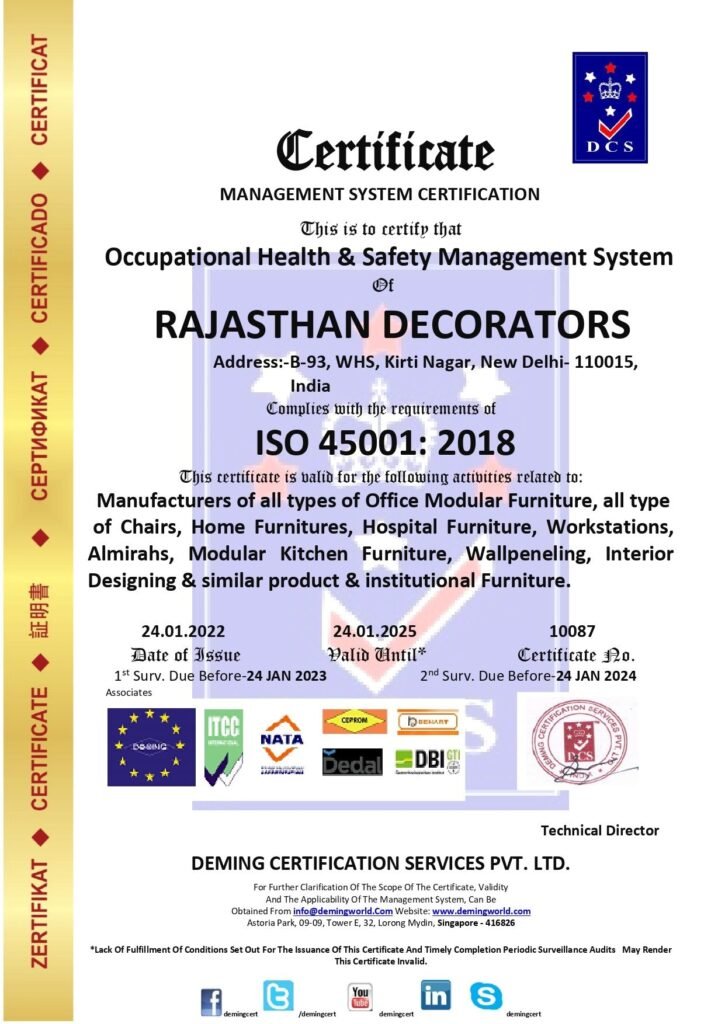
The company’s certification portfolio, according to the information provided, included ISO 14001:2015 Environmental Management System and ISO 45001:2018 Occupational Health & Safety Management System, in addition to ISO 9001:2015. These systems addressed areas that were closely connected with the organization’s everyday activities.
The introduction of environmental management brought a new perspective to the business. Furniture and interior activities can involve the use of different materials, packaging, energy, transportation, finishing processes, and waste streams. An environmental management system provides a structured way to identify relevant environmental aspects, establish controls, monitor performance, and encourage continual improvement.
For Rajasthan Decorators, environmental responsibility could therefore become part of management planning rather than being treated as a separate activity. The organization could consider how resources were used, how waste was handled, and where improvements could be introduced within its applicable operations.
The ISO 14001:2015 framework also encouraged awareness among employees. Environmental management is more effective when people understand how everyday actions influence organizational performance. Simple practices such as responsible material handling, organized storage, appropriate waste segregation, efficient resource use, and awareness of environmental requirements can become part of an organizational culture when they are supported by management systems.
The addition of ISO 45001:2018 introduced another important dimension: occupational health and safety.
Furniture manufacturing, assembly, handling, transportation, installation, and interior work can involve different workplace activities and associated hazards. Employees may work with equipment, tools, furniture components, electrical systems, lifting activities, installation materials, and customer-site conditions. A systematic safety-management approach helps organizations identify applicable hazards and establish appropriate controls.
For Rajasthan Decorators, occupational health and safety could therefore become integrated with planning and operational management. Employee awareness, workplace controls, training, communication, incident reporting, emergency preparedness, and continual improvement can all contribute to a stronger safety culture.
The promoter’s role became increasingly important as these systems developed. Leadership in a management-system environment involves more than approving documents. Management needs to communicate the importance of quality, environmental responsibility, and safety while providing appropriate resources for implementation.
The promoter could also use management reviews to understand organizational performance and identify areas requiring attention. This creates a cycle in which planning leads to implementation, implementation leads to monitoring, and monitoring creates opportunities for improvement.
The integration of multiple management systems could also help avoid viewing each certification as an isolated activity. Quality, environment, and safety often intersect in practical business operations.
For example, effective material management can influence product quality, environmental performance, and workplace safety simultaneously. Proper storage can protect materials from damage, reduce unnecessary waste, and improve workplace organization. Similarly, well-planned production and installation processes can support quality while reducing risks to employees and customers.
This integrated perspective was especially relevant to Rajasthan Decorators because of the diversity of its product and service portfolio. Office workstations, modular kitchens, hospital furniture, institutional furniture, chairs, almirahs, and interior projects all require different forms of planning, but they can be managed within a common organizational framework.
The company’s movement beyond ISO 9001:2015 therefore represented a broader understanding of what professional business management could involve.
The certification journey also strengthened the organization’s ability to communicate its management-system commitments. Credentials can provide customers and stakeholders with documented evidence that an organization has undergone an assessment against specified requirements within the applicable certification scope. However, the continuing value of certification depends on maintaining the systems and using them effectively.
For Rajasthan Decorators, this meant that the focus needed to remain on implementation rather than simply displaying certificates.
The organization could use audits, inspections, reviews, customer feedback, employee suggestions, corrective actions, and performance monitoring to identify areas for improvement. These activities could gradually contribute to greater organizational discipline.
The supplied records indicate that the certification cycle associated with these credentials began with an issue date in 2022 and a stated validity date in 2025. This period represented an important stage in Rajasthan Decorators’ documented management-system journey.
The promoter’s growth story consequently became broader than the growth of a furniture business alone. It became a story of developing systems around people, products, customers, environmental considerations, and workplace safety.
By expanding beyond quality, Rajasthan Decorators established a foundation for the next stage of development—one in which its furniture and interior solutions could be considered not only in terms of appearance and functionality but also through the perspectives of ergonomics, user experience, environmental responsibility, occupational safety, and professional management.
The journey demonstrated an important organizational principle: sustainable development requires attention to the complete system in which a product is designed, produced, delivered, installed, and used.
#QualityManagementSystem
Chapter 4 – Furniture as a Complete Customer Experience
As Rajasthan Decorators continued developing its management systems, the organization increasingly viewed furniture and interior solutions as more than individual products. Every chair, workstation, modular kitchen, almirah, office desk, hospital furniture item, or wall-paneling project formed part of a larger customer experience. This perspective became particularly important as the company continued serving different categories of customers from its location at B-93, WHS, Kirti Nagar, New Delhi – 110015.
The furniture industry combines functionality, design, materials, craftsmanship, engineering, installation, and service. A product may look attractive, but customers also expect it to perform according to its intended application. An office workstation must support practical working requirements. A chair needs to provide appropriate functionality and comfort for its intended use. A modular kitchen needs to make effective use of available space while providing suitable storage and accessibility. Institutional and hospital furniture can have specific functional requirements that need careful attention.
This variety made customer-requirement management an important part of Rajasthan Decorators’ quality journey.
The ISO 9001:2015 Quality Management System provided a framework for focusing on customer requirements throughout the process. Instead of beginning with production alone, the organization could place greater emphasis on understanding what the customer actually needed before the work commenced.
For customized furniture and interior projects, this could involve discussions about measurements, layouts, materials, finishes, colors, functional requirements, installation conditions, timelines, and other project-specific expectations. Proper understanding at the beginning can help reduce confusion later in the project.
Design became another important part of the customer experience. Interior designing and furniture are closely connected because the final solution must fit within the physical and functional environment in which it will be used.
For an office, furniture may need to accommodate employees, computers, storage requirements, meeting areas, circulation spaces, and organizational workflows. In a home, furniture and modular kitchens may need to reflect available space and the customer’s practical requirements. In institutions and hospitals, furniture can have different operational needs.
Rajasthan Decorators’ broad scope enabled the organization to work across these different applications.
The promoter’s role in this environment was to encourage a culture in which customer expectations were treated as an important input to planning. A successful project depends on communication between customers and the organization. Questions need to be clarified, requirements recorded, designs reviewed, and changes controlled where applicable.
Once requirements were established, the next challenge was ensuring that the agreed solution was executed consistently.
This connected customer satisfaction directly with internal processes. Procurement needed to obtain appropriate materials. Production or preparation activities needed to follow applicable specifications. Quality checks needed to verify the finished work. Delivery and installation needed coordination. Finally, customer feedback could provide information about the overall experience.
The management system provided a framework for connecting these stages.
Rajasthan Decorators’ product range also encouraged the organization to think about standardization while maintaining customization. Models identified in the supplied certification information, including RD-101B, RD-102B, RD-103B, RD-104B, RD-105B, RD-106B, RD-107B, RD-108B, RD-109B, and RD-110B, formed part of the documented product references provided for the certification portfolio.
Product identification can be useful in maintaining consistency because clearly defined models or product references can help connect specifications, records, inspections, and customer requirements.
Another important aspect was the relationship between product quality and installation. Furniture and interior projects do not always end when manufacturing is completed. Proper delivery, assembly, positioning, and installation can influence the customer’s perception and the practical performance of the finished solution.
For Rajasthan Decorators, this meant that customer satisfaction could depend on the complete chain of activities.
The company’s development of environmental and occupational health and safety systems further broadened this customer experience. Customers could increasingly view a supplier not only through the products it delivered but also through how it managed environmental and workplace responsibilities.
The organization’s supplied certification portfolio included BIFMA, AIOTA, and Green Guard certificates, alongside ISO 9001:2015, ISO 14001:2015, and ISO 45001:2018. These credentials addressed different areas within the organization’s broader product and management-system journey.
For the promoter, the accumulation of these certifications represented a growing emphasis on professionalization. Each credential had its own scope and requirements, but collectively they helped create a more structured framework for communicating organizational capabilities.
The most important lesson was that customer satisfaction could not be separated from internal discipline. A company may have skilled employees and creative designers, but consistent customer service also requires organized processes.
Every enquiry, drawing, measurement, purchase, production activity, inspection, delivery, installation, and feedback interaction could contribute to the final customer experience.
This way of thinking transformed quality from a narrow inspection function into an organization-wide responsibility.
Rajasthan Decorators’ journey therefore continued to develop around a central principle: the customer experiences the entire organization, not just the final product.
By strengthening processes and connecting design, production, quality, installation, service, safety, environmental awareness, and customer feedback, the organization could build a more comprehensive approach to furniture and interior solutions.
The promoter’s growth journey was consequently linked with organizational maturity. As the company expanded its management-system perspective, it created a stronger foundation for serving diverse customers while maintaining a consistent focus on quality, functionality, responsibility, and continual improvement.
#FurnitureIndustry
Chapter 5 – Ergonomics and Workplace Design
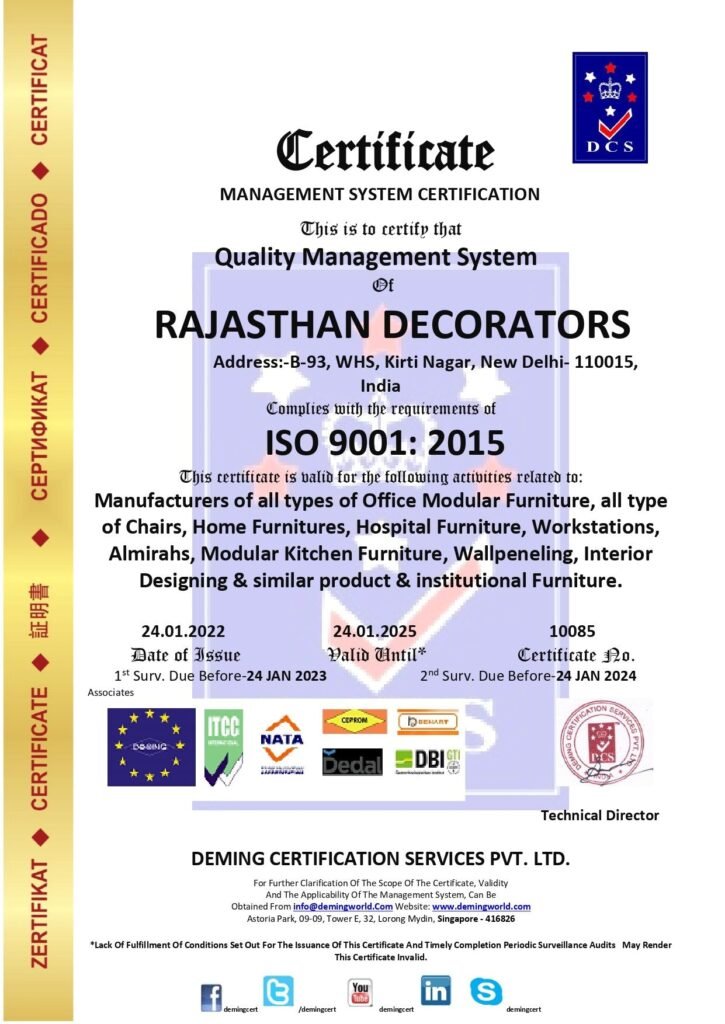
As Rajasthan Decorators continued to strengthen its management systems and expand its furniture and interior solutions, another important area became increasingly significant: ergonomic design and performance. Furniture exists to serve people, and the relationship between a person and the furniture can influence comfort, usability, productivity, accessibility, and the overall experience of a workplace or living environment.
Rajasthan Decorators’ scope specifically includes Ergonomic Design & Performance, reflecting the importance of considering human requirements in the development and application of furniture solutions. This aspect was particularly relevant to the company’s office modular furniture, workstations, chairs, institutional furniture, and other products designed for regular use.
The introduction of ergonomic thinking added another dimension to the organization’s quality journey. ISO 9001:2015 had already encouraged the company to focus on customer requirements and consistent processes. Ergonomic design encouraged the organization to look more closely at the people who would ultimately use the products.
An office workstation, for example, is not simply a desk. It forms part of the environment in which an employee may spend many hours working. Its height, layout, storage arrangement, working area, accessibility, and relationship with other furniture can influence how effectively the space is used.
Similarly, office chairs need to be considered in terms of their intended application and user requirements. A chair may need appropriate dimensions, support, adjustability, stability, and functional characteristics depending on the environment in which it is used.
This human-centered approach could also influence the design of institutional and hospital furniture. These environments often have specific functional requirements because furniture may be used by staff, visitors, patients, students, or other groups with different needs.
For Rajasthan Decorators, ergonomics therefore became part of a larger understanding of quality. A product can be considered from multiple perspectives: appearance, material, durability, functionality, safety, user interaction, and suitability for its intended application.
The company’s work in interior designing and workstations further strengthened the relevance of ergonomic thinking. An interior environment is made up of interconnected elements. Furniture placement, circulation, workspace organization, lighting considerations, storage, and accessibility can all contribute to the usability of the overall space.
The promoter’s role was important in encouraging this broader approach. Business growth in the furniture sector is not only about increasing the number of products sold. It also involves understanding changing customer expectations and developing solutions that address practical problems.
Customers may approach a furniture and interior company because they need to use space more effectively, create a professional office environment, improve storage, organize workstations, develop a modular kitchen, or furnish an institution. In each case, understanding the intended use of the space becomes essential.
Ergonomic considerations can therefore begin during requirement analysis and design rather than being added at the end.
The organization’s certification portfolio, according to the information supplied, also includes an AIOTA Certificate. Within the context of the company’s broader certification journey, this credential forms part of the organization’s emphasis on ergonomic considerations and performance.
Such certifications can support an organization’s efforts to communicate specific capabilities, provided the applicable certificate scope and requirements are clearly understood.
The development of ergonomic awareness could also influence employees within Rajasthan Decorators. Designers, supervisors, sales personnel, installation teams, and other employees may need to understand why dimensions, positioning, accessibility, and intended usage matter.
A well-designed solution begins with asking appropriate questions.
Who will use the furniture? How frequently will it be used? What activities will take place? What space is available? What storage is required? What level of flexibility is needed? Are there special application requirements? How will the furniture interact with other elements of the room?
These questions can help transform a generic furniture product into a solution designed around a particular purpose.
This approach was especially valuable for customized office environments. Workstations could be planned according to available space and organizational requirements, while storage and seating could be considered alongside the overall layout.
The same principle applied to modular kitchens. A kitchen is a working environment where movement, storage, preparation, cleaning, and accessibility need to work together. Furniture design therefore needs to consider how users will interact with the space.
For the promoter, this represented an important evolution in the company’s identity. Rajasthan Decorators was not simply supplying furniture; its scope allowed it to participate in the creation of functional environments.
The combination of ISO 9001:2015 quality management and ergonomic design principles created an opportunity to connect organizational processes with human-centered product development. Quality could be considered not only in terms of whether a product met specifications but also in terms of whether the solution was appropriate for its intended use.
The company’s broader certification portfolio, including ISO 14001:2015, ISO 45001:2018, BIFMA, AIOTA, and Green Guard, further demonstrated the multidimensional direction of its certification journey.
Each certification had its own specific scope, but together they formed part of a larger story of organizational development.
Rajasthan Decorators’ ergonomic journey therefore represented more than a technical consideration. It reflected a change in perspective—from asking simply, “Can we make this product?” to also asking, “How will this product serve the person who uses it?”
That question placed the customer and end user at the center of design thinking and supported the organization’s continuing effort to combine quality, functionality, design, safety, and responsible business practices.
Through this approach, ergonomics became another building block in Rajasthan Decorators’ continuing journey toward professional furniture and interior solutions.
#ModularFurniture
Chapter 6 – Environmental Responsibility and Green Products
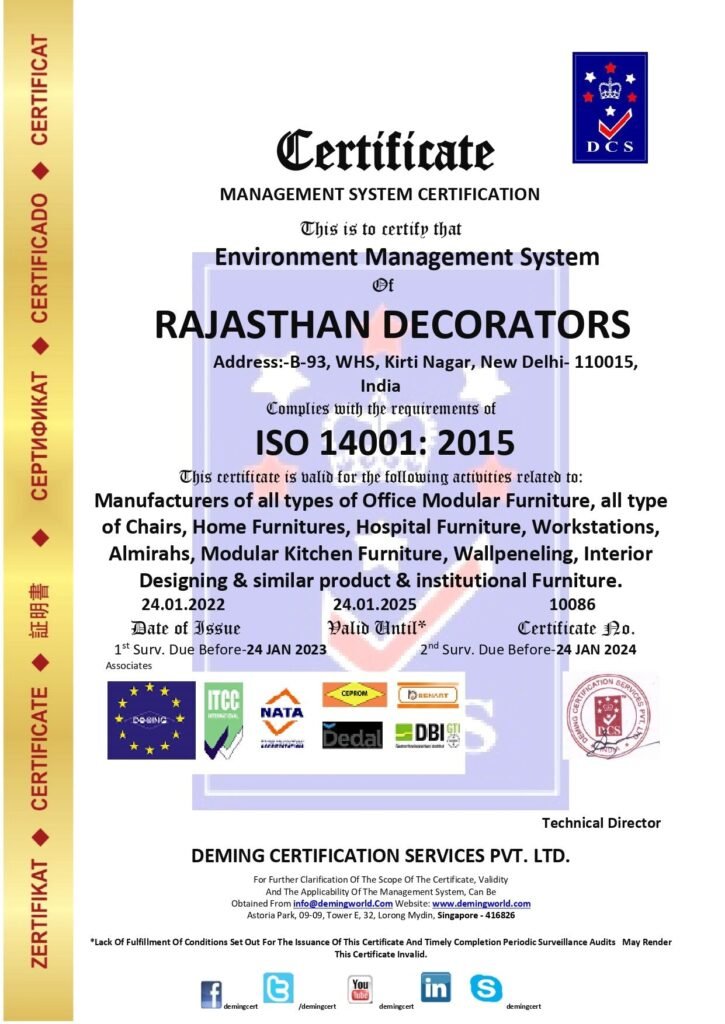
The development of Rajasthan Decorators did not remain limited to quality and ergonomic considerations. As the organization strengthened its management systems, environmental responsibility became another important part of its business journey. The company’s certification portfolio included ISO 14001:2015 Environmental Management System, reflecting the importance given to systematic environmental management within its broader organizational framework.
For a furniture and interior solutions company, environmental considerations can arise throughout the life cycle of a project. The organization may work with furniture boards, hardware, fittings, upholstery, packaging materials, finishing materials, electrical accessories, and other inputs. Production, transportation, storage, installation, and project completion can also involve the use of resources and the generation of waste.
The ISO 14001:2015 framework provided Rajasthan Decorators with a structured way to consider these activities from an environmental-management perspective. Instead of treating environmental responsibility as a separate initiative, it could be connected with regular planning, operational controls, monitoring, documentation, and continual improvement.
This was an important step in the company’s development because environmental performance increasingly forms part of how organizations evaluate their suppliers and business partners. Corporate offices, institutions, architects, interior professionals, and other customers may consider several factors when selecting furniture and interior solution providers. Product quality remains important, but environmental awareness and responsible management can also influence procurement expectations.
For Rajasthan Decorators, environmental management created an opportunity to examine how resources were used within its applicable activities.
Material utilization is one area where careful planning can contribute to efficiency. Furniture projects frequently require accurate measurements and design calculations. Better planning can help reduce unnecessary material consumption and avoid mistakes that could result in rework. Similarly, appropriate storage practices can help protect materials from damage and reduce avoidable losses.
Waste management is another important consideration. Furniture and interior activities can produce different types of waste depending on the project, including packaging materials, material off-cuts, damaged components, and other operational waste. A systematic environmental approach encourages organizations to identify applicable waste streams and establish appropriate controls.
Employee awareness also plays an important role. Environmental management cannot depend entirely on management instructions. Employees involved in design, procurement, production, storage, transportation, installation, and administration can all contribute to responsible resource use.
Simple operational practices can become meaningful when they are implemented consistently. Organized storage, appropriate material handling, prevention of unnecessary damage, responsible disposal practices, and awareness of environmental requirements can support the overall management system.
The promoter’s role was therefore not limited to obtaining an environmental certificate. Leadership was important in creating a culture where environmental considerations became part of decision-making.
The organization’s supplied certification portfolio also includes a Green Guard Certificate. This credential formed part of Rajasthan Decorators’ broader product and environmental positioning. Green-related certification can be particularly relevant in furniture and interior environments because customers may have an interest in products associated with indoor environmental considerations, subject to the specific scope and requirements of the certificate.
The combination of ISO 14001:2015 and the Green Guard credential added another dimension to the company’s development.
Environmental responsibility could also be considered during product and interior design. A well-planned design may improve space utilization, reduce unnecessary material requirements, and support efficient installation. When designers understand both customer requirements and environmental considerations, they can contribute to more responsible project planning.
For office furniture and workstations, these considerations could become part of larger workplace projects. Corporate customers may require furniture solutions that fit within broader organizational sustainability objectives. Institutional and hospital projects can similarly involve detailed specifications and procurement requirements.
Rajasthan Decorators’ broad product scope created opportunities to address these diverse expectations.
The promoter’s growth journey therefore began to reflect a more comprehensive understanding of business responsibility. Quality, ergonomics, environmental management, and customer satisfaction could no longer be viewed as completely separate subjects. They could be connected through the organization’s overall management system.
For example, reducing material waste can support environmental objectives while also improving resource efficiency. Preventing damage during storage can reduce waste and protect product quality. Proper workplace organization can support environmental practices while also contributing to safer operations.
This interconnected approach was consistent with the broader management-system journey that Rajasthan Decorators was developing.
The supplied certification information records an issue date of 2022 and validity through 2025 for the certification cycle. During such a certification period, maintaining the system requires continuing attention to implementation, monitoring, review, and improvement.
Certification therefore became a continuing management responsibility rather than a one-time achievement.
For the organization, environmental management also represented an opportunity to strengthen its professional identity. Customers could see that Rajasthan Decorators’ business scope extended beyond conventional furniture supply and included consideration of broader management practices.
The company’s portfolio of ISO 9001:2015, ISO 14001:2015, ISO 45001:2018, BIFMA, AIOTA, and Green Guard credentials represented different aspects of its organizational and product-related journey. Each credential had its own requirements and scope, but together they demonstrated the company’s effort to address multiple dimensions of performance.
The environmental chapter of Rajasthan Decorators’ story therefore illustrates an important principle: responsible growth requires organizations to consider how their operations affect resources, employees, customers, and the surrounding environment.
By integrating environmental awareness into its management approach, Rajasthan Decorators could build upon the foundation established by ISO 9001:2015 and move toward a broader model of responsible furniture and interior business management.
The journey continued with the understanding that quality is important, but quality combined with responsible resource management can create a more comprehensive foundation for long-term organizational development.
#InteriorDesign
Chapter 7 – Safety as a Business Responsibility
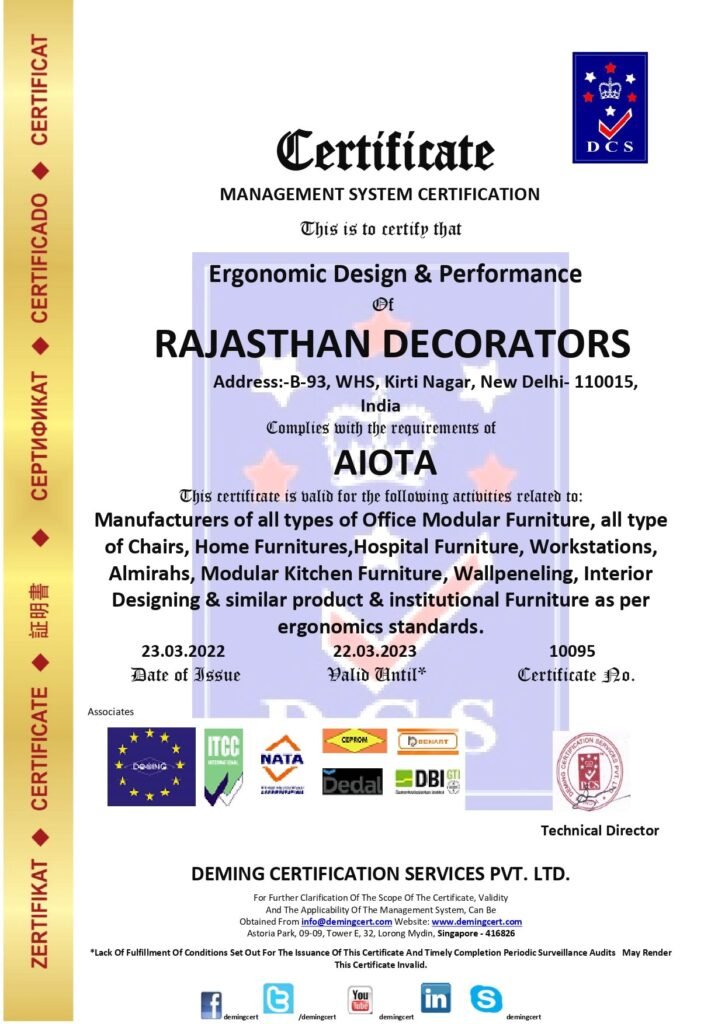
As Rajasthan Decorators continued to develop its management systems, occupational health and safety became another important part of the organization’s growth journey. The company’s scope covers furniture manufacturing and related activities involving office modular furniture, home furniture, modular kitchens, institutional furniture, hospital furniture, chairs, almirahs, workstations, wall paneling, and interior designing. These activities involve people, materials, equipment, tools, transportation, assembly, and installation, making workplace safety an important management consideration.
The introduction of ISO 45001:2018 Occupational Health & Safety Management System represented a further development beyond the quality-management foundation established through ISO 9001:2015. While ISO 9001 focuses primarily on quality and customer requirements, ISO 45001 provides a framework for managing occupational health and safety risks and improving workplace safety performance.
For Rajasthan Decorators, this approach encouraged the organization to view safety as an integral part of operations rather than as a separate responsibility.
Furniture-related activities can involve several stages. Materials may need to be unloaded and stored, components may be moved between work areas, furniture may be assembled, products may require transportation, and installation teams may work at customer locations. Interior projects can introduce additional site-specific considerations.
A systematic safety-management approach begins with understanding these activities and identifying applicable hazards.
Employees are an important part of this process. A safety-management system becomes meaningful when employees understand the risks associated with their work and know the procedures and controls applicable to their responsibilities. Training, communication, awareness, supervision, emergency preparedness, incident reporting, and continual improvement can all contribute to developing a stronger safety culture.
The promoter’s role was particularly significant in this stage of Rajasthan Decorators’ development. Leadership commitment helps establish the importance of safety throughout the organization. When management communicates clear expectations and provides appropriate resources, employees are more likely to understand that safety is a fundamental part of professional work.
Safety can also be connected with quality and productivity. A well-organized workplace can support smoother operations while reducing unnecessary disruption. Clear work instructions, organized material storage, appropriate handling practices, and controlled processes can benefit multiple areas simultaneously.
The relationship between safety and furniture installation is especially relevant. Installation teams may work in offices, homes, institutions, hospitals, and other customer environments. Each location may have different conditions, access arrangements, working spaces, and operational requirements. Planning the work before beginning installation can help employees understand the conditions under which the work will be performed.
The organization’s broader management-system approach provided a framework for considering these issues systematically.
Another important element was emergency preparedness. Organizations need to consider how they would respond to applicable emergency situations and how employees would be informed about appropriate procedures. Periodic awareness and review can help ensure that emergency arrangements remain relevant to organizational activities.
Incident and near-miss information can also provide opportunities for improvement. Instead of treating an incident only as an isolated event, a management system can encourage organizations to examine underlying causes and determine whether preventive or corrective measures are appropriate.
For Rajasthan Decorators, this continual-improvement philosophy connected occupational safety with the same systematic thinking that had been established through ISO 9001:2015.
The company’s certification portfolio also included ISO 14001:2015 Environmental Management System, creating an opportunity to consider environmental and safety issues together where their operational controls overlap.
For example, organized material storage can help protect products, reduce waste, and improve workplace conditions. Responsible handling of materials can support product quality while also reducing avoidable risks. Good housekeeping can similarly contribute to both operational efficiency and workplace safety.
This integrated perspective was useful because management systems are most effective when they support actual business processes rather than operating as independent administrative exercises.
The promoter’s development journey therefore involved creating a culture in which quality, safety, environmental responsibility, and customer satisfaction could work together.
The supplied certification information records ISO 45001:2018 among Rajasthan Decorators’ certifications, with the certification cycle identified as having an issue date in 2022 and validity through 2025. This documented milestone represented an important stage in the organization’s broader management-system development.
However, certification itself was only one part of the journey. Maintaining a safety-management system requires continuing implementation. Employees need appropriate awareness, hazards and risks need to be reviewed, controls need to remain effective, and management needs to evaluate performance.
For Rajasthan Decorators, this meant that safety could become part of the organization’s everyday operating philosophy.
The company’s diverse product and service scope made this particularly relevant. Office furniture, home furniture, hospital furniture, institutional furniture, workstations, chairs, almirahs, modular kitchens, and interior projects may each present different operational circumstances. A structured system allows applicable risks and controls to be considered according to the work being performed.
The result was a broader understanding of organizational responsibility. The company’s growth was not simply about delivering more furniture or completing more interior projects. It was also about creating processes through which work could be planned and performed responsibly.
The promoter’s leadership, employee participation, management review, operational controls, training, and continual improvement all became important elements of this development.
Rajasthan Decorators’ safety journey therefore strengthened the principle that people are an essential part of quality. A successful organization needs to consider not only what it delivers to customers but also how its employees and project teams perform the work.
Through the integration of ISO 45001:2018 with its existing quality and environmental-management framework, Rajasthan Decorators continued building a more systematic foundation for professional growth and responsible business operations.
#ISO14001
Chapter 8 – Recognition Through Multiple Certifications
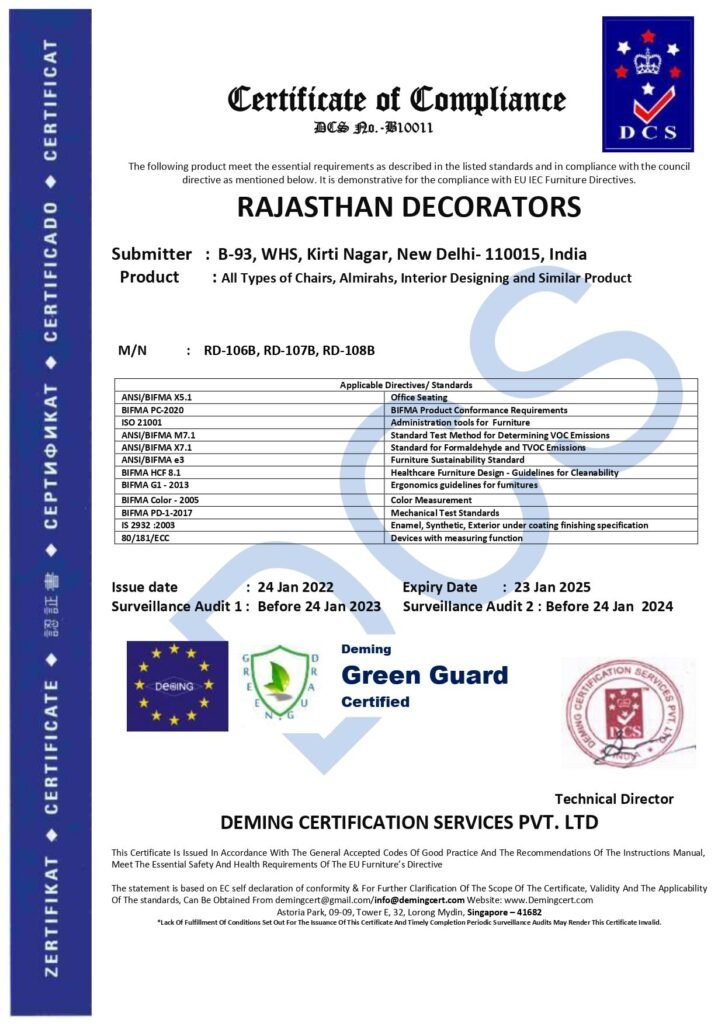
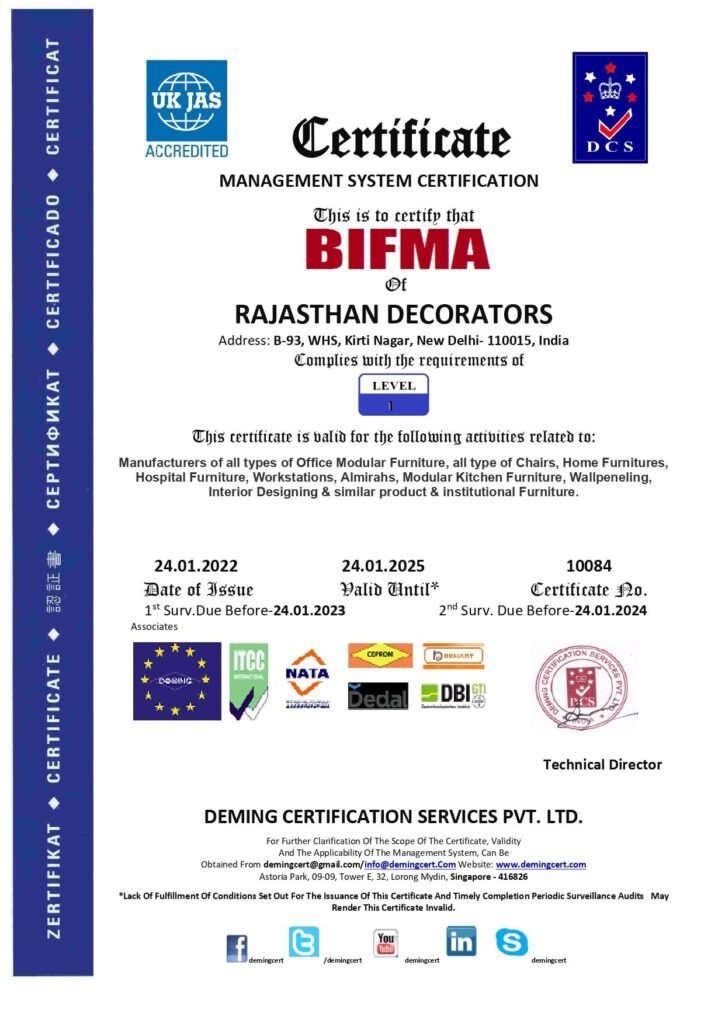
The journey of Rajasthan Decorators from a quality-focused furniture organization toward a broader management-system framework reached another important stage as the company developed a portfolio of certifications and credentials covering different aspects of its operations and products. According to the information provided, the organization’s certification portfolio included ISO 9001:2015, BIFMA Certificate, ISO 14001:2015, ISO 45001:2018, AIOTA Certificate, and Green Guard Certificate.
Each certification represented a particular area of organizational or product-related requirements. Together, they reflected the company’s effort to establish a broader approach to quality, environmental responsibility, occupational health and safety, ergonomic design, and furniture-related performance.
The foundation of this journey was the ISO 9001:2015 Quality Management System. Quality management provided the organizational structure through which customer requirements, processes, responsibilities, documentation, monitoring, corrective action, and continual improvement could be addressed.
For a company such as Rajasthan Decorators, this foundation was particularly relevant because its scope covered many categories of furniture and interior solutions. Office modular furniture, home furniture, modular kitchens, institutional furniture, hospital furniture, chairs, almirahs, workstations, wall paneling, and interior designing can each involve different requirements. A common quality-management framework can help bring consistency to these diverse activities.
The BIFMA Certificate added a furniture-industry dimension to the company’s certification portfolio. BIFMA-related standards and certifications are associated with furniture performance and applicable product requirements. For an organization working extensively in office and institutional furniture, product-related standards can provide an additional reference point for design, testing, and performance expectations, depending on the specific certification scope.
The inclusion of BIFMA in Rajasthan Decorators’ portfolio therefore represented another aspect of the company’s development within the furniture sector.
The environmental dimension was represented by ISO 14001:2015. Environmental management encouraged the organization to consider applicable environmental aspects of its operations, including resource use, waste management, operational controls, and continual improvement.
This became increasingly relevant as environmental considerations gained importance in business procurement and interior projects. Organizations seeking furniture suppliers may have requirements concerning environmental management and product-related environmental characteristics.
The Green Guard Certificate included in Rajasthan Decorators’ supplied certification information added another green-related dimension. Such certification can be relevant to indoor-environment considerations and product characteristics, depending on the exact certification and applicable product scope.
For the company, this provided another way of demonstrating its engagement with requirements extending beyond conventional furniture production.
The ISO 45001:2018 Occupational Health & Safety Management System addressed another essential organizational responsibility. The furniture and interior sector involves employees and installation teams working across various activities and environments. A systematic occupational health and safety framework encourages identification of applicable hazards, risk controls, employee awareness, training, emergency preparedness, and continual improvement.
The AIOTA Certificate also formed part of the supplied certification portfolio and was associated with the organization’s focus on ergonomic design and performance.
Ergonomics is particularly significant in workplace furniture. Workstations, chairs, desks, and other office products are ultimately used by people, often for extended periods. Considering human interaction with furniture can contribute to more functional and user-oriented solutions.
For Rajasthan Decorators, the combination of these credentials created a broader organizational narrative.
The promoter could communicate that the company’s development was not centered on one dimension of performance. Instead, the organization was building capabilities around quality management, furniture-related requirements, environmental management, occupational safety, ergonomic considerations, and green-product expectations.
At the same time, each certification needed to be understood within its own defined scope. A certificate provides evidence of conformity with the requirements applicable to that particular certification and scope; it should not automatically be interpreted as guaranteeing every characteristic of every product or service.
This distinction was important for responsible communication.
The certification journey also influenced the organization internally. Multiple management systems require coordination. Employees may need awareness of different procedures and responsibilities. Management may need to review objectives, audit findings, customer feedback, operational performance, safety matters, and environmental issues.
The promoter’s leadership therefore became increasingly important in maintaining alignment between certifications and actual business practices.
The product references supplied for the certification portfolio included RD-101B, RD-102B, RD-103B, RD-104B, RD-105B, RD-106B, RD-107B, RD-108B, RD-109B, and RD-110B. Such references can assist with product identification and documentation when properly connected to the applicable certification scope.
The organization’s certification journey also created an opportunity to strengthen its market presentation. When customers evaluate furniture and interior solution providers, they may examine product capabilities, project experience, management practices, quality systems, and applicable certifications.
For Rajasthan Decorators, a documented portfolio could therefore become part of its professional communication with customers and stakeholders.
However, the deeper value of certification remained internal. A certificate displayed on a wall has limited value if the associated system is not implemented. The real development occurs when employees follow processes, management reviews performance, problems are investigated, corrective actions are implemented, and improvements become part of everyday work.
The 2022–2025 certification period supplied for Rajasthan Decorators represented such an opportunity for continued implementation and improvement.
For the promoter, the multiple-certification journey could therefore be seen as an organizational transformation. The company’s identity increasingly included not only furniture and interior design but also systematic management, responsible operations, product performance, ergonomic thinking, environmental awareness, and occupational safety.
The journey demonstrated that business growth can involve developing the organization itself—not merely increasing the number of products or projects.
Rajasthan Decorators’ certification portfolio became one visible expression of this development. Behind each credential stood the larger challenge of maintaining processes and translating documented requirements into practical working methods.
The story of this stage was therefore about recognition supported by systems. Certifications provided formal milestones, while continual implementation, employee participation, customer focus, and management commitment provided the foundation for lasting organizational development.
#ISO45001
Chapter 9 – From Certification to Sustainable Growth
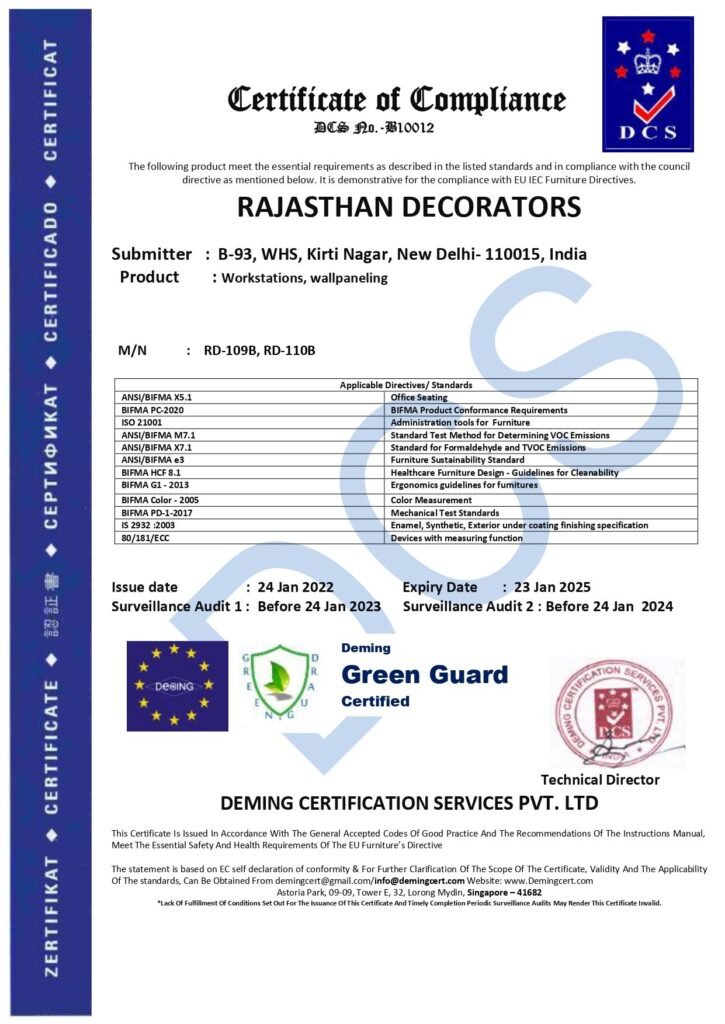
The certification journey of Rajasthan Decorators reached an important stage when quality management, environmental responsibility, occupational health and safety, ergonomics, and product-related requirements began to operate as interconnected elements of the organization’s broader business framework. The certification information provided records an issue date in 2022 and validity through 2025, covering a portfolio that included ISO 9001:2015, ISO 14001:2015, ISO 45001:2018, BIFMA, AIOTA, and Green Guard credentials.
For Rajasthan Decorators, certification could serve as a foundation for disciplined organizational growth. However, the real significance of a management system lies in how it is maintained and applied after certification. A certificate can demonstrate conformity within a defined scope, while continued improvement depends on the organization’s people, processes, leadership, monitoring, and response to changing requirements.
The company’s wide scope of work made this continual approach particularly relevant. Rajasthan Decorators operates across office modular furniture, home furniture, modular kitchen furniture, institutional furniture, hospital furniture, chairs, almirahs, workstations, wall paneling, interior designing, and similar products. Such diversity requires the organization to manage different customer requirements while maintaining consistency in its fundamental processes.
Customer relationships became an important part of this process.
Every project could provide useful information about customer expectations. Feedback regarding design, material, dimensions, finishing, delivery, installation, functionality, or service could be reviewed to identify opportunities for improvement. Positive feedback could help reinforce effective practices, while complaints or nonconformities could provide valuable information about areas requiring corrective action.
The ISO 9001:2015 approach encouraged Rajasthan Decorators to consider these inputs systematically.
For the promoter, this meant that growth involved more than obtaining new orders. It also involved strengthening the organization’s ability to execute existing and future projects reliably. A business becomes more structured when responsibilities are clear, processes are documented where necessary, performance is monitored, and improvement actions are followed through.
Supplier management was another area connected with sustainable organizational development. Furniture quality depends partly on the consistency of purchased materials and components. Establishing appropriate purchasing controls and evaluating suppliers can help reduce variations that might otherwise affect production or final product quality.
Better planning can also contribute to efficiency. Accurate project requirements, appropriate material planning, clear specifications, and coordination between design and execution can help reduce unnecessary rework. In an interior project, changes or errors can affect multiple stages, making early requirement clarification particularly valuable.
The environmental-management system added another perspective to these activities. Efficient use of materials and resources can have both operational and environmental implications. Reducing unnecessary waste, preventing material damage, and improving resource management can support environmental objectives while also contributing to efficient business operations.
Similarly, occupational health and safety became connected with daily operational discipline. Safe material handling, workplace organization, employee awareness, appropriate controls, and project planning can support employees while contributing to smoother operations.
Ergonomic thinking added a customer-focused dimension. Rajasthan Decorators’ inclusion of Ergonomic Design & Performance in its scope emphasized the relationship between furniture and its users.
Office furniture and workstations are particularly relevant because people may interact with them for extended periods. Design decisions concerning dimensions, arrangement, usability, accessibility, and functionality can influence how effectively a workplace environment serves its intended purpose.
The promoter’s growth journey therefore increasingly involved balancing several objectives at the same time: meeting customer requirements, maintaining product quality, managing resources responsibly, protecting employees, and developing functional furniture solutions.
The product references supplied for the certification information—RD-101B through RD-110B—also formed part of the documented product/model information associated with the certification journey. Clear product identification can support traceability and organized documentation when appropriately linked to specifications and certification requirements.
The broader certification portfolio could also support professional communication with customers. Organizations often evaluate suppliers based on several factors, including capabilities, management systems, product requirements, and documented credentials. Rajasthan Decorators could present its applicable certifications as evidence of conformity within their respective scopes.
At the same time, sustainable growth required the organization to ensure that certifications remained connected with actual practices.
Audits, management reviews, inspections, employee suggestions, customer feedback, corrective actions, and performance monitoring can all contribute to this process. These activities help management identify whether systems are working as intended and where further improvement may be needed.
The company’s journey therefore demonstrates an important distinction between certification and continual improvement. Certification represents a formal milestone, while continual improvement is an ongoing organizational activity.
For Rajasthan Decorators, the period beginning in 2022 provided an opportunity to embed management-system thinking into the company’s day-to-day operations. The stated validity through 2025 marked a defined period during which the organization could maintain, review, and improve its systems within the applicable certification arrangements.
The promoter’s role remained central throughout this process. Leadership could influence whether employees viewed procedures as administrative requirements or as tools that genuinely supported their work. When processes are practical and understood, they can help employees perform their responsibilities more consistently.
This approach could also support organizational learning. A recurring problem can become an opportunity to improve a procedure. Customer feedback can inspire a design adjustment. Supplier performance can lead to revised purchasing controls. An internal audit finding can encourage better documentation or training. A safety observation can lead to improved workplace controls.
In this way, small improvements can accumulate over time.
Rajasthan Decorators’ growth story was therefore not simply about the certificates obtained during the 2022–2025 period. It was about using the principles behind those certifications to strengthen the organization.
From quality management to environmental responsibility, from occupational safety to ergonomics, and from furniture performance to customer satisfaction, each area contributed to a broader understanding of responsible business development.
The promoter’s journey consequently became one of building organizational capability.
The central lesson of this chapter is that sustainable growth is supported by systems that learn, adapt, and improve. For Rajasthan Decorators, certification provided a structured platform, but the continuing commitment to customers, employees, processes, products, and improvement remained the foundation on which future development could be built.
#ErgonomicDesign
Chapter 10 – A Continuing Journey of Improvement
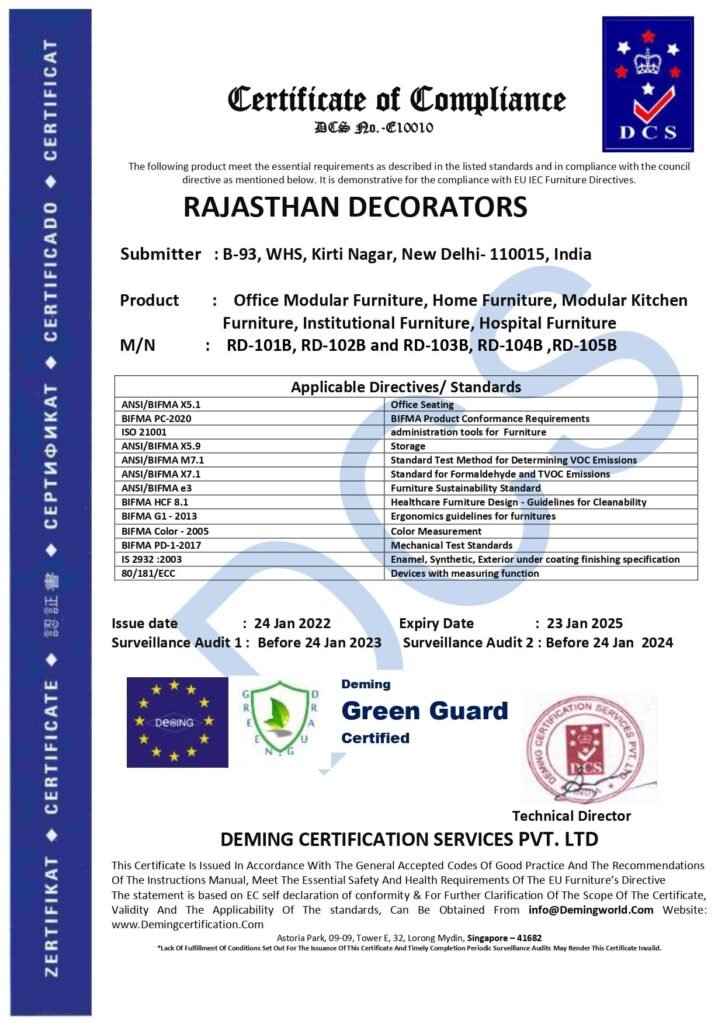
The story of Rajasthan Decorators is ultimately a story of organizational development through quality, structured management, responsible operations, and continuous improvement. From its location at B-93, WHS, Kirti Nagar, New Delhi – 110015, India, the organization has developed a broad scope covering office modular furniture, home furniture, modular kitchen furniture, institutional furniture, hospital furniture, chairs, almirahs, interior designing, workstations, wall paneling, and similar products.
The journey gained an important milestone with the implementation and certification of the ISO 9001:2015 Quality Management System. For Rajasthan Decorators, this provided a structured framework for managing customer requirements, processes, responsibilities, documentation, monitoring, corrective actions, and continual improvement.
The certification journey subsequently expanded beyond quality. The supplied certification portfolio includes BIFMA, ISO 14001:2015, ISO 45001:2018, AIOTA, and Green Guard certificates. These credentials represented different aspects of the organization’s broader approach, including furniture-related requirements, environmental management, occupational health and safety, ergonomic design and performance, and green-related product considerations.
The certification information supplied for the organization records an issue date in 2022 and validity through 2025. The associated product/model references include RD-101B, RD-102B, RD-103B, RD-104B, RD-105B, RD-106B, RD-107B, RD-108B, RD-109B, and RD-110B.
These milestones became part of the organization’s professional development story.
However, the most important lesson from the journey is that certification should be viewed as a continuing process rather than a final destination. A management system creates value when it is implemented consistently and used to improve organizational performance.
For Rajasthan Decorators, continual improvement could involve many different activities. Customer feedback can identify opportunities to improve products and services. Internal audits can highlight process gaps. Management reviews can help leadership evaluate objectives and performance. Employee suggestions can reveal practical improvements that may not be visible through formal inspections alone.
Supplier performance can also provide valuable information. Consistent materials and components are important for furniture manufacturing and interior projects. Reviewing supplier performance and maintaining appropriate purchasing controls can help support product consistency.
The organization’s broad product range creates another opportunity for learning. Experiences gained from office furniture projects may provide useful knowledge for future workstation projects. Lessons from modular kitchen installations can contribute to improved planning for similar projects. Institutional and hospital furniture requirements can encourage greater attention to application-specific customer needs.
In this way, every project can become a source of organizational knowledge.
Ergonomics remains another important area of development. Rajasthan Decorators’ scope includes Ergonomic Design & Performance, making human-centered design an important part of its product and service approach. Furniture ultimately exists to serve users, and the usability of workstations, chairs, storage systems, and other products depends on how effectively they respond to their intended application.
Environmental management also remains relevant. Through the ISO 14001:2015 framework and the supplied Green Guard Certificate, environmental considerations form part of the company’s broader certification journey. Responsible material use, waste management, resource efficiency, and awareness can contribute to a more systematic approach to environmental performance within the applicable scope.
Similarly, ISO 45001:2018 reinforces the importance of occupational health and safety. Employees and installation teams are central to the company’s operations, and their awareness and participation are essential to maintaining effective safety practices.
The promoter’s role connects all these areas.
Leadership is responsible for creating direction and supporting a culture in which quality, safety, environmental responsibility, and customer focus are taken seriously. The promoter’s growth journey can therefore be understood as a transition from managing individual business activities to developing an organization capable of managing interconnected systems.
This organizational maturity can also strengthen communication with customers. When customers understand the company’s capabilities, product scope, management systems, and applicable certifications, they can make more informed decisions about whether the organization meets their particular requirements.
At the same time, responsible communication requires that each certificate be presented according to its actual scope. Certification provides evidence relating to specified requirements and does not automatically mean that every product or service possesses every possible characteristic.
This distinction is important for maintaining transparency and trust.
Looking beyond the stated certification period, Rajasthan Decorators’ future development can continue through the same principles that shaped its earlier journey: customer focus, process discipline, employee involvement, innovation, monitoring, and continual improvement.
The furniture and interior-design sector continues to evolve. Customers may seek new workplace concepts, flexible furniture, improved space utilization, ergonomic solutions, sustainable materials, customized designs, and efficient project execution. Organizations that systematically listen to customers and learn from their operations can adapt their processes accordingly.
For Rajasthan Decorators, this creates opportunities to build on the management-system foundation established during its certification journey.
The company’s story also demonstrates that growth is multidimensional. Growth can involve expanding product capabilities, improving processes, developing employees, strengthening customer relationships, increasing operational consistency, and establishing stronger systems.
Financial or numerical business growth cannot be attributed to certification alone without supporting evidence. However, certification can provide a framework within which an organization can organize its processes and pursue continual improvement.
For the promoter, this distinction is important. The objective is not simply to collect certificates but to make the systems behind those certificates part of the organization’s culture.
The journey that began with ISO 9001:2015 therefore continues through quality awareness, environmental responsibility, occupational safety, ergonomic design, product performance, and customer-focused service.
Rajasthan Decorators’ certification story can be summarized through one central idea:
Quality creates the foundation, systems create consistency, people create performance, and continual improvement creates the pathway for future development.
From its Kirti Nagar base, Rajasthan Decorators’ journey represents the evolution of a furniture and interior solutions organization toward a more structured and comprehensive approach to business management.
The certificates mark important milestones, but the lasting achievement lies in the organizational practices developed around them. By continuing to review processes, understand customers, support employees, manage resources responsibly, and improve its products and services, Rajasthan Decorators can continue building upon the foundation established through its quality-management journey.
The story therefore does not truly end with Chapter 10. The stated certification period may have concluded in 2025, but organizational improvement is continuous. Every new project, customer requirement, employee suggestion, audit observation, design challenge, and operational lesson can become another step in the company’s continuing journey.
The future remains an opportunity to transform experience into knowledge, knowledge into better processes, and better processes into consistently delivered furniture and interior solutions.
That is the enduring principle behind Rajasthan Decorators’ journey: certification is a milestone, while continual improvement is the journey.
#BusinessGrowth
#OfficeFurnitureSolutions #SustainableFurniture #WorkplaceDesign #FurnitureQuality #ModularInteriorSolutions
Take the Next Step Today
Don’t wait to enhance your business’s quality and efficiency. Partner with Mayu Group Global and experience the transformation that comes with expert consultancy and training. Contact us today to learn more about how we can help you achieve your business goals. Reach out via phone at
+91-9322728183, visit our website at www.mayugroup.com, or email us at investor@mayugroup.com Let us be your guide on the journey to excellence and innovation.