Ashok Sreedhar Of M/S High-Volt Electricals Pvt. Ltd.
- Ashok Sreedhar Of M/S High-Volt Electricals Pvt. Ltd.
- Chapter 1 — The Beginning of a Quality-Driven Journey
- Chapter 2 — Building a Culture of Technical Discipline
- Chapter 3 — Strengthening Welding Competence and Process Control
- Chapter 4 — From Certification to Customer Confidence
- Chapter 5 — Developing a Stronger Foundation for Growth
- Chapter 6 — Continual Improvement and Organizational Learning
- Chapter 7 — Strengthening Professional Credibility
- Chapter 8 — Expanding Opportunities Through Quality Awareness
- Chapter 9 — Leadership, People, and the Human Side of Quality
- Chapter 10 — A Continuing Journey of Quality and Growth
- Take the Next Step Today

Chapter 1 — The Beginning of a Quality-Driven Journey
At J 46-47, MIDC Tarapur, Boisar, Maharashtra, the industrial environment represented more than factories, machines, welding equipment, and production activities. It represented the determination of people and businesses working to build reliable products and services for demanding industrial requirements. Among these organizations was M/S High-Volt Electricals Pvt. Ltd., associated with promoter Ashok Sreedhar, whose journey toward greater quality awareness became an important chapter in the company’s development.
For Ashok Sreedhar, business growth was not simply about increasing the volume of work. It was also about developing confidence in processes, strengthening technical practices, and creating a working environment where quality could become part of everyday operations. As industrial customers increasingly expected consistency, documented procedures, competent personnel, and reliable technical performance, the importance of a structured quality approach became more evident.
The company’s association with quality certification and qualification requirements marked a significant stage in this journey. The certification period beginning in 2022 and continuing through 2024 provided an opportunity to reinforce systematic practices and focus attention on technical competence. The work was connected with Welder Qualification Testing, an area where the skills of individual welders and the suitability of welding procedures can have a direct influence on the quality and reliability of fabricated work.
Welding is a highly skill-dependent activity. Two welds may appear similar to an untrained observer, yet their quality can depend on numerous factors, including welding parameters, materials, preparation, technique, equipment, and the competence of the person performing the operation. For an organization working in an industrial environment, controlling these variables becomes essential.
This was particularly relevant to the requirements associated with EN 15085-2:2020, together with ISO 15614-1 for welding procedure qualification and ISO 9606-2:2004 for welder qualification involving aluminium and its alloys. These technical references helped establish a framework in which welding competence and procedure control could be approached systematically rather than informally.
For Ashok Sreedhar, this emphasis on qualification represented more than a certificate on paper. It created an opportunity to develop greater awareness among employees and technical personnel about the importance of following approved methods and maintaining consistency. A quality-oriented system encouraged the organization to consider not only whether a task had been completed, but also whether it had been performed according to defined requirements.
The certification journey also contributed to a change in mindset. Earlier, quality could easily be viewed as something checked after work was completed. A more systematic approach encouraged quality to become part of the process itself. Preparation, competence, documentation, inspection, testing, corrective action, and continual improvement could all be connected within a common framework.
For a promoter such as Ashok Sreedhar, implementing such practices required leadership. Quality systems are not sustained by documents alone. They require people to understand why procedures exist and how those procedures protect both the organization and its customers. Leadership therefore became important in communicating expectations, encouraging discipline, and supporting employees in adopting better working methods.
The company’s location in MIDC Tarapur, Boisar also placed it within an important industrial ecosystem. In such an environment, businesses interact with customers, suppliers, contractors, technical professionals, inspection agencies, and other industrial organizations. Reputation and technical credibility can therefore become valuable assets. A structured certification and qualification approach provided a way to demonstrate that the company took quality requirements seriously.
The 2022 issue date represented a formal milestone. It gave the organization an opportunity to reflect on its existing practices and strengthen areas requiring greater control. The certification remained valid until 2024, creating a defined period during which the organization could apply, monitor, and improve its quality-related practices.
For the people involved in welding operations, qualification requirements could encourage greater attention to personal competence. For management, they could create stronger awareness of process control. For customers, documented qualification could provide greater confidence that technical requirements were being addressed systematically.
The journey was therefore not simply about achieving recognition. It was about creating a culture in which quality could support long-term organizational development. Ashok Sreedhar’s role as promoter was central to this transformation because sustainable quality improvement requires management commitment as well as technical implementation.
The story of M/S High-Volt Electricals Pvt. Ltd. consequently began with a simple but important principle: industrial growth becomes more sustainable when quality is built into the way work is performed. The certification and welder qualification journey provided the foundation for this approach. It encouraged the company to look beyond immediate production requirements and consider competence, consistency, documentation, customer expectations, and continual improvement.
As the organization moved forward, the lessons learned during this period could influence its approach to future projects and technical challenges. The certification period of 2022–2024 became an important reference point in the company’s development—a period in which quality awareness, welding competence, and systematic working practices gained greater significance.
For Ashok Sreedhar and his team, this was only the beginning. The next stage would involve translating certification requirements into everyday practices, strengthening employee participation, improving technical discipline, and demonstrating that a quality-focused organization could create lasting value for its customers and its own future growth.
#HighVoltElectricals
Chapter 2 — Building a Culture of Technical Discipline
After the certification milestone, the next important phase for M/S High-Volt Electricals Pvt. Ltd. was turning quality principles into everyday working habits. For promoter Ashok Sreedhar, certification was not intended to remain a document kept in an office file. Its greater value came from applying systematic practices to actual technical activities and helping employees understand the importance of consistency.
The company’s involvement in Welder Qualification Testing made technical discipline particularly important. Welding is influenced by many variables, and reliable results depend upon competent personnel, appropriate procedures, suitable materials, correctly maintained equipment, and controlled working conditions. A structured quality approach helped bring these elements together.
One of the first changes encouraged by a quality-oriented system was greater attention to documentation. Welding-related activities could no longer depend entirely on individual memory or informal instructions. Procedures, qualification records, inspection findings, and supporting documents became important references. This created a clearer trail of information and helped employees understand what was expected from them.
Ashok Sreedhar understood that documentation should support the work rather than become an unnecessary burden. When records are properly organized, they can help an organization identify what was done, who performed it, which procedure was followed, and whether the required checks were completed. Such information can become valuable whenever a customer asks for evidence of compliance or when management needs to investigate a technical issue.
The requirements associated with EN 15085-2:2020 further emphasized the importance of controlled welding practices in relevant railway-related applications. The company’s work also involved ISO 15614-1, concerning welding procedure qualification, and ISO 9606-2:2004, concerning qualification testing of welders for aluminium and its alloys. These references reinforced the principle that welding competence should be demonstrated through defined qualification processes rather than assumed solely from experience.
For welders, this created a stronger sense of professional responsibility. Practical experience remained valuable, but formal qualification provided an additional mechanism for demonstrating competence. Employees could better appreciate that their individual skills contributed directly to the reputation of the organization.
Management also had an important role in developing this culture. Ashok Sreedhar had to ensure that employees understood the purpose behind the requirements. Simply telling people to complete forms or follow procedures would not necessarily create meaningful improvement. Employees needed to see how disciplined working methods could reduce errors, improve repeatability, and strengthen customer confidence.
Training and communication therefore became important elements of the journey. Workers could discuss practical challenges, clarify requirements, and understand why particular controls were necessary. Over time, this type of interaction could reduce dependence on assumptions and encourage employees to seek clarification whenever technical conditions differed from established procedures.
Another important aspect was the control of equipment and working resources. Welding quality depends not only on the operator but also on the condition and suitability of equipment. Regular attention to machines, accessories, measuring devices, and other resources supports a more controlled working environment. A quality system encourages organizations to consider these requirements systematically.
The same philosophy could be applied to materials. Correct identification and handling of materials are important when different grades or specifications are involved. When documentation and identification are properly maintained, the possibility of confusion can be reduced. This is particularly significant when welding requirements depend on specific material characteristics.
Inspection also became part of the broader quality mindset. Instead of considering inspection as an activity performed only at the end, the organization could use checks throughout the process. Early identification of deviations can help prevent problems from progressing further. This approach supports the principle of prevention rather than relying exclusively on final detection.
For Ashok Sreedhar, these changes represented organizational maturity. Growth is not measured only by the number of projects or customers an organization serves. It can also be reflected in the organization’s ability to control its processes, respond to problems, maintain records, and learn from experience.
The certification period from 2022 to 2024 provided a structured timeframe in which these practices could be strengthened. During this period, the company had an opportunity to review its methods and identify areas where greater consistency could be achieved. Each audit, inspection, training activity, and review could contribute to a cycle of learning.
Employees gradually became more conscious of the connection between their daily work and the company’s larger objectives. A welder’s preparation, technique, adherence to procedure, and attention to detail were no longer viewed simply as individual responsibilities. They became part of the organization’s overall quality performance.
This change in thinking could also influence customer relationships. Industrial customers generally require confidence that suppliers can deliver work consistently. When an organization can demonstrate defined procedures, qualified personnel, and controlled processes, communication with customers becomes more structured. Questions can be answered with documented information rather than informal assurances.
The journey also encouraged a more preventive approach to problems. If a nonconformity or deviation occurred, the organization could examine its underlying cause rather than simply correcting the immediate defect. This helped create opportunities for continual improvement.
By developing technical discipline, M/S High-Volt Electricals Pvt. Ltd. strengthened an important foundation for future growth. The company began to see quality not as a separate department or certification requirement, but as a responsibility shared across management, technical personnel, welders, inspectors, and support staff.
For Ashok Sreedhar, this was an important realization. A certificate can mark an achievement, but a quality culture is built through repeated actions. Every correctly followed procedure, every properly maintained record, every qualified welder, and every lesson learned from an inspection contributes to that culture.
Thus, the second stage of the company’s journey was about transforming formal requirements into practical discipline. The foundation established through certification and qualification created a pathway toward greater consistency, stronger technical awareness, and more organized operations—preparing M/S High-Volt Electricals Pvt. Ltd. for the challenges of the next phase of its development.
#AshokSreedhar
Chapter 3 — Strengthening Welding Competence and Process Control
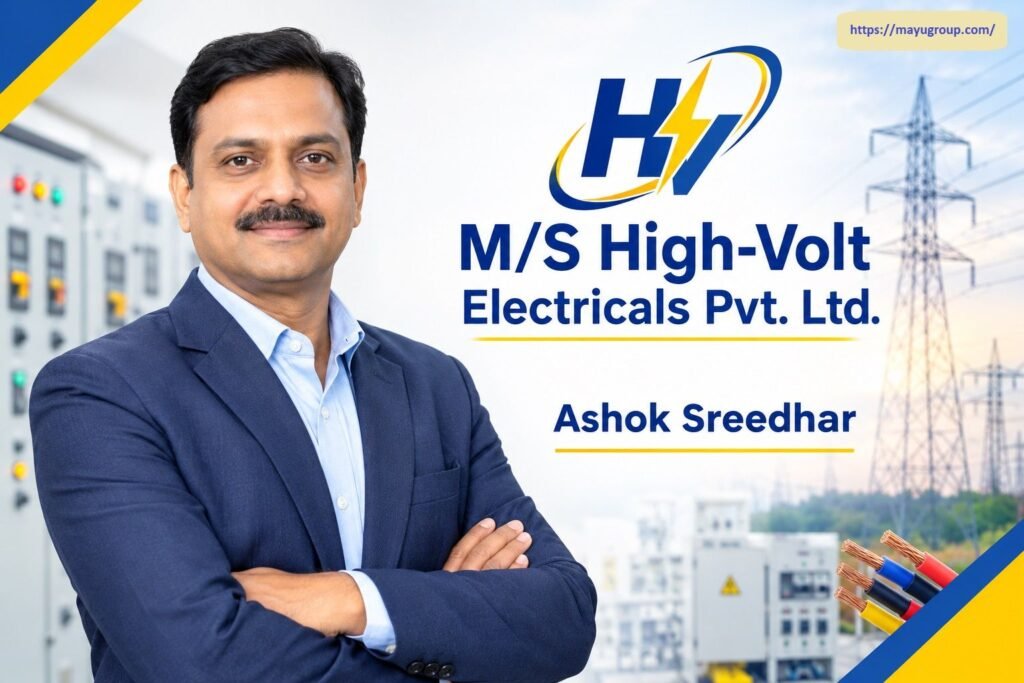
As M/S High-Volt Electricals Pvt. Ltd. progressed through its quality journey, the attention of promoter Ashok Sreedhar increasingly moved toward one of the most important foundations of the organization’s technical work: competence. A quality management approach could establish procedures and records, but the effectiveness of those systems ultimately depended on people who understood the requirements and could apply them correctly.
For an organization involved in Welder Qualification Testing, this connection was especially significant. Welding is both a technical process and a skilled practical activity. Equipment, materials, procedures, parameters, preparation, and operator technique must work together to achieve consistent results. The certification and qualification journey therefore encouraged a more structured approach to determining, demonstrating, and maintaining competence.
The company’s work was associated with EN 15085-2:2020, along with ISO 15614-1 and ISO 9606-2:2004. These standards and requirements provided a technical framework for welding procedure and welder qualification. Rather than relying only on past experience, the organization could place greater emphasis on documented qualification and controlled practices.
For Ashok Sreedhar, this represented an opportunity to build confidence within the workforce. Experienced welders brought valuable practical knowledge, but formal qualification helped establish a common basis for demonstrating competence. Employees could better understand that technical skill must be supported by consistency, discipline, and adherence to specified requirements.
The qualification process itself could become a learning experience. Preparing for a qualification test required attention to material identification, joint preparation, welding technique, equipment settings, and procedural requirements. It encouraged welders to concentrate on details that might otherwise be overlooked during routine work.
Once employees understood the importance of these details, the benefits could extend beyond the qualification test. The same discipline could influence normal production and fabrication activities. A welder who develops a habit of checking requirements before beginning work is more likely to recognize potential deviations before they become larger problems.
Management also became more conscious of the importance of matching personnel competence with assigned responsibilities. A structured system encouraged the organization to consider whether individuals had the necessary knowledge, training, experience, and qualification for particular activities. This could help reduce the risk of assigning technically demanding work without adequate competence.
Another important area was procedure control. Welding procedures provide a consistent method for performing specific welding activities. When a procedure is appropriately established and followed, workers have a defined reference instead of depending entirely on personal interpretation. This can be especially valuable when multiple employees perform similar operations.
For the company, procedure control also supported communication. Supervisors, welders, inspectors, and management could refer to documented requirements when discussing a particular job. Instead of relying on verbal instructions alone, technical information could be communicated through controlled documents and records.
This approach strengthened accountability. When responsibilities and requirements are clearly established, employees can better understand their role in maintaining quality. Supervisors can monitor implementation, while management can review whether the system is functioning effectively.
Equipment and measurement also received greater attention during this phase. Welding operations require appropriate equipment and supporting resources. Maintaining equipment in suitable condition helps create stable working conditions. Similarly, inspection and measuring resources need appropriate control so that decisions are based on dependable information.
The company could also use records as a source of organizational learning. Qualification documents, inspection findings, corrective actions, and customer feedback can collectively reveal patterns. If recurring issues are identified, management can investigate their causes and introduce preventive measures.
This is where certification began to influence the company’s broader management thinking. Quality was no longer limited to correcting defective work. Instead, the organization could ask why a problem occurred, whether the process allowed the problem to develop, and what could be changed to prevent recurrence.
Ashok Sreedhar’s leadership was important in encouraging this approach. Employees are more likely to accept new systems when management demonstrates that quality requirements are genuinely valued. When leadership participates in reviews, supports training, and provides appropriate resources, employees receive a clear message that quality is an organizational priority.
The certification period of 2022–2024 therefore became a period of consolidation. The company had an opportunity to move from simply meeting documented requirements toward understanding the practical value behind those requirements. Each qualification activity could strengthen technical confidence; each inspection could provide feedback; and each corrective action could become an opportunity to improve.
Customer expectations also played an important role. Industrial customers need confidence that suppliers understand their technical responsibilities. A company capable of demonstrating qualified personnel and controlled welding practices can communicate its capabilities more clearly. Documentation can provide evidence that important requirements have been considered and addressed.
The company’s location in MIDC Tarapur also provided a practical environment in which technical competence could support professional relationships. Industrial businesses frequently depend upon reliability, responsiveness, and technical understanding. A reputation for organized work can become an important part of long-term business development.
For employees, the developing quality culture encouraged a greater sense of ownership. A welder was not simply someone completing an assigned operation. The welder became an important contributor to the organization’s overall quality performance. Similarly, supervisors, inspectors, and management each had responsibilities within the larger system.
The result was a gradual strengthening of process control. The company could increasingly connect competence, procedures, inspection, documentation, and improvement into one coordinated approach. This helped create a stronger foundation for future projects.
For Ashok Sreedhar, the lesson was clear: sustainable growth depends not only on opportunities but also on the organization’s ability to deliver consistently. Certification could open the door to greater confidence, but competent people and disciplined processes were required to walk through it.
Chapter 3 therefore marked an important stage in the story of M/S High-Volt Electricals Pvt. Ltd. The organization continued building its technical capabilities, strengthening welding competence, and developing more systematic process control. These efforts established the groundwork for the next phase—using quality information, customer expectations, and continual improvement to make the organization more responsive and dependable.
#ISO9001Certification
Chapter 4 — From Certification to Customer Confidence
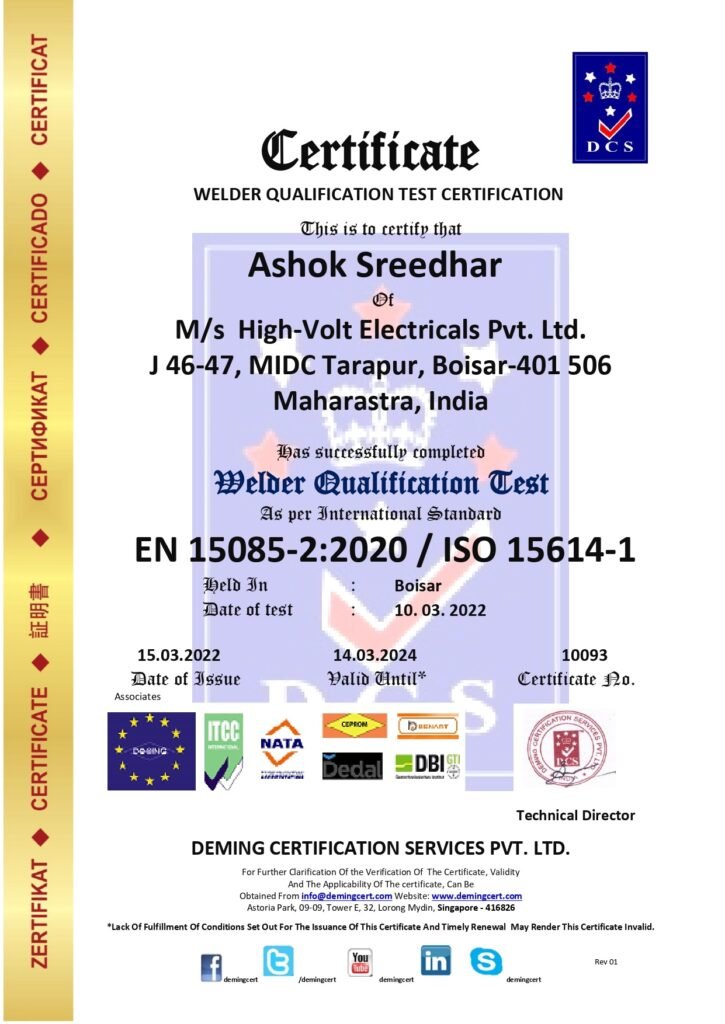
As M/S High-Volt Electricals Pvt. Ltd. continued its journey after the certification milestone, promoter Ashok Sreedhar increasingly recognized that the true value of a quality system could be seen in the confidence it created among employees, customers, and business partners. The certification period from 2022 to 2024 provided an opportunity to strengthen the organization’s working practices and demonstrate a more systematic approach to technical activities.
For a company associated with Welder Qualification Testing, customer confidence was closely connected with technical competence. Customers seeking welding-related services need assurance that the organization understands applicable requirements and can maintain consistency in its work. The company’s association with EN 15085-2:2020, ISO 15614-1, and ISO 9606-2:2004 provided an important technical framework for this responsibility.
Ashok Sreedhar understood that certification alone could not guarantee customer satisfaction. A certificate could demonstrate that a defined system or qualification requirement had been addressed, but customer confidence ultimately depended on the organization’s day-to-day performance. This encouraged the company to focus on practical implementation rather than treating certification as a one-time achievement.
One of the important improvements was greater attention to customer requirements before work began. Understanding specifications, scope, technical expectations, documentation requirements, and qualification needs helped reduce ambiguity. When requirements are understood at the beginning of an assignment, teams have a clearer basis for planning and execution.
Communication also became an important part of the company’s quality culture. Technical work often involves interaction between customers, supervisors, welders, inspectors, and management. Clear communication helps ensure that information is transferred accurately. When technical instructions or requirements change, the relevant personnel need to be informed so that the change can be implemented correctly.
Documentation supported this process. Properly maintained records allowed the organization to demonstrate what had been completed and what checks had been performed. For customers, such records could provide useful evidence of technical control. For management, they could provide information for review and future improvement.
The company also developed greater awareness of traceability. In welding-related work, knowing the relevant material, procedure, personnel qualification, inspection information, and supporting documentation can be important. Traceability helps connect the finished activity with the records that support it.
For employees, this created a stronger sense of responsibility. Every stage of work contributed to the final customer experience. A missing record, incorrect identification, incomplete inspection, or deviation from an approved process could affect the reliability of the overall result. Consequently, employees were encouraged to see quality as a shared responsibility.
Ashok Sreedhar’s leadership helped reinforce this understanding. Rather than limiting quality responsibilities to a particular individual or department, management could encourage participation across the organization. Supervisors could monitor processes, technical staff could verify requirements, welders could maintain disciplined working methods, and administrative personnel could support accurate documentation.
Another important element was customer feedback. Feedback provided an opportunity to understand whether the organization’s services were meeting expectations. Positive feedback could confirm that established practices were effective, while complaints or observations could identify areas requiring attention.
A mature quality approach does not treat complaints simply as negative events. They can become sources of information. When an issue is raised, the organization can investigate what happened, identify the underlying cause, determine corrective action, and monitor whether the solution is effective.
This approach encouraged a culture of continual improvement at M/S High-Volt Electricals Pvt. Ltd. Instead of asking only whether an assignment had been completed, management could ask whether the process could be made more reliable, efficient, or understandable.
Efficiency and quality were also increasingly viewed as complementary objectives. Well-controlled processes can reduce rework, avoid unnecessary repetition, improve planning, and minimize confusion. When employees know what is expected and have access to appropriate resources, work can proceed more smoothly.
The company’s industrial environment at MIDC Tarapur provided a setting in which such improvements could have practical significance. Industrial customers often evaluate suppliers on several factors, including technical capability, responsiveness, documentation, consistency, and professional communication. Developing these areas could support stronger business relationships.
The qualification of welders was another important component of credibility. A qualified welder represents a demonstrated level of competence under specified conditions. Maintaining awareness of qualification requirements helped the organization understand that personnel competence must remain aligned with the work being undertaken.
The connection between ISO 15614-1 and ISO 9606-2:2004 also highlighted the relationship between procedures and people. A suitable welding procedure establishes a controlled method, while welder qualification demonstrates the individual’s ability to perform welding under defined conditions. Together, these concepts reinforce the importance of both process control and human competence.
For Ashok Sreedhar, this was an important stage in the company’s growth story. The organization was not simply collecting certifications or technical references. It was developing a more disciplined business culture in which quality information could support decisions and customer requirements could be handled systematically.
The period from 2022 to 2024 therefore became a valuable learning phase. Employees gained greater familiarity with documentation and qualification requirements. Management developed stronger awareness of process performance. Customers could interact with an organization increasingly focused on structured technical practices.
This did not mean that every challenge disappeared. Industrial work always involves changing requirements, technical difficulties, time pressures, resource considerations, and opportunities for improvement. The value of a quality system lies partly in providing a framework for responding to such challenges in an organized manner.
The company’s journey demonstrated that customer confidence is built gradually. It comes from consistent communication, competent personnel, controlled processes, reliable documentation, and a willingness to learn from experience. Certification can support this process, but the organization’s everyday actions give certification its practical meaning.
By the end of this phase, M/S High-Volt Electricals Pvt. Ltd. had strengthened an important foundation for continued development. Ashok Sreedhar’s emphasis on technical discipline and quality awareness helped connect certification with practical business performance.
The journey was moving beyond compliance toward a broader objective: creating an organization capable of earning confidence through the way it worked. This foundation would become increasingly important as the company sought to strengthen relationships, handle more demanding technical requirements, and continue its journey of professional growth.
#QualityManagement
Chapter 5 — Developing a Stronger Foundation for Growth
As the quality journey of M/S High-Volt Electricals Pvt. Ltd. progressed, promoter Ashok Sreedhar began to view certification not simply as an achievement but as a foundation for developing a more organized and technically conscious company. The period from 2022 to 2024 created an opportunity to strengthen internal practices, improve communication, and establish greater consistency in activities associated with Welder Qualification Testing.
The industrial environment at J 46-47, MIDC Tarapur, Boisar, Maharashtra demanded attention to technical requirements. Businesses operating in such environments frequently have to coordinate people, equipment, materials, documentation, schedules, and customer expectations. A systematic quality approach could help bring these different elements together.
One of the important lessons from the certification journey was the relationship between planning and quality. Work performed without adequate planning can create confusion, delays, or avoidable corrections. By understanding requirements before beginning an assignment, employees could prepare the necessary resources and identify important technical considerations in advance.
For welding-related activities, preparation was particularly important. Materials, joint preparation, welding procedures, personnel qualifications, equipment, and inspection requirements all needed appropriate attention. A structured process encouraged employees to consider these factors rather than treating them as separate or informal activities.
Ashok Sreedhar also recognized that employees were central to the company’s development. Equipment and documentation can support a quality system, but people operate the equipment, interpret instructions, identify problems, and interact with customers. Developing employee awareness was therefore an important part of strengthening the organization.
The company could encourage personnel to understand not only what needed to be done but also why it needed to be done. When employees understand the purpose of a requirement, they are more likely to follow it consistently. This understanding can also help them recognize situations in which clarification or additional technical review is necessary.
Welder qualification became an important example of this principle. A qualification test is not merely an examination. It provides a structured means of demonstrating that a welder can produce acceptable work under specified conditions. The requirements associated with ISO 9606-2:2004 emphasized the importance of demonstrated competence for applicable aluminium welding activities.
Similarly, ISO 15614-1 provided a framework associated with welding procedure qualification. Together with the relevant requirements of EN 15085-2:2020, these references encouraged the organization to think systematically about the relationship between procedures, personnel, and welding performance.
This technical discipline could also contribute to better resource utilization. When processes are planned and controlled, unnecessary rework can potentially be reduced. Rework consumes time, materials, labor, and equipment capacity. Preventing avoidable errors can therefore support both quality objectives and operational efficiency.
Another important area was corrective action. When an issue occurred, employees were encouraged to look beyond the immediate correction. For example, if an error resulted from unclear instructions, insufficient training, incomplete documentation, or inadequate process control, addressing the underlying cause could help prevent recurrence.
This approach encouraged a learning culture. Mistakes and deviations became opportunities to examine processes rather than simply assigning blame. Such a culture can encourage employees to report problems earlier, allowing management to respond before small issues become larger ones.
For Ashok Sreedhar, this represented an important shift in management thinking. Sustainable organizational growth requires the ability to learn. Every project can provide information about what worked well and what could be improved. By reviewing that information, an organization can gradually strengthen its processes.
Customer requirements also continued to influence this development. Customers often expect suppliers to provide clear information and respond professionally to technical questions. A company with organized documentation and defined processes can communicate more effectively.
The company’s certification experience also strengthened awareness of internal accountability. Employees understood that their individual activities could affect the performance of the wider organization. A missing record could create difficulty later. An incorrectly followed procedure could affect quality. A delayed communication could affect a customer’s schedule.
As this awareness developed, teamwork became increasingly important. Quality was not the responsibility of one person. Management, technical personnel, welders, inspectors, and administrative staff each contributed to the overall system.
Regular review and monitoring could help management identify areas requiring improvement. Reviewing records, feedback, inspection results, and process performance provided opportunities to make informed decisions. Rather than waiting for a major problem, the organization could gradually identify smaller weaknesses and address them.
This approach was particularly valuable during the certification period. Maintaining quality requires continuous attention. Procedures may need clarification, employees may require additional training, equipment may need maintenance, and customer expectations may change. A quality system provides a structure through which such changes can be considered.
The journey also helped strengthen the professional identity of the organization. Certification and technical qualification demonstrated an intention to work according to recognized requirements. For Ashok Sreedhar, this could support a business philosophy based on competence, transparency, and disciplined execution.
The growth of a company is rarely the result of a single event. It is generally created through a series of decisions and improvements. For M/S High-Volt Electricals Pvt. Ltd., the certification and qualification journey became one such stage in that development.
The 2022–2024 period provided valuable experience in organizing technical work, strengthening employee awareness, maintaining documentation, and responding to customer expectations. These practices could provide a foundation for future projects and new opportunities.
By this stage, the organization had begun to understand that quality and growth could work together. Quality practices could support efficiency, technical confidence, customer communication, and organizational learning. They could also provide a framework for responding to challenges in a controlled manner.
For Ashok Sreedhar, the most important outcome was therefore not merely the existence of a certificate. It was the gradual development of a stronger organizational mindset. The company was learning to plan more carefully, document more systematically, communicate more clearly, and treat competence as a central part of its technical identity.
This foundation prepared M/S High-Volt Electricals Pvt. Ltd. for the next stage of its journey, where continual improvement, customer relationships, and stronger operational discipline would become increasingly important to the company’s long-term development.
#WelderQualification
Chapter 6 — Continual Improvement and Organizational Learning
The quality journey of M/S High-Volt Electricals Pvt. Ltd. entered another important phase as the organization began to recognize that certification was not the destination of its development. For promoter Ashok Sreedhar, the greater opportunity was to use the experience gained during the certification period from 2022 to 2024 to create a culture of continual improvement.
In an industrial organization, improvement does not always mean introducing expensive machinery or making dramatic changes. Often, meaningful improvement begins with small changes in daily working practices. Better documentation, clearer instructions, improved planning, more effective communication, timely maintenance, and stronger employee awareness can collectively create significant organizational value.
The company’s work related to Welder Qualification Testing made continual improvement particularly relevant. Welding activities involve technical variables that need to be controlled carefully. The requirements associated with EN 15085-2:2020, ISO 15614-1, and ISO 9606-2:2004 encouraged the organization to maintain attention to procedures, competence, and qualification.
Ashok Sreedhar understood that technical requirements could not remain limited to management discussions. They had to reach the people performing the work. Employees needed to understand the significance of following defined procedures and maintaining appropriate records. When this understanding developed, quality became increasingly connected with everyday behavior.
One of the most useful tools in this process was organizational learning. Every completed assignment could provide information. Employees could identify what worked effectively, where delays occurred, which instructions were unclear, and which activities required additional attention. Capturing such lessons could help the company avoid repeating unnecessary difficulties.
For example, if an activity required repeated clarification because technical information was incomplete, management could review how requirements were communicated at the beginning of future assignments. If documentation was difficult to locate, the company could improve its record-management approach. If employees needed additional technical guidance, training could be considered.
This approach transformed problems into learning opportunities.
Corrective action became another important element. When a deviation or nonconformity was identified, simply correcting the immediate issue might solve the short-term problem. However, examining the underlying cause could provide a longer-term solution. Management could ask whether the issue resulted from inadequate training, unclear procedures, insufficient supervision, unsuitable resources, or another process weakness.
Such analysis encouraged prevention. Preventing recurrence is often more valuable than repeatedly correcting the same problem.
For the welding team, this philosophy could encourage greater attention to preparation. Before beginning work, personnel could confirm relevant requirements, materials, equipment, and qualification conditions. Such checks can reduce uncertainty and provide greater control over the operation.
Equipment maintenance also formed part of continual improvement. Reliable equipment supports consistent work. Preventive attention to equipment can help identify problems before they interrupt operations. It also reinforces the broader principle that quality should be built into the process rather than inspected only at the end.
Measurement and inspection activities provided another source of information. Inspection results can indicate whether a process is performing as expected. When results are reviewed systematically, management can identify trends and decide whether additional controls or training are necessary.
Ashok Sreedhar’s role in this process was to encourage an environment where employees could participate in improvement. Workers often have direct knowledge of practical difficulties because they encounter them during everyday operations. Giving employees opportunities to provide suggestions can reveal improvement opportunities that may not be visible from management offices.
Employee participation can also strengthen ownership. When workers see their suggestions being considered and implemented, they can become more engaged with organizational objectives. Quality becomes something they contribute to rather than something imposed upon them.
Customer feedback remained another valuable source of learning. Customers can identify areas where communication, documentation, responsiveness, or technical execution can be improved. Listening carefully to such feedback can help an organization adapt its processes.
The company could also use reviews to examine whether established procedures remained suitable. Industrial requirements can evolve, and organizational experience can reveal opportunities to simplify or strengthen processes. Periodic review helps ensure that the quality system remains practical rather than becoming a collection of outdated documents.
The certification experience also encouraged greater awareness of risk. Before starting an activity, the organization could consider what might go wrong and what controls could reduce that possibility. This preventive mindset supports more reliable operations.
For example, identifying the need for qualified personnel before assigning a welding activity can reduce the possibility of competence-related problems. Ensuring that relevant documentation is available before beginning work can reduce confusion. Confirming equipment readiness can help prevent avoidable interruptions.
These practices may appear simple individually, but together they create a more disciplined organization.
The period from 2022 to 2024 therefore represented a valuable learning cycle for M/S High-Volt Electricals Pvt. Ltd. The company could use certification-related activities, qualification requirements, inspections, feedback, and internal observations to improve its systems.
For Ashok Sreedhar, continual improvement also became connected with long-term growth. A company that learns from experience is better positioned to adapt to changing customer requirements and technical expectations. Growth becomes more sustainable when operational systems grow alongside business opportunities.
The company’s journey demonstrated that quality improvement is not a single project with a fixed completion date. It is a continuing process. Procedures can be reviewed, employees can develop new skills, records can become more organized, and communication can become clearer.
The focus on EN 15085-2:2020, ISO 15614-1, and ISO 9606-2:2004 provided an important technical reference point, while the broader quality approach provided a management framework for learning and improvement.
By this stage, M/S High-Volt Electricals Pvt. Ltd. had moved further from simply seeking certification toward using quality principles as part of its organizational development. Ashok Sreedhar’s leadership helped reinforce the idea that every activity could become an opportunity to learn.
The result was a stronger culture of awareness—one in which employees could recognize the importance of competence, management could use information for decision-making, and the organization could respond to challenges through structured corrective and preventive actions.
This continual improvement mindset would become an important foundation for the company’s future. As the organization continued developing, the ability to learn, adapt, and strengthen its processes could help it remain prepared for new technical requirements and customer expectations.
#WeldingCertification
Chapter 7 — Strengthening Professional Credibility
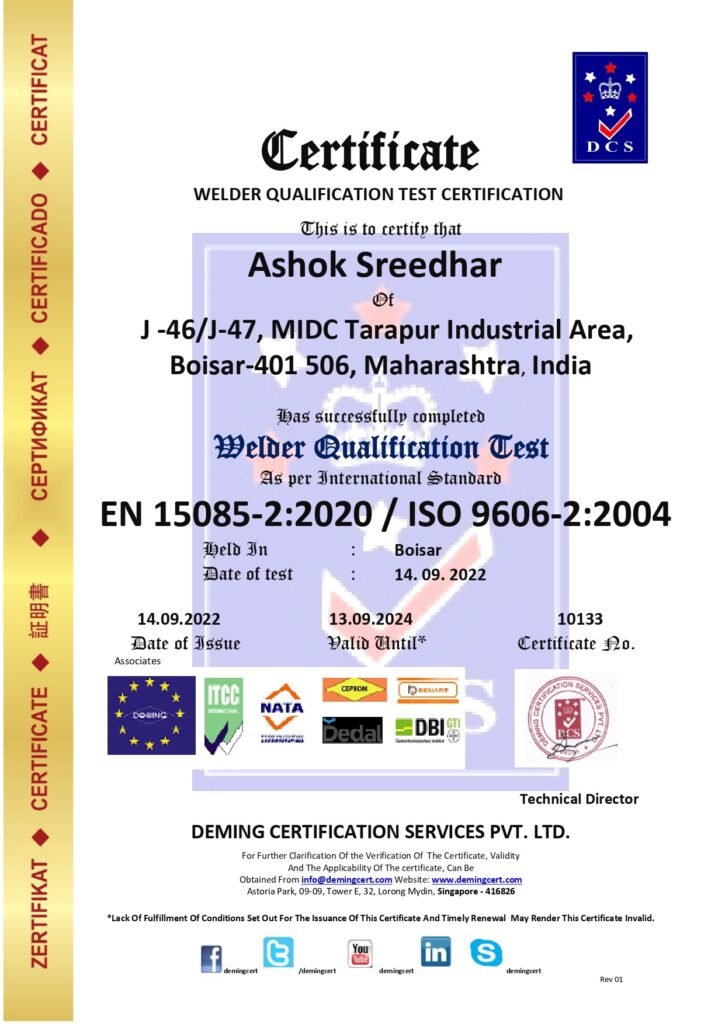
As M/S High-Volt Electricals Pvt. Ltd. continued its development, the quality and qualification journey began to influence not only internal processes but also the professional identity of the organization. For promoter Ashok Sreedhar, the certification period from 2022 to 2024 provided an opportunity to establish stronger confidence in the company’s technical approach and demonstrate a commitment to organized working practices.
In industrial business, professional credibility is built over time. It develops through consistent performance, reliable communication, technical competence, appropriate documentation, and the ability to meet defined requirements. Certification can support this credibility when it is integrated into everyday operations rather than treated merely as a formal achievement.
For M/S High-Volt Electricals Pvt. Ltd., this was particularly relevant because of its involvement in Welder Qualification Testing. Welding activities require practical skill as well as controlled procedures. The company’s association with EN 15085-2:2020, ISO 15614-1, and ISO 9606-2:2004 reinforced the importance of qualified personnel and systematic technical practices.
Ashok Sreedhar understood that customers often look beyond a company’s claims when evaluating technical capability. They may want evidence of competence, qualification, process control, and consistency. Maintaining appropriate records and demonstrating structured working methods could therefore help the organization communicate its capabilities more effectively.
One of the important outcomes of the quality journey was greater confidence in documentation. Documents were not simply administrative records. They could provide evidence of what had been planned, what had been performed, what had been inspected, and what actions had been taken when necessary.
This became particularly useful when discussing technical matters with customers or business partners. Clear records can reduce misunderstandings and allow information to be verified. They can also help new employees understand established processes and responsibilities.
The company also gained greater awareness of the importance of consistency. A customer expects a supplier to maintain similar standards across assignments. If one project is handled carefully while another is managed informally, confidence can be affected. A systematic quality approach encourages organizations to establish repeatable processes.
For welders, consistency meant following defined requirements rather than relying entirely on personal preferences. Experienced personnel may have developed their own working habits, but controlled procedures establish a common technical basis. This helps create greater uniformity across operations.
The qualification requirements associated with ISO 9606-2:2004 highlighted the importance of demonstrated welder competence for applicable aluminium welding activities. Qualification provides a structured means of establishing capability under specified conditions. Maintaining awareness of qualification requirements also helps management make more informed decisions when assigning technical work.
Similarly, ISO 15614-1 reinforced the importance of welding procedure qualification. A procedure establishes a controlled method for achieving the required welding result. When procedures and personnel competence are considered together, the organization has a stronger basis for controlling welding activities.
The relationship between procedures and competence became an important part of the company’s professional approach. It demonstrated that quality depends on both systems and people. A well-written procedure is not sufficient if personnel do not understand or follow it, and a highly skilled worker may still require a defined procedure for specific technical applications.
Training therefore remained important. Employees could be encouraged to strengthen their understanding of technical requirements and organizational procedures. Training also provided an opportunity to communicate changes and reinforce lessons learned from previous work.
Another aspect of professional credibility was responsiveness. Customers value organizations that communicate clearly when requirements change or challenges arise. A quality-focused organization can use its documented processes to assess changes systematically and communicate the implications to relevant personnel.
The company’s location in MIDC Tarapur, Boisar placed it within a busy industrial environment where relationships and reputation can influence opportunities. Building a professional image through disciplined working methods could support long-term interactions with customers and industrial partners.
Ashok Sreedhar’s leadership was therefore important in connecting technical quality with business development. Management decisions regarding training, documentation, equipment, supervision, and process improvement could influence how effectively the organization delivered its services.
Professional credibility also involves transparency. If a requirement cannot be met under existing conditions, recognizing the limitation and addressing it is generally more sustainable than making unsupported assurances. A structured quality system encourages organizations to base decisions on documented information and actual capability.
During the certification period, employees could increasingly appreciate this principle. Quality was not only about passing an inspection. It was about creating a working environment in which requirements were understood before work began and evidence could be provided afterward.
This approach could also improve internal coordination. When departments and individuals work from common information, the possibility of conflicting instructions can be reduced. Technical staff can communicate with administrative personnel more effectively, while management can review performance using available records.
The benefits of professional credibility extend beyond individual projects. A company known for disciplined processes can create a stronger foundation for future opportunities. Customers may be more comfortable discussing technically demanding assignments when they have confidence in the organization’s approach.
However, credibility must be maintained continuously. A certificate issued in 2022 and valid through 2024 represented a defined period of recognition, but the underlying principles of quality remained relevant beyond the validity period. The organization had to continue demonstrating commitment through its actual behavior.
For Ashok Sreedhar, this became one of the most important lessons of the journey. Certification could mark a milestone, but reputation is built through repeated performance. Every properly documented activity, every qualified professional, every carefully executed welding operation, and every responsibly handled customer requirement contributed to the company’s professional standing.
The journey of M/S High-Volt Electricals Pvt. Ltd. therefore entered a stage where technical quality and business credibility became increasingly connected. The company was developing a stronger identity based on competence, process discipline, documentation, and customer-oriented working practices.
By strengthening these areas, the organization created a more reliable foundation for future development. Its experience demonstrated that professional credibility is not created overnight. It grows through continuous attention to quality and through the consistent actions of everyone within the organization.
For Ashok Sreedhar, this was another important step in the company’s growth story: transforming certification and technical qualification into a broader culture of professionalism, responsibility, and dependable performance.
#EN15085
Chapter 8 — Expanding Opportunities Through Quality Awareness
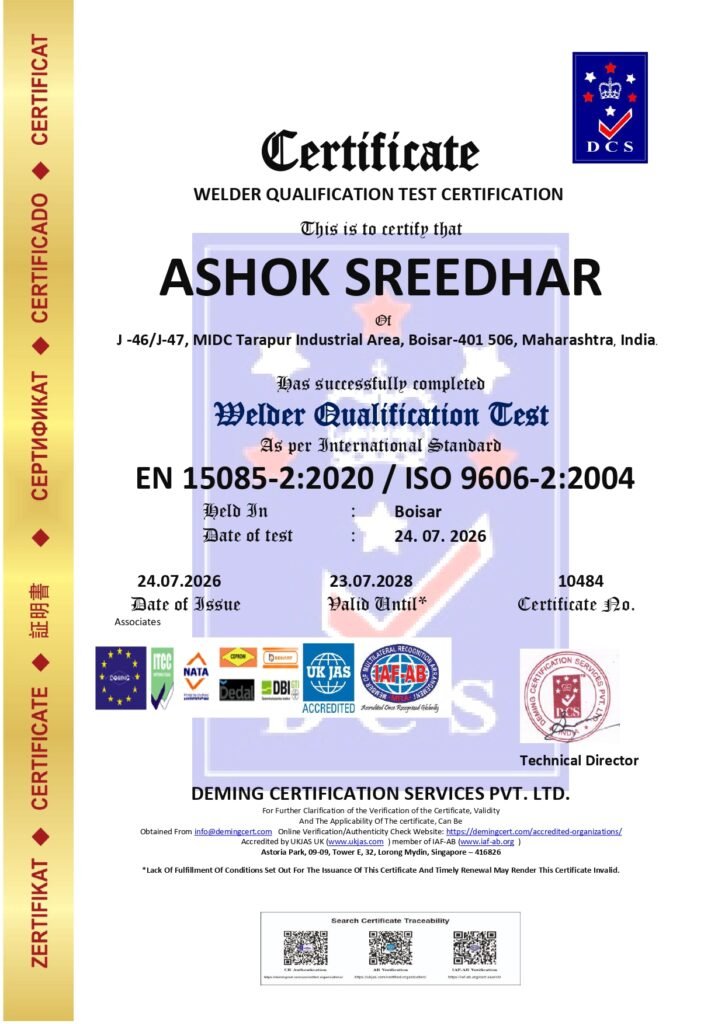
As M/S High-Volt Electricals Pvt. Ltd. continued to build on the experience gained during its certification period, promoter Ashok Sreedhar increasingly recognized that a structured approach to quality could support the company’s readiness for future opportunities. The period from 2022 to 2024 was therefore not only a period of compliance and qualification but also a period of organizational learning.
The company’s involvement in Welder Qualification Testing required close attention to competence, procedures, technical requirements, and documentation. Its work was associated with EN 15085-2:2020, ISO 15614-1, and ISO 9606-2:2004. These requirements encouraged the organization to maintain a disciplined approach to welding-related activities.
As employees became more familiar with quality procedures, they could approach new assignments with greater awareness of what needed to be considered before work started. Planning became increasingly important. Instead of beginning an assignment immediately and addressing requirements later, teams could first examine the technical scope, personnel requirements, materials, equipment, procedures, and inspection needs.
This approach helped create greater preparedness.
For Ashok Sreedhar, preparedness was closely connected with business growth. New opportunities often bring new technical requirements. A company that already has organized systems and competent personnel can assess such requirements more systematically. It can identify what it can perform using existing resources and what additional preparation may be required.
Quality awareness therefore became a business capability.
The company’s experience also encouraged employees to think more carefully about customer expectations. Customers may have different specifications, documentation requirements, schedules, or inspection expectations. Understanding these requirements at the beginning helps avoid misunderstandings later.
Communication became an important part of this process. Technical discussions between customers and company representatives needed to be translated into clear instructions for the people performing the work. Any relevant changes also needed to reach the appropriate personnel.
A structured documentation system could support this communication. When information is properly recorded, employees can refer to it rather than depending entirely on memory. This becomes particularly valuable when several people are involved in an assignment.
The focus on welding qualification also helped strengthen the company’s understanding of human competence. A project may require specific welding skills, and personnel qualifications need to correspond with the work being undertaken. Maintaining awareness of qualification requirements can help management plan resources more effectively.
The principles associated with ISO 9606-2:2004 provided a reference for welder qualification for applicable aluminium welding activities. Meanwhile, ISO 15614-1 addressed welding procedure qualification. Together, these requirements highlighted the relationship between qualified people and controlled processes.
For an organization working with technical customers, this relationship can support confidence in project execution. Customers can have clearer information about how welding activities are controlled and how competence is demonstrated.
The experience gained through certification also encouraged greater attention to risk. Before accepting or starting an assignment, management could consider possible technical challenges. What qualifications were required? Were suitable procedures available? Were necessary resources accessible? Were inspection and testing requirements understood?
Such questions helped move the organization toward preventive thinking.
Risk awareness also supported efficiency. Identifying potential problems early can help reduce interruptions and avoid unnecessary rework. Planning for technical requirements before work begins can save time and resources.
For employees, this approach encouraged greater ownership. Instead of waiting for management to identify every issue, workers could become more proactive in identifying risks and suggesting improvements. This contributed to a stronger quality culture.
Ashok Sreedhar’s leadership remained important in maintaining this environment. Management had to provide the necessary resources and demonstrate that quality expectations were genuine. Employees are more likely to follow procedures when they see management applying the same discipline in decision-making.
The company could also use customer feedback as a source of opportunity. Feedback does not only identify problems. It can reveal changing expectations, emerging requirements, and areas where the organization could improve its services.
This information could support future planning. If customers repeatedly requested particular documentation or technical capabilities, management could consider whether additional training, equipment, or process improvements would be appropriate.
The organization’s industrial location at MIDC Tarapur, Boisar also provided opportunities for interaction with other businesses and technical professionals. In an industrial environment, professional reputation can develop through repeated interactions. Consistency and reliability can help strengthen relationships over time.
However, growth was not viewed simply as an increase in the number of assignments. Ashok Sreedhar’s quality-oriented approach emphasized the importance of sustainable development. Accepting more work without adequate resources or process control could create pressure on quality. Therefore, organizational capacity needed to grow alongside opportunities.
This principle was particularly relevant to technical work. Every additional project could involve new specifications, deadlines, materials, or customer requirements. A company needed sufficient competent personnel, appropriate procedures, and supporting resources to manage such work effectively.
The certification experience provided a framework for considering these factors. Instead of making decisions solely on immediate business considerations, management could also consider technical feasibility and quality risks.
During the 2022–2024 period, the organization therefore strengthened its ability to view quality from a broader perspective. Quality supported technical work, customer communication, employee competence, documentation, risk management, and business preparedness.
The company’s journey demonstrated that certification can become a platform for organizational development when its principles are integrated into daily activities. For Ashok Sreedhar, the objective was not merely to possess a recognized certificate but to build systems that could continue providing value.
The lessons learned could support the organization as it encountered future customers and technical challenges. Employees could carry forward their understanding of procedure control, qualification, inspection, documentation, and continual improvement.
By this stage, M/S High-Volt Electricals Pvt. Ltd. had developed a stronger awareness that quality and opportunity were interconnected. The better an organization understands its processes and capabilities, the more systematically it can evaluate new requirements.
This did not eliminate uncertainty or guarantee business growth, but it created a more organized foundation from which future decisions could be made. For Ashok Sreedhar, that foundation was one of the most meaningful outcomes of the company’s quality journey.
The experience from certification and welder qualification had gradually become part of the company’s organizational knowledge. It strengthened technical awareness, encouraged disciplined planning, and prepared the organization to approach future opportunities with greater clarity and responsibility.
#ISO15614
Chapter 9 — Leadership, People, and the Human Side of Quality
Behind every quality system are people. Documents, procedures, standards, certificates, inspection records, and technical requirements can establish a framework, but their effectiveness ultimately depends on the individuals who understand and implement them. For Ashok Sreedhar, promoter of M/S High-Volt Electricals Pvt. Ltd., this became one of the most important lessons of the organization’s quality journey.
During the certification period from 2022 to 2024, the company had an opportunity to strengthen not only its technical processes but also its people-oriented approach to quality. The organization’s work involving Welder Qualification Testing made human competence particularly significant. Welding requires practical ability, concentration, discipline, and an understanding of defined technical requirements.
The company’s association with EN 15085-2:2020, ISO 15614-1, and ISO 9606-2:2004 reinforced the importance of competent personnel and controlled welding practices. These requirements encouraged management to consider competence as a planned organizational responsibility rather than simply an individual attribute.
Ashok Sreedhar understood that experienced workers were an important source of knowledge. Employees who had spent years working with welding equipment and industrial processes could bring practical understanding that was difficult to replace with documentation alone. At the same time, experience needed to be combined with current requirements, documented procedures, and appropriate qualification.
This created a balanced approach. Practical experience could be respected while systematic training and qualification provided a common technical foundation.
For welders, qualification could also become a source of professional confidence. A formal qualification process gave employees an opportunity to demonstrate their skills under defined conditions. It reinforced the idea that their work was technically important and that their individual competence contributed to the reputation of the organization.
Management could support this development by creating opportunities for training and communication. Employees needed to know about relevant procedures and understand how changes affected their work. When instructions were communicated clearly, employees could perform their responsibilities with greater confidence.
Communication was particularly important when dealing with technical deviations. Workers should feel able to raise questions when conditions differ from expectations. An organization that encourages communication can identify problems earlier than one in which employees hesitate to report difficulties.
Ashok Sreedhar’s leadership therefore involved more than setting targets. It involved establishing an environment in which employees understood the importance of quality and felt responsible for contributing to it.
The quality culture also encouraged teamwork. Welding-related activities often involve more than the welder alone. Supervisors, technical personnel, inspectors, administrative staff, and management may all contribute to planning and execution. If one part of the process fails to communicate effectively, the impact can extend to other stages.
A shared quality culture helped connect these responsibilities.
For example, technical personnel could communicate procedure requirements, supervisors could monitor implementation, welders could follow approved practices, and inspection personnel could verify results. Administrative staff could support documentation and record control. Each role had a place within the wider system.
The company also had an opportunity to strengthen accountability without creating a culture of blame. When a problem occurred, management could focus on understanding why it happened. Was the instruction unclear? Was the employee adequately trained? Was the required information available? Was equipment suitable? Were responsibilities clearly defined?
These questions could lead to constructive corrective action.
Such an approach also encouraged employees to report issues. If workers believed that reporting a problem would automatically result in blame, they might hesitate to communicate. If management treated problems as opportunities to improve processes, employees could become more willing to share information.
This was particularly important for continual improvement. Employees working directly with processes often notice small inefficiencies before management does. Their observations can help identify opportunities to improve workplace organization, documentation, communication, and technical practices.
Ashok Sreedhar could use these observations to strengthen organizational learning. A suggestion from a welder might lead to a clearer instruction. A supervisor’s observation might result in a better planning checklist. An inspector’s finding might encourage additional training. Each contribution could become part of the improvement cycle.
The human side of quality also involved recognizing the importance of discipline. Quality does not depend solely on advanced technology. Simple behaviors such as checking documents before beginning work, confirming material identification, maintaining equipment, recording information accurately, and following approved procedures can have significant effects.
These behaviors become sustainable when they are reinforced consistently.
The certification experience helped create greater awareness of this principle. Employees began to understand that quality was not the responsibility of an external auditor or a quality representative alone. Every person had a role.
For Ashok Sreedhar, leadership meant maintaining this message throughout the organization. Management needed to demonstrate through actions that quality requirements were important even when deadlines or operational pressures existed.
At the same time, quality had to remain practical. Procedures that employees cannot understand or realistically implement may not produce the intended result. Therefore, the organization had an interest in keeping processes clear, useful, and connected to actual work.
The period from 2022 to 2024 provided an opportunity to strengthen this balance. The company could review its procedures, communicate expectations, develop competence, and encourage employee participation.
As this culture developed, employees could begin to see themselves not simply as workers completing assigned tasks but as contributors to the company’s professional reputation. Every successful qualification, correctly executed welding operation, accurate record, and responsibly handled customer requirement contributed to the larger organizational identity.
The role of Ashok Sreedhar was central to this transformation. A promoter’s commitment can influence the priorities of the entire organization. By emphasizing quality, competence, responsibility, and continual improvement, management can create conditions in which employees understand how their work contributes to long-term objectives.
The journey of M/S High-Volt Electricals Pvt. Ltd. therefore demonstrated an important principle: quality is ultimately a human activity. Standards provide requirements, procedures provide guidance, and certificates provide formal recognition, but people turn those elements into actual performance.
For the company, the experience gained through certification and welder qualification became an opportunity to strengthen this human foundation. Employees gained greater awareness of technical responsibilities, management gained better visibility into processes, and the organization developed a more collaborative approach to improvement.
As the company looked toward the future, this people-centered quality culture became one of its most valuable assets. Equipment and procedures could change, customer requirements could evolve, and new projects could introduce unfamiliar challenges. A workforce committed to learning and quality could help the organization respond to those changes in a structured manner.
For Ashok Sreedhar, the journey had therefore become more than a certification story. It had become a story about people learning, processes improving, and an organization gradually building a stronger professional identity through collective responsibility.
#ISO9606
Chapter 10 — A Continuing Journey of Quality and Growth
The journey of Ashok Sreedhar of M/S High-Volt Electricals Pvt. Ltd. through certification, technical qualification, and organizational development represents a story of gradual transformation. Located at J 46-47, MIDC Tarapur, Boisar, Maharashtra, the organization used the certification period from 2022 to 2024 as an opportunity to strengthen its understanding of quality, technical competence, documentation, and systematic working.
The journey began with a recognition that quality needed to become part of everyday operations. The company’s work involving Welder Qualification Testing required attention to competence and process control. Its technical scope was associated with EN 15085-2:2020 / ISO 15614-1 and EN 15085-2:2020 / ISO 9606-2:2004. These requirements provided important references for welding procedure and welder qualification.
For Ashok Sreedhar, the significance of this experience extended beyond the certificate itself. Certification provided a structured opportunity to examine how the company planned work, controlled processes, maintained records, developed employee competence, and responded to customer requirements.
The first major lesson was that quality begins with people. Welders and technical personnel needed appropriate knowledge and competence. Employees had to understand the importance of following defined requirements and recognizing the consequences of deviations. Management, meanwhile, needed to provide resources and create an environment where employees could perform their responsibilities effectively.
The second lesson was the importance of process discipline. Welding activities cannot depend entirely on individual habits. Procedures, qualification requirements, inspection activities, equipment, materials, and documentation need to work together. A systematic process helps create greater consistency and makes it easier to identify areas requiring improvement.
The third lesson involved documentation. Records can provide evidence of completed activities and support traceability. They can also help management understand what happened during a project. When documentation is organized and accessible, it becomes a useful management resource rather than simply an administrative requirement.
The fourth lesson was continual improvement. During the certification period, the organization had opportunities to learn from inspections, customer feedback, employee observations, and corrective actions. Each lesson could be used to strengthen future processes.
These improvements did not necessarily require dramatic changes. Sometimes, improvement came through clearer instructions, better planning, stronger communication, more effective record control, or additional employee awareness. Over time, small improvements could contribute to a stronger organizational culture.
The fifth lesson was the importance of customer confidence. Industrial customers expect suppliers to understand their requirements and maintain appropriate technical controls. A structured approach can help an organization communicate its capabilities more clearly and provide supporting documentation when required.
For Ashok Sreedhar, customer confidence was closely connected with professional responsibility. It was not enough to say that quality was important. The company needed to demonstrate this through its actions, processes, records, and technical practices.
The company’s association with ISO 15614-1 and ISO 9606-2:2004 also reinforced the connection between procedures and personnel. A controlled welding procedure provides a defined method, while welder qualification provides evidence of individual competence under specified conditions. Considering both aspects together helps create a more systematic approach to welding activities.
The relevance of EN 15085-2:2020 further emphasized the importance of controlled welding practices in applicable railway-related contexts. For an organization working within such technical expectations, disciplined process management becomes particularly important.
Another significant outcome was the development of organizational confidence. As employees became more familiar with procedures and qualification requirements, they could approach technical activities with greater awareness. Management could also make decisions using better-organized information.
The certification journey also demonstrated that quality and business development do not have to be separate objectives. A company with organized processes can potentially manage customer requirements more effectively, identify risks earlier, reduce avoidable rework, and improve communication. These capabilities can support sustainable organizational development.
At the same time, the journey showed that certification is not the end of improvement. A certificate has a defined validity period, while the principles of quality remain relevant beyond that period. The experience gained between 2022 and 2024 could therefore continue influencing the organization’s approach to future work.
For Ashok Sreedhar, leadership remained essential. A quality culture must be maintained through consistent management attention. Employees need encouragement to follow procedures, report problems, develop skills, and contribute suggestions. Management must also be prepared to review processes and make improvements when circumstances change.
The story of M/S High-Volt Electricals Pvt. Ltd. therefore becomes a story of people and systems developing together. The company strengthened its awareness of technical competence while also developing a broader understanding of organizational discipline. Certification provided structure; employees provided capability; management provided direction; and continual improvement connected these elements.
Looking ahead, the organization could build on this experience by continuing to invest in competence, documentation, process control, customer communication, equipment readiness, and improvement activities. Future projects may bring new technical challenges, but the lessons learned during the certification period provide a useful foundation for addressing them systematically.
The journey of Ashok Sreedhar also demonstrates that growth should not be measured only through financial or numerical indicators. Organizational growth can include stronger systems, better employee awareness, improved technical competence, clearer communication, and greater ability to respond to customer requirements.
The certification and qualification experience became a milestone in this broader development. It encouraged the organization to think more carefully about how work was performed and how quality could be sustained.
Ultimately, the story of M/S High-Volt Electricals Pvt. Ltd. is a story of continual learning. From the initial focus on certification and qualification to the development of stronger process discipline, customer awareness, employee participation, and improvement practices, each stage contributed to the company’s organizational maturity.
For Ashok Sreedhar, the most lasting outcome was the understanding that quality is a continuing journey. Standards may provide requirements, certificates may mark milestones, and qualifications may demonstrate competence, but lasting progress comes from applying those principles consistently.
The period from 2022 to 2024 therefore stands as an important chapter in the company’s development. The experience created a stronger foundation for future technical activities and organizational learning. The journey did not end with the certification period; instead, it provided lessons that could continue guiding the organization toward greater consistency, professionalism, and responsible growth.
#QualityAssurance
#IndustrialQuality #WeldingQualityManagement #TechnicalCompetence #MIDCTarapur #ContinuousImprovement
Take the Next Step Today
Don’t wait to enhance your business’s quality and efficiency. Partner with Mayu Group Global and experience the transformation that comes with expert consultancy and training. Contact us today to learn more about how we can help you achieve your business goals. Reach out via phone at
+91-9322728183, visit our website at www.mayugroup.com, or email us at investor@mayugroup.com Let us be your guide on the journey to excellence and innovation.