A TO Z Laundry
- A TO Z Laundry
- Chapter 1 – The Beginning of a Quality Journey
- Chapter 2 – Understanding and Building the Quality Management System
- Chapter 3 – Building Consistency in Laundry Operations
- Chapter 4 – Customer Satisfaction as a Quality Objective
- Chapter 5 – Employee Participation and Responsibility
- Chapter 6 – Documentation, Monitoring and Continuous Improvement
- Chapter 7 – Strengthening the Service Experience
- Chapter 8 – Continuous Improvement and Operational Discipline
- Chapter 9 – The Certification Milestone and Organizational Development
- Chapter 10 – Looking Toward the Future
- Take the Next Step Today
Chapter 1 – The Beginning of a Quality Journey
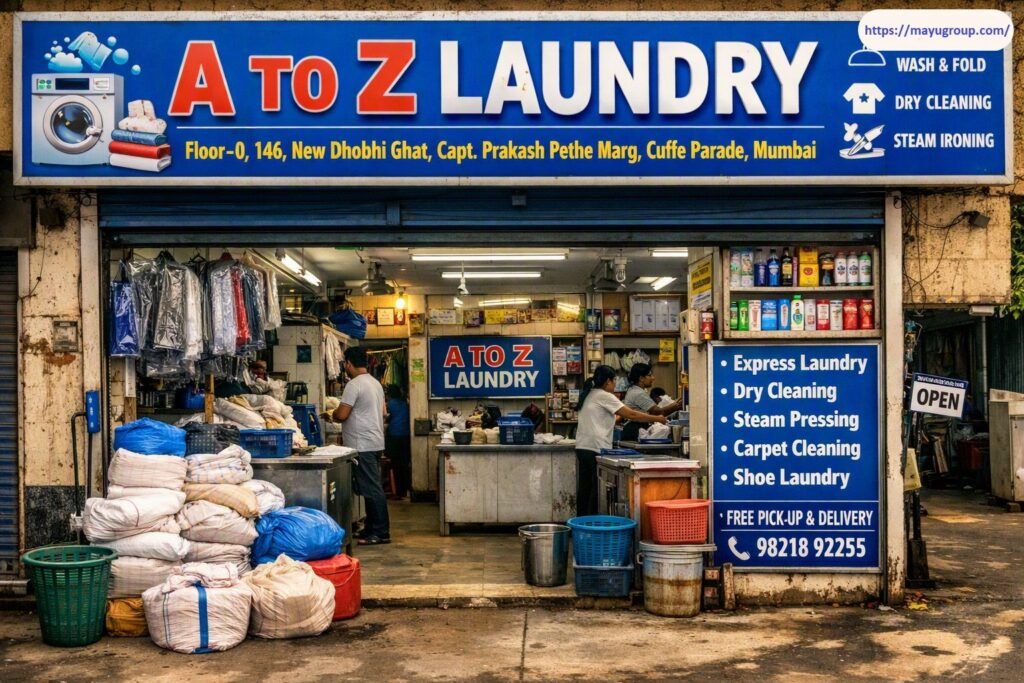
A TO Z Laundry, located at Floor-0, 146, New Dhobhi Ghat, Captain Prakash Pethe Marg, Cuffe Parade, Mumbai – 400005, Maharashtra, India, represents the kind of service organization where quality is closely connected with everyday customer experience. Laundry may appear to be a simple service from the outside, but behind every completed order is a sequence of activities that requires coordination, care, discipline and consistency. From receiving garments to sorting, processing, finishing and returning them to customers, every stage can influence how a customer evaluates the service. For A TO Z Laundry, the decision to develop a formal Quality Management System became an important step in creating a more structured approach to these activities.
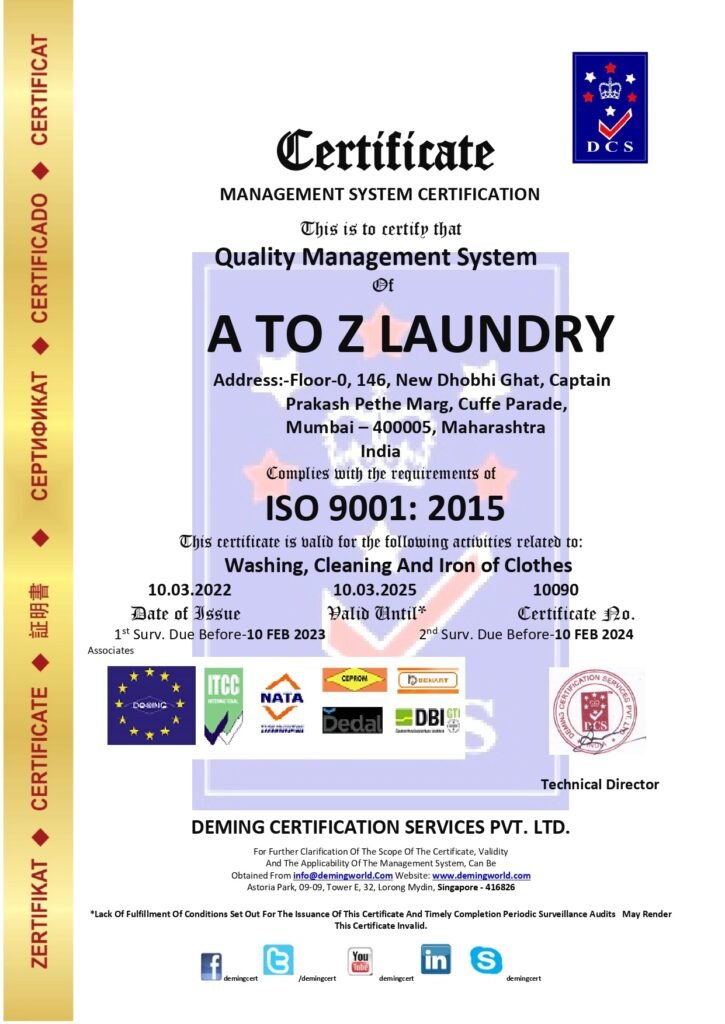
The organization obtained an ISO 9001:2015 certificate in 2022 for its defined scope of Quality Management System. The certificate was stated as valid through 2025. This milestone represented an important stage in the organization’s development because ISO 9001:2015 provides a systematic framework for managing quality, understanding customer requirements, controlling processes and pursuing continual improvement.
Before discussing certification as a document or achievement, it is useful to understand why a Quality Management System can be significant for a laundry service. Every customer handing over clothing or other washable items expects careful handling. The customer expects the items to be processed appropriately, returned in acceptable condition and handled within the agreed service expectations. A small error in identification, sorting, processing or delivery can affect the customer’s perception of the entire service. Consequently, quality must be considered throughout the service cycle rather than only at the final stage.
The ISO 9001:2015 approach encourages organizations to think in terms of processes. For a laundry organization, this means looking at the complete movement of an order rather than considering each activity independently. An order begins with customer requirements and moves through different operational stages before reaching completion. Each stage has an effect on the next. If information is not properly communicated at the beginning, the problem may continue through subsequent stages. If garments are not appropriately identified or separated, the risk of an incorrect outcome increases. If finishing and final checking are not given sufficient attention, the customer experience may be affected.
The Quality Management System therefore provided A TO Z Laundry with a structured framework for considering how its activities could be controlled and improved. The objective was not simply to introduce paperwork. The larger purpose of a quality system is to establish an organized method for planning activities, assigning responsibilities, maintaining appropriate controls, monitoring performance and responding when problems occur.
The certification journey also brought greater attention to the relationship between employees and quality. Laundry operations depend heavily on people performing their responsibilities carefully and consistently. Different individuals may be involved in receiving items, identifying orders, sorting materials, processing garments, ironing or finishing, packing and coordinating delivery. When responsibilities are clearly understood, employees can work with greater awareness of how their activities contribute to the final service.
Another important element of the journey was customer focus. ISO 9001:2015 places significant importance on understanding customer requirements and improving customer satisfaction. For A TO Z Laundry, this principle could be translated into everyday service practices. A customer’s requirements need to be understood, communicated and addressed as part of the service process. Feedback and complaints, when received, can provide useful information about where improvements may be necessary. Instead of treating feedback as an isolated event, a structured management approach can use it as an input for improvement.
The 2022 certification milestone therefore became part of a broader quality journey. It established a formal framework within which A TO Z Laundry could examine its operations and develop greater consistency. Documentation, process awareness, employee responsibilities and monitoring could work together to support the organization’s service objectives.
The significance of certification also extends beyond the certificate itself. An ISO 9001:2015 system requires continued attention. Processes must be maintained, responsibilities must remain clear, and opportunities for improvement should continue to be identified. This means that certification is better understood as the beginning of an organized quality-management journey rather than the end of one.
For A TO Z Laundry, the period beginning in 2022 provided an opportunity to strengthen this foundation. The organization could use the principles of quality management to create greater operational discipline while remaining focused on the practical needs of its customers. Each completed order could become part of a continuous learning process: understand the requirement, perform the service, verify the result, address issues and look for opportunities to improve.
Operating in Mumbai, where customers have diverse service expectations and where businesses must maintain dependable service standards, a structured quality approach can support organizational confidence. The ISO 9001:2015 certification gave A TO Z Laundry a recognized framework for organizing its quality activities and establishing a culture in which consistency and customer satisfaction could remain central considerations.
The beginning of A TO Z Laundry’s ISO 9001:2015 journey was therefore not simply about obtaining a certificate in 2022. It was about creating a foundation for systematic working. The journey connected everyday laundry activities with broader principles of quality management: customer focus, process control, employee responsibility, documented practices, monitoring and continual improvement.
As the organization moved forward, this foundation could support further development. The following chapters explore how such a quality-management approach can influence operational discipline, customer satisfaction, employee participation, process improvement and the organization’s broader growth story during and beyond its certification period.
#ISO9001
Chapter 2 – Understanding and Building the Quality Management System
The ISO 9001:2015 certification journey of A TO Z Laundry was not limited to receiving a certificate. It represented a transition toward a more structured way of thinking about quality, processes and customer service. With the Quality Management System established within its defined scope, the organization had a framework through which its everyday activities could be understood, documented, monitored and improved. For a laundry service, where numerous individual activities contribute to one completed customer order, this process-based approach can provide an important foundation for consistency.
Laundry operations involve a chain of connected activities. A customer’s items may first be received and identified, followed by sorting and preparation, processing, drying, ironing or finishing, checking, packing and eventual return or delivery. Although these activities appear straightforward, each stage requires attention. The quality of the final service depends upon how effectively the stages work together. A problem at an earlier stage can affect the outcome of later stages. Consequently, developing a Quality Management System encouraged A TO Z Laundry to consider the entire service cycle rather than focusing only on the final result.
One of the important principles behind ISO 9001:2015 is the process approach. Instead of managing activities as isolated tasks, the organization can understand how inputs, activities, outputs and responsibilities are connected. In the context of A TO Z Laundry, customer requirements can be considered the starting point of the service process. These requirements then move through a sequence of operational activities before the finished service reaches the customer.
This approach creates greater awareness among employees. Each employee can understand that their work is connected to the work of others. Accurate identification at the receiving stage, for example, can support correct sorting and processing later. Proper communication can help prevent misunderstandings. Careful processing can support better finishing. Final checking can provide another opportunity to identify issues before an order is returned to the customer. The system therefore encourages employees to recognize their role in the complete service chain.
Another important aspect of building the Quality Management System is defining responsibilities. Organizations often work more effectively when employees know what is expected from them. A structured system can establish responsibilities for different operational activities and management functions. This reduces dependence on informal instructions and helps create a more consistent working environment.
Documentation also becomes important. Documentation should not be viewed merely as administrative paperwork. Properly maintained procedures and records can provide a reference for employees and management. They can help establish how activities are expected to be performed and provide evidence that important processes are being controlled. For A TO Z Laundry, this type of discipline can be particularly useful when multiple activities need to be coordinated throughout the working day.
The Quality Management System also encourages organizations to consider risks and opportunities. In a laundry operation, different stages may present different operational challenges. Garments may require different handling methods, customer instructions may vary, and processing activities must be managed carefully. Identifying potential problems before they occur allows an organization to consider suitable controls. Similarly, opportunities for improving workflow, communication, service consistency or customer interaction can be considered as part of continual improvement.
Customer requirements remain at the center of this system. A laundry customer does not simply expect a process to be followed; the customer expects a satisfactory service outcome. Therefore, understanding customer requirements becomes an important management responsibility. When requirements are understood clearly and communicated appropriately, employees have a stronger basis for carrying out their tasks.
Customer feedback can also become a valuable source of information. Positive feedback may indicate that certain practices are working effectively, while complaints or service concerns can identify areas requiring attention. A structured Quality Management System provides a way to record, review and respond to such information. The purpose is not simply to solve one problem but, where appropriate, to understand why the problem occurred and consider whether changes can reduce the possibility of recurrence.
Employee awareness is another essential part of implementation. A quality system becomes meaningful when employees understand why procedures exist. If employees see quality requirements as part of their daily responsibilities rather than as separate certification formalities, the system becomes more practical. For A TO Z Laundry, this could mean connecting quality principles directly with activities such as garment handling, sorting, processing, finishing, checking and customer service.
Management review and monitoring also provide a mechanism for maintaining the system. A Quality Management System needs periodic attention to remain effective. Management can examine process performance, customer feedback, identified issues, corrective actions and opportunities for improvement. This creates a cycle in which information from daily operations can influence future decisions.
The ISO 9001:2015 certification obtained in 2022 therefore provided A TO Z Laundry with a structured foundation for managing quality. The system brought together process thinking, customer focus, employee responsibilities, documentation, monitoring and continual improvement.
For the organization, the value of this approach could extend beyond the certification period itself. Once quality principles become part of routine operations, they can continue to guide the organization as its customer requirements and operating environment evolve. A formal Quality Management System can provide stability while still allowing processes to improve.
The development of this system marked an important stage in A TO Z Laundry’s story. The organization was not simply seeking recognition; it was creating a framework through which everyday work could be understood and managed more systematically. This foundation would become increasingly relevant as the organization focused on consistency, service reliability and customer satisfaction in the chapters that followed.
#ISO9001Certification
Chapter 3 – Building Consistency in Laundry Operations
After establishing a structured Quality Management System, the next important stage in A TO Z Laundry’s quality journey was the development of consistency in everyday operations. A laundry service is built around repeated activities. Customers may bring different garments and have different requirements, but the organization must aim to deliver a dependable service experience each time. Consistency therefore becomes an important connection between process control and customer satisfaction.
For A TO Z Laundry, the implementation of ISO 9001:2015 provided a framework for examining how its routine activities were performed. Instead of depending entirely on individual experience or informal instructions, the organization could approach its operations through defined processes and responsibilities. This helped create awareness that quality begins when an order is received and continues until the processed items are properly completed and returned to the customer.
The first stage of any laundry service involves understanding and identifying the customer’s requirements. Items received for processing need to be associated with the appropriate customer and order information. Accurate identification is important because every subsequent stage depends on knowing which items belong to which order and what requirements apply to them. A systematic approach can reduce avoidable confusion and provide employees with clearer information for the work that follows.
Sorting is another important part of the operational process. Different garments and materials may require different types of handling. Therefore, employees need to pay attention to the characteristics of the items being processed and follow appropriate procedures. A Quality Management System encourages organizations to establish controls around such activities so that important decisions are not left entirely to individual assumptions.
The processing stage represents another major part of operational quality. Washing and related activities need to be carried out according to established requirements and available process controls. Consistency in routine practices can help the organization maintain predictable results. When employees understand the expected process and have appropriate instructions, there is a stronger basis for maintaining uniformity from one order to another.
Drying and finishing also contribute significantly to the final service experience. Once processing has been completed, items need to move through subsequent activities in an organized manner. Ironing, finishing, folding, packing and final handling may appear to be separate tasks, but together they influence how the customer receives the completed order. A process-based management system encourages employees to recognize the connection between each stage.
Another area of attention is final checking. Quality should not be considered only after a customer identifies a problem. Internal checking can provide an opportunity to identify issues before the order reaches the customer. A systematic final review can help confirm that the order is complete and that the expected service requirements have been addressed. When an issue is identified, corrective action can be taken within the organization rather than waiting for the customer to report it.
The development of consistency also depends on communication. Laundry operations involve the movement of items and information between different stages. If an instruction is not communicated clearly, the final outcome can be affected. The Quality Management System therefore encourages organizations to establish appropriate communication practices and responsibilities. Employees need to know what information is important and where that information should be recorded or communicated.
Training and employee awareness are equally important. A documented procedure has limited value if employees do not understand it. Training can help workers become familiar with established methods and quality expectations. It can also provide opportunities to explain why certain controls are important. Employees who understand the reasons behind a procedure may be better positioned to identify unusual situations and communicate them to management.
The ISO 9001:2015 framework also supports the idea of evidence-based decision-making. When an organization monitors its activities and maintains appropriate records, management has information that can be reviewed when making decisions. Instead of relying only on assumptions, management can consider customer feedback, process information, complaints, corrective actions and other available evidence when identifying improvement opportunities.
Consistency does not mean that every customer or garment must be treated identically. On the contrary, quality management requires the organization to understand individual requirements and apply suitable processes. Consistency means that the organization has a reliable method for determining what needs to be done and for ensuring that important requirements are not overlooked.
For A TO Z Laundry, this way of working could strengthen the relationship between operational discipline and customer confidence. Customers generally expect their laundry to be handled carefully and returned according to agreed requirements. A structured system gives the organization a framework for working toward these expectations in a repeatable manner.
The certification obtained in 2022 therefore became part of an operational improvement journey. The objective was not simply to display an ISO 9001:2015 certificate but to integrate quality principles into everyday activities. By focusing on process control, identification, sorting, handling, finishing, checking, communication and employee awareness, A TO Z Laundry could develop stronger foundations for consistent service.
This consistency also created a platform for future improvement. Once an organization understands its processes and establishes clearer controls, it becomes easier to identify where changes may be useful. Problems can be reviewed systematically, employee suggestions can be considered and customer feedback can become an input for improvement.
A TO Z Laundry’s quality journey therefore moved beyond certification documentation toward practical operational discipline. The emphasis on consistency helped connect the Quality Management System with the real work performed every day. It demonstrated how structured processes can support a service organization in its continuing effort to provide dependable customer experiences while creating a foundation for the next stage of growth.
#QualityManagementSystem
Chapter 4 – Customer Satisfaction as a Quality Objective
For A TO Z Laundry, the implementation of an ISO 9001:2015 Quality Management System created a stronger connection between internal processes and the expectations of customers. A laundry business operates in a service environment where customers directly experience the outcome of organizational processes. They judge the service through factors such as handling, cleanliness, finishing, communication, order accuracy and the overall experience of receiving their processed items. Consequently, customer satisfaction became an important consideration in the organization’s continuing quality journey after its certification in 2022.
The Quality Management System encouraged A TO Z Laundry to view quality from the customer’s perspective. A process may appear efficient internally, but its true value is determined by whether it addresses the requirements agreed with the customer. This perspective encouraged greater attention to understanding requirements before an order entered the processing cycle. Clear information at the beginning could help employees manage subsequent activities more effectively.
Customer requirements can vary depending on the type of item, quantity, requested service and other specific instructions. A structured system provides a framework for ensuring that relevant requirements are communicated to the people responsible for carrying out the work. When information is clear, employees have a stronger basis for performing their responsibilities and reducing avoidable misunderstandings.
Customer satisfaction is also influenced by reliability. A customer expects an organization to provide its service in a dependable manner. For a laundry service, reliability involves more than processing an item. It includes appropriate identification, careful handling, suitable processing, proper finishing and organized return of the completed order. Each stage contributes to the customer’s final impression.
The Quality Management System helped connect these activities. Instead of treating customer satisfaction as the responsibility of one employee or one department, quality management encourages the organization to recognize that everyone involved in the process contributes to the final result. The person receiving an order, the employee handling the processing stage and the person involved in final checking all have a role in protecting customer requirements.
Another important element is feedback. Customers can provide valuable information about whether a service is meeting expectations. Feedback may be positive, or it may identify an area where improvement is necessary. Under a structured quality approach, such information can become an input for management review and improvement activities. A complaint, for example, can be examined not only as an individual customer concern but also as an opportunity to understand whether a process requires greater control.
Corrective action can play an important role in this process. If a service issue occurs, the immediate priority may be to address the customer’s concern appropriately. However, a Quality Management System also encourages organizations to consider the underlying cause. If a similar issue could occur again, management can examine whether a procedure, communication method, employee awareness activity or process control needs improvement.
This approach can create a culture in which mistakes are viewed as information for improvement rather than simply as isolated incidents. The purpose is to reduce recurrence and strengthen the process. For A TO Z Laundry, this type of systematic thinking could support continuous development of its service operations.
Customer communication also forms part of the quality experience. Customers need confidence that their requirements are understood. Clear communication can help reduce uncertainty and create a more professional service relationship. Employees who understand the importance of customer interaction can contribute to building this confidence through their daily activities.
The location of A TO Z Laundry in Cuffe Parade, Mumbai, places the organization within an active urban service environment. In such an environment, customers may have different expectations and service requirements. A structured Quality Management System can provide stability while allowing the organization to respond to those requirements through controlled processes. Rather than changing procedures informally each time a new situation arises, the organization can use its established quality framework to evaluate the requirement and determine an appropriate response.
Customer satisfaction is also connected to continual improvement. Expectations can change over time, and organizations need to remain attentive to those changes. By monitoring feedback and reviewing processes, A TO Z Laundry could identify opportunities to improve its service experience. Small improvements in communication, process coordination, order handling or final checking can contribute to a stronger overall service system.
The ISO 9001:2015 certification issued in 2022 provided formal recognition of the organization’s Quality Management System within its stated scope. However, the longer-term value of such a system depends upon how consistently its principles are applied. Customer focus must therefore remain part of everyday management rather than being limited to certification audits.
For employees, this meant understanding that the customer’s experience begins before the actual laundry processing takes place. It begins when the order is received and continues through every stage until completion. Each activity has the potential either to support or weaken the final customer experience. This awareness can encourage greater responsibility and attention to detail.
For management, customer feedback and process performance can provide useful information for making decisions. When customer-related information is reviewed together with operational observations, management can identify areas that deserve attention. This creates a cycle of understanding requirements, delivering the service, monitoring results, addressing issues and improving processes.
A TO Z Laundry’s journey after ISO 9001:2015 certification can therefore be viewed as a continuing effort to connect quality management with customer expectations. The certificate provided a recognized framework, while daily implementation gave that framework practical meaning.
By placing customer requirements at the center of its Quality Management System, A TO Z Laundry could strengthen the relationship between operational discipline and service satisfaction. The journey demonstrated that quality is not created only during the final inspection of a completed order. It is built throughout the entire service process, through clear requirements, responsible employees, controlled activities, effective communication, feedback and continual improvement.
#QualityManagement
Chapter 5 – Employee Participation and Responsibility
The development of a successful Quality Management System depends not only on procedures and documentation but also on the people who implement those processes every day. For A TO Z Laundry, the ISO 9001:2015 certification journey beginning in 2022 brought greater attention to employee participation, responsibility and awareness. Laundry operations involve a continuous sequence of activities, and every person involved can influence the quality of the final service. A structured quality system therefore provides an opportunity to connect individual responsibilities with the organization’s broader commitment to customer satisfaction.
In a service organization such as A TO Z Laundry, employees are closely connected to the practical side of quality. They may be involved in receiving customer items, recording requirements, sorting garments, carrying out processing activities, handling finished items, checking orders or coordinating their return. Although these tasks may appear separate, they form one connected service chain. If one stage is not performed correctly, the effects can continue into subsequent stages. Employee awareness is therefore an important element of process control.
ISO 9001:2015 emphasizes competence and awareness. Employees need to understand the processes relevant to their work and the importance of meeting applicable requirements. For A TO Z Laundry, this principle could be applied by ensuring that employees understand their respective responsibilities and the quality expectations associated with their activities. When employees know what is expected, they can perform their work with greater consistency.
Training can support this objective. New or existing employees may need guidance regarding established processes, customer requirements, equipment use, handling practices, safety considerations and quality controls relevant to their responsibilities. Training does not necessarily have to be limited to formal classroom sessions. Practical demonstrations, work instructions, supervised activities and discussions can also contribute to employee competence.
An important benefit of employee awareness is that it can reduce dependence on individual assumptions. Without clear processes, two employees may approach the same task differently. A Quality Management System provides a common framework that can help establish consistent working methods. Employees can refer to defined practices and communicate when a situation falls outside the normal process.
Communication between employees is equally important. Laundry operations involve movement of items and information through multiple stages. If an important customer requirement is not communicated properly, the eventual service outcome may be affected. Clear communication helps ensure that relevant information reaches the people who need it. A structured system can define responsibilities for communication and create appropriate methods for recording or transferring important information.
Employee participation also creates an opportunity for improvement. People working directly with a process often have practical knowledge about its strengths and difficulties. They may identify unnecessary movement, repeated work, communication gaps or other operational challenges that are not immediately visible from a management perspective. Encouraging employees to communicate such observations can provide useful inputs for continual improvement.
The concept of continual improvement is particularly important because a Quality Management System should not remain unchanged after certification. ISO 9001:2015 encourages organizations to continually improve the suitability, adequacy and effectiveness of their quality system. Employee suggestions can form part of this improvement process. A small operational change suggested by someone working directly with a process may contribute to better efficiency or consistency.
Responsibility also involves recognizing and reporting problems. Employees should have an appropriate way to communicate when something does not proceed as expected. If an item is difficult to process, information is incomplete or an operational issue is identified, timely communication allows management to consider the appropriate response. This can help prevent a small problem from becoming a larger service issue.
A culture of responsibility can also influence teamwork. When employees understand that their work affects other stages, they become more aware of the importance of completing their responsibilities correctly. The person receiving an order has an impact on the processing team. The processing team affects finishing. The finishing stage affects final checking and presentation. The final stage influences the customer’s experience. Quality therefore becomes a shared responsibility rather than the task of one person.
Management has an important role in supporting this culture. Employees need suitable resources, clear expectations and opportunities to develop competence. Management can also reinforce the importance of quality through regular communication and review. When employees see that quality-related issues are taken seriously, they are more likely to treat their own responsibilities with similar attention.
Employee involvement also supports organizational resilience. Processes should not depend entirely on one individual’s personal knowledge. Documented practices, training and shared responsibilities help create a system in which knowledge can be communicated more effectively. This can be particularly useful when responsibilities change or new employees join the organization.
For A TO Z Laundry, the ISO 9001:2015 certification therefore provided a framework for connecting people with processes. The certificate itself recognized the Quality Management System, but employees gave that system practical meaning through their daily work. Every carefully handled order, every correctly followed process and every communicated improvement became part of the organization’s quality culture.
The journey also demonstrated that quality management is not simply a management-level activity. It involves everyone whose work can influence the service outcome. From the first interaction with the customer to the final completion of an order, employee awareness and responsibility remain essential.
As A TO Z Laundry continued its quality journey during the certification period, stronger employee participation could support consistency, communication and continual improvement. The organization’s future development could therefore build not only on procedures and documentation but also on the knowledge, experience and commitment of the people performing the work.
In this way, employee participation became an important pillar of the Quality Management System. It helped transform quality from a formal certification requirement into a practical part of everyday operations, creating a stronger foundation for service reliability and continued organizational development.
#AToZLaundry
Chapter 6 – Documentation, Monitoring and Continuous Improvement
The implementation of a Quality Management System at A TO Z Laundry created a structured foundation for controlling processes and supporting continual improvement. After receiving its ISO 9001:2015 certification in 2022, the organization had an opportunity to use documentation, monitoring and review activities as practical tools for strengthening its everyday service operations. The purpose of these activities was not simply to create records, but to establish greater visibility into how work was performed and where improvements could be introduced.
Documentation is an important component of an organized quality system. In a laundry service, several activities take place between receiving an order and completing it. Information associated with customer requirements, processing activities and final completion needs to move through the organization appropriately. Documented procedures and relevant records can help establish a common understanding of responsibilities and provide evidence that important processes are being managed.
For A TO Z Laundry, documentation could support consistency by providing employees with clear references for established practices. When a process is documented, employees have a basis for understanding what is expected rather than relying entirely on memory or informal instructions. This can become particularly valuable when new employees are introduced to the organization or when responsibilities are transferred between individuals.
Documentation can also support accountability. When relevant activities are recorded appropriately, management can review information when questions arise. Records can provide useful evidence about what happened, when an activity was performed and whether a particular requirement was addressed. This can help management investigate problems and make informed decisions.
However, documentation alone cannot create quality. Its value depends on whether the information is practical, controlled and actually used. The Quality Management System therefore needs to connect documented practices with real operational activities. Employees need to understand the purpose of the information they maintain and how it supports their responsibilities.
Monitoring provides the next important element. An organization needs to understand how its processes are performing. A TO Z Laundry could use observations, customer feedback, process information, identified problems and other appropriate indicators to review its operational performance. Monitoring helps management identify areas that are working as expected and areas that may require attention.
Customer feedback can be particularly valuable. If customers consistently express satisfaction with a particular aspect of service, it may indicate that the related process is functioning effectively. Conversely, repeated complaints or concerns can signal that a process requires review. The important point is to use such information systematically rather than treating each incident as completely separate.
When an issue is identified, corrective action can become part of the improvement process. Corrective action involves addressing the problem and considering its cause. For example, if an operational error occurs repeatedly, simply correcting the individual order may not be sufficient. Management may need to consider whether the process, communication, training or control mechanism needs modification.
This approach encourages a shift from reacting to problems toward preventing recurrence. It also creates a learning cycle. An organization identifies an issue, examines it, determines an appropriate response, implements the response and later reviews whether the action was effective. Such a cycle is consistent with the continual-improvement philosophy of ISO 9001:2015.
Internal review activities can also contribute to this process. Periodic assessment of the Quality Management System provides an opportunity to examine whether established practices continue to be followed and whether they remain suitable for the organization’s needs. Internal audits, for example, can identify areas where processes are working well as well as areas where corrective or preventive attention may be useful.
Management review provides another level of oversight. Management can consider information relating to customer satisfaction, process performance, identified issues, corrective actions and opportunities for improvement. This creates a connection between operational information and organizational decision-making. Rather than allowing quality information to remain within individual processes, management can use it when considering future priorities.
For A TO Z Laundry, this systematic approach could also contribute to better organizational discipline. When employees understand that processes are monitored and reviewed, there is greater awareness of the importance of following established practices. At the same time, monitoring should not be viewed simply as an inspection mechanism. Its broader purpose is to understand performance and identify opportunities to make the system more effective.
Continuous improvement can occur through both large and small changes. An organization does not necessarily need to introduce major technological or operational changes to improve. A clearer instruction, better communication method, improved organization of work, additional employee training or stronger final checking practice can all contribute to improvement when implemented appropriately.
The ISO 9001:2015 framework therefore gave A TO Z Laundry a structured method for connecting information with action. Documentation created references and evidence. Monitoring provided visibility. Review activities encouraged reflection. Corrective actions addressed identified issues. Continual improvement connected these elements into an ongoing cycle.
The certification period from 2022 to 2025 provided an important opportunity to apply these principles consistently. During this period, the Quality Management System could serve as a management tool rather than simply a certification requirement. Its effectiveness depended on the organization’s continued attention to processes, records, customer feedback and improvement opportunities.
For a service organization such as A TO Z Laundry, this systematic approach could strengthen confidence in daily operations. When processes are understood, information is controlled and problems are reviewed logically, employees and management have a stronger basis for maintaining quality.
The broader lesson of this stage of A TO Z Laundry’s journey is that certification provides a framework, but continual improvement gives the framework lasting value. Documentation and monitoring are not ends in themselves. Their purpose is to help the organization understand its operations, respond to customer requirements and improve the way work is performed.
By developing these practices as part of its Quality Management System, A TO Z Laundry could continue building upon the foundation created through its ISO 9001:2015 certification. The emphasis on information, monitoring and improvement strengthened the organization’s ability to learn from its operations and prepare for the next stage of its quality journey.
#LaundryServices
Chapter 7 – Strengthening the Service Experience
The ISO 9001:2015 certification journey gave A TO Z Laundry an opportunity to look beyond individual operational activities and consider the complete customer service experience. For a laundry organization, service quality is created through many connected stages. A customer may judge the organization by the condition of the finished items, but the final result is influenced by everything that happens before completion. Order handling, identification, sorting, processing, finishing, checking, packaging and communication all contribute to the overall experience.
Following its certification in 2022, A TO Z Laundry could use the principles of its Quality Management System to bring greater structure to this service cycle. The objective of a quality system is not merely to identify problems after they occur. It is also to create processes that help prevent avoidable problems and encourage employees to work consistently.
One of the first elements of a strong service experience is clear customer communication. Customers need confidence that their requirements have been understood. Information received at the beginning of an order can influence the way subsequent activities are performed. A structured process helps ensure that important requirements are communicated to the appropriate people. This can reduce uncertainty and provide employees with a clearer basis for carrying out their responsibilities.
The handling of customer items is another important part of service quality. Laundry involves physical items that customers expect to be handled responsibly. Proper identification and organized movement through the processing stages can help maintain control over orders. Employees need to remain aware that each item represents a customer’s expectation and that careful handling contributes to trust.
The Quality Management System also encourages process discipline. When employees follow established procedures, the organization has a stronger basis for maintaining consistency. This does not mean that every order must be treated mechanically. Different requirements may need different approaches. Rather, the system provides a controlled framework through which those requirements can be understood and addressed.
Finishing and presentation are also part of the customer experience. Once processing has been completed, attention may be required to ensure that items are properly finished, organized and prepared for return. A final checking stage can provide an opportunity to verify that relevant requirements have been addressed before the order reaches the customer.
The concept of customer satisfaction extends beyond the physical output of the service. Communication, responsiveness and the handling of concerns can also influence customer perception. When customers raise questions or provide feedback, the organization has an opportunity to demonstrate that their concerns are taken seriously. A structured complaint and feedback process can help management identify recurring issues and consider suitable improvements.
For A TO Z Laundry, customer feedback could therefore become an important source of organizational learning. If a customer identifies an issue, management can examine the immediate situation and consider whether a broader process improvement is appropriate. The purpose of such analysis is to understand the cause and reduce the possibility of recurrence.
Employee behavior also contributes to the service experience. Employees represent the organization during many customer interactions. Their understanding of quality requirements, communication responsibilities and service expectations can influence how customers perceive the organization. Training and awareness can therefore support not only operational quality but also the professionalism of the service relationship.
Another important element is coordination. A laundry order passes through multiple stages, and delays or communication gaps at one stage can affect subsequent activities. Process coordination helps employees understand where an order is within the service cycle and what needs to happen next. Clear responsibilities can reduce unnecessary confusion and support smoother workflow.
The Quality Management System can also help management identify opportunities for improving efficiency. When processes are reviewed regularly, management may discover areas where work can be organized more effectively. Improvement might involve clearer documentation, better communication, improved workplace organization, employee training or more effective monitoring. Even relatively small changes can become meaningful when they improve the consistency of repeated activities.
A TO Z Laundry’s location in Cuffe Parade, Mumbai, places its service operation within a busy urban environment. Customers in such environments may value dependable service and clear communication. A formal quality-management approach can provide a structured way of responding to these expectations while maintaining consistency in internal operations.
The ISO 9001:2015 certificate issued in 2022 also provided an external reference point for the organization’s quality commitment. However, the real service benefit comes from applying quality principles in daily work. A certificate can demonstrate that a management system has been established within a defined scope, but customer confidence is built through repeated experiences.
This distinction is important in understanding A TO Z Laundry’s growth journey. The organization’s progress should not be measured only by the existence of certification. The more significant development lies in the quality culture supported by the system: employees becoming more aware of responsibilities, processes becoming more organized, customer requirements receiving greater attention and problems becoming opportunities for improvement.
A strong service experience is ultimately created through consistency. When an organization repeatedly understands requirements, controls its processes, communicates effectively and reviews results, customers have a stronger basis for confidence. ISO 9001:2015 provides a framework for this disciplined approach, while the organization’s employees and management make it part of everyday practice.
For A TO Z Laundry, the certification period from 2022 to 2025 could therefore serve as an important stage in strengthening the connection between internal quality management and external customer experience. The organization had an opportunity to use its Quality Management System as a practical tool for maintaining service discipline and identifying improvement opportunities.
The journey demonstrated that customer satisfaction is not created by one final action. It develops through every stage of the service process. From the first communication with a customer to the final return of completed items, each activity contributes to the organization’s reputation for quality. By maintaining a systematic approach, A TO Z Laundry could continue building a service culture centered on reliability, responsibility, customer focus and continual improvement.
#CustomerSatisfaction
Chapter 8 – Continuous Improvement and Operational Discipline
The journey of A TO Z Laundry after receiving its ISO 9001:2015 certification in 2022 entered another important stage as the organization continued to focus on continuous improvement and operational discipline. A Quality Management System is most effective when it becomes part of everyday working practices rather than remaining a collection of documents maintained only for certification purposes. For A TO Z Laundry, the principles of quality management provided a framework for regularly reviewing processes, identifying opportunities for improvement and strengthening consistency in service delivery.
Continuous improvement begins with the recognition that even an established process can be made more effective. Customer expectations may change, operational circumstances may develop and employees may identify better ways of completing routine activities. A quality-oriented organization therefore needs to remain open to learning. For A TO Z Laundry, this meant treating the Quality Management System as an ongoing management framework rather than a one-time project.
Operational discipline was particularly important because laundry services involve repeated activities. Orders move through different stages, and every stage needs appropriate attention. When employees follow established practices consistently, the organization has a stronger basis for maintaining predictable service. Process discipline can also make it easier to identify when something has gone outside the normal procedure.
One important principle is the Plan-Do-Check-Act approach. Planning involves understanding requirements, identifying processes and determining appropriate controls. Doing means carrying out the planned activities. Checking involves monitoring results and reviewing whether requirements have been met. Acting involves making improvements based on the information obtained. This cycle can be applied to many areas of a laundry operation.
For example, management may identify a particular operational activity that requires greater consistency. The organization can define the expected process, communicate responsibilities, observe how the process is performed and review the results. If an issue is identified, appropriate corrective action can be considered. After implementation, the organization can review whether the change produced the intended improvement. This creates a practical cycle of learning.
Employee participation remains important in this process. Employees who work directly with daily operations may notice practical issues that are not immediately visible to management. They may identify unnecessary movement, unclear instructions, repeated work or communication difficulties. Creating appropriate channels for communicating these observations can provide management with useful information for improvement.
Corrective action is another important element. When an issue occurs, the immediate response may involve correcting the affected activity. However, a quality-management approach encourages the organization to look further. Management can consider why the issue occurred and whether the existing process allowed the problem to develop. Depending on the circumstances, the organization may consider additional training, clearer instructions, improved communication or changes to the process.
This approach helps distinguish correction from improvement. Correction addresses an existing issue. Improvement seeks to strengthen the process so that similar issues are less likely to recur. Both are useful, but understanding the underlying cause can provide greater long-term value.
Monitoring also supports operational discipline. Management needs information about whether processes are functioning as intended. Customer feedback, complaints, process observations, internal audit findings and other appropriate information can help provide this visibility. Reviewing such information regularly can help the organization recognize patterns rather than responding only to isolated incidents.
The quality system can also encourage greater accountability. When responsibilities are clearly defined, employees understand who is responsible for different activities. This can reduce uncertainty and make communication easier. Accountability does not mean placing blame when something goes wrong. Instead, it means establishing clear ownership of processes and ensuring that identified issues are addressed appropriately.
For A TO Z Laundry, continuous improvement could also involve workplace organization. A well-organized working environment can support smoother movement of orders and reduce unnecessary confusion. Clearly defined areas, appropriate identification practices and orderly handling of items can contribute to operational control. These improvements may appear small individually, but repeated improvements can strengthen the overall process.
Another important area is awareness of customer requirements. Continuous improvement should ultimately contribute to better service. When management considers process changes, the effect on customer requirements should remain part of the evaluation. An improvement that makes an internal process easier but negatively affects customer requirements would need careful consideration. Quality management therefore requires balance between operational efficiency and customer satisfaction.
The ISO 9001:2015 certification period from 2022 to 2025 provided A TO Z Laundry with a defined period in which its Quality Management System could be maintained, reviewed and developed. The organization could use this period to strengthen its processes and establish a culture of continual improvement.
A quality culture develops gradually. It is created when management consistently communicates the importance of quality, employees understand their responsibilities, processes are followed, information is reviewed and improvement opportunities are acted upon. Over time, these practices can become part of the organization’s normal way of working.
For A TO Z Laundry, this represented a shift from viewing quality as an inspection activity toward viewing quality as a management responsibility shared across the organization. Instead of waiting until the end of a process to identify problems, employees could focus on controlling quality throughout the service cycle.
The organization’s growth story after certification can therefore be understood through this continuing emphasis on discipline and improvement. ISO 9001:2015 provided the structure, while daily implementation gave the system practical meaning. Each review, employee suggestion, customer observation and corrective action could contribute to a stronger process.
Continuous improvement also prepares an organization for future changes. Customer expectations, service requirements and operating conditions may evolve. An organization with established review and improvement mechanisms is better positioned to examine those changes systematically and determine how its processes should respond.
A TO Z Laundry’s quality journey thus became more than a certification milestone. The emphasis on operational discipline and continual improvement provided a foundation for sustained quality management. By maintaining attention to processes, employees, customers and performance, the organization could continue developing its service approach beyond the initial certification achievement.
The central lesson of this stage was simple: quality is not a destination. It is an ongoing process of understanding requirements, performing work carefully, reviewing results and improving wherever opportunities are identified. For A TO Z Laundry, this philosophy provided an important foundation for the next phase of its organizational development.
#ContinuousImprovement
Chapter 9 – The Certification Milestone and Organizational Development
The year 2022 represented an important milestone in the quality journey of A TO Z Laundry. The organization received its ISO 9001:2015 certification for its defined Quality Management System, with the certificate stated as valid through 2025. This achievement marked the formal recognition of a structured approach to quality management and provided the organization with a framework for continuing its development. However, the significance of certification extended beyond the certificate itself. It represented an opportunity to establish quality as an ongoing management practice.
For a service organization, certification can provide a structured reference for understanding how processes are managed. ISO 9001:2015 focuses on areas such as customer requirements, process management, organizational responsibilities, monitoring, corrective action and continual improvement. These principles can be applied to the everyday activities of a laundry organization, where consistency and customer satisfaction are closely connected.
The certification milestone encouraged A TO Z Laundry to view its activities through a process-based perspective. Every customer order moves through a sequence of activities, and the effectiveness of one stage can influence the next. Receiving information accurately, identifying items, sorting them appropriately, processing them according to requirements, completing finishing activities and preparing the order for return are all interconnected.
This process approach also creates a stronger understanding of responsibility. Employees involved in different stages can recognize that their work contributes to the final customer experience. Quality is therefore not limited to one employee or one final inspection. It is created through the combined performance of the organization.
Another important aspect of certification is the emphasis on customer focus. A TO Z Laundry’s service ultimately exists to address customer requirements. The Quality Management System provided a structured way to consider those requirements throughout the service process. Customer feedback and complaints could become sources of information for improvement, while effective communication could help reduce misunderstandings.
The certification period also provided an opportunity for the organization to strengthen documentation and monitoring. Documented processes can provide employees with clear references, while appropriate records can support management review. Monitoring allows management to understand whether processes are functioning as intended and whether particular areas require additional attention.
When a problem is identified, the quality system provides a framework for corrective action. This can involve addressing the immediate problem and considering whether the underlying cause requires attention. Such an approach can help the organization move beyond temporary solutions and consider longer-term process improvement.
The role of employees remained central throughout this stage. A Quality Management System cannot operate effectively without the people responsible for implementing it. Employee awareness, competence and participation help transform documented requirements into actual working practices. Training and communication can help employees understand their responsibilities and recognize how their actions influence service quality.
The certification milestone also contributed to organizational awareness. When quality objectives are clearly established, employees and management can work toward common expectations. Instead of viewing quality as an isolated activity, the organization can connect quality requirements with everyday operational decisions.
For A TO Z Laundry, this approach could also support greater confidence when reviewing its own performance. A structured system creates opportunities to examine processes regularly and identify areas that may require attention. Internal reviews and management evaluation can help determine whether procedures remain suitable and whether improvement actions are effective.
The 2022–2025 certification period can therefore be seen as an important chapter in the organization’s development. It provided time to apply quality-management principles consistently and to understand how formal processes could support practical service operations. The value of this experience was not restricted to the certification period itself. The knowledge and discipline developed through the system could provide a foundation for future quality initiatives.
The certification also represented a point at which the organization could communicate its commitment to systematic quality management to relevant stakeholders. An ISO 9001:2015 certificate within a defined scope demonstrates that the organization had established a Quality Management System subject to the applicable certification process. For customers and business stakeholders, such recognition can provide information about the organization’s formal approach to quality.
At the same time, certification should not be considered a guarantee that every individual service outcome will always be perfect. Quality management is an ongoing process. Processes need to be maintained, monitored and improved. Customer requirements continue to evolve, and organizations need to remain responsive to those requirements.
This understanding helped place the certification milestone in its proper context. The certificate was an important achievement, but the continuing application of quality principles was equally important. The organization could use the framework to examine its operations, identify weaknesses, encourage employee participation and improve service practices.
For A TO Z Laundry, the journey from certification to organizational development involved creating stronger connections between management objectives and daily activities. Quality objectives could be translated into practical responsibilities. Customer expectations could be connected with process controls. Employee participation could support improvement. Monitoring could provide information for decision-making.
The certification journey also encouraged a long-term perspective. Instead of considering quality as a temporary project, the organization could incorporate it into its continuing operational culture. This could support greater consistency as the organization responded to changing customer needs and business conditions.
As the certificate approached the end of its stated validity in 2025, the experience gained since 2022 provided an important foundation for considering the organization’s next quality-management steps. The organization could reflect on its processes, review achievements, identify improvement opportunities and consider how its quality system should continue developing.
The story of A TO Z Laundry’s certification milestone is therefore a story of structured development. In 2022, ISO 9001:2015 provided formal recognition of its Quality Management System. During the following years, the principles of process control, customer focus, employee responsibility, monitoring and continual improvement could become increasingly connected with daily operations.
Ultimately, the significance of certification lies in what an organization does with the framework it has established. For A TO Z Laundry, the certification provided a foundation for strengthening its approach to quality and creating a more systematic path toward organizational development. The experience became another step in a continuing journey toward disciplined processes, customer-focused service and continual improvement.
#QualityAssurance
Chapter 10 – Looking Toward the Future
The ISO 9001:2015 certification journey of A TO Z Laundry, beginning with certification in 2022 and extending through the stated validity period to 2025, represents an important chapter in the organization’s approach to quality management. Located at Floor-0, 146, New Dhobhi Ghat, Captain Prakash Pethe Marg, Cuffe Parade, Mumbai – 400005, Maharashtra, A TO Z Laundry used the framework of a Quality Management System to create greater awareness around processes, customer requirements, employee responsibilities and continual improvement.
The completion of a certification period does not mean that the principles of quality management have to end. In many organizations, certification becomes a foundation upon which future improvements can be developed. The experience gained from establishing processes, maintaining documentation, reviewing performance and responding to customer feedback can remain useful as the organization moves into its next stage.
One of the most important lessons from the quality journey is that customer satisfaction depends on the complete service experience. Laundry customers expect their requirements to be understood and their items to be handled appropriately. They also expect consistency in the service process. These expectations make process discipline important at every stage, from the initial receipt of items through processing, finishing and final return.
A TO Z Laundry’s Quality Management System provided a structured way to address these requirements. The organization could consider its activities as connected processes rather than isolated tasks. This process-based thinking can continue to guide future improvements, particularly when changes are introduced into the way work is organized.
Future development can also build upon employee participation. Employees who understand the organization’s quality objectives can contribute to maintaining established processes and identifying opportunities for improvement. Their practical experience can provide valuable information about the everyday operation of the system. Encouraging appropriate communication between employees and management can help ensure that useful observations are considered.
Training and competence can remain important areas of attention. As processes change and employees develop new responsibilities, ongoing awareness can help maintain consistency. Training can also provide opportunities to reinforce customer-focused service, process requirements and quality responsibilities.
Another area for continued development is the use of customer feedback. Customer comments can provide information about the effectiveness of existing processes. Positive feedback may indicate areas where practices are working well, while concerns can identify opportunities for corrective action. A structured approach to feedback allows management to examine information systematically and determine whether changes are necessary.
Continual improvement can also involve reviewing internal processes for efficiency. An organization can periodically examine how information moves between activities, how responsibilities are assigned and whether existing procedures remain suitable. Improvements may involve small adjustments rather than major changes. Better organization, clearer instructions, improved communication or additional process controls can all contribute to operational development.
The principles of ISO 9001:2015 can also support a culture of evidence-based decision-making. Rather than relying entirely on assumptions, management can consider available information when determining priorities. Customer feedback, process observations, internal reviews and corrective-action records can all contribute to a more informed understanding of organizational performance.
The experience gained during the 2022–2025 certification period can therefore become a reference point for future quality initiatives. A TO Z Laundry can reflect on what worked effectively, where difficulties occurred and which processes may benefit from additional attention. This type of reflection is an important part of continual improvement.
The future of a quality-management system also depends upon leadership commitment. Management has an important role in establishing quality objectives, providing appropriate resources, communicating expectations and reviewing performance. When quality is consistently supported by leadership, employees receive a clear message that customer requirements and process discipline are organizational priorities.
Another important lesson is that quality should remain integrated with business operations. It should not be treated as a separate department or occasional activity. When quality principles are incorporated into normal working practices, they can influence everyday decisions. This creates a stronger connection between organizational management and customer service.
For A TO Z Laundry, the certification journey also demonstrates how a service organization can use a recognized quality framework to organize its development. The certificate itself was an important milestone, but the processes, responsibilities and quality awareness developed during the journey can have longer-term relevance.
The organization’s future growth story can therefore be viewed as an ongoing process. New customer requirements may emerge, operational practices may change and opportunities for service improvement may arise. A structured quality-management approach provides a method for examining these developments systematically.
As A TO Z Laundry looks beyond the stated 2025 validity period of its certificate, the experience gained through the ISO 9001:2015 journey can serve as a foundation for future decisions. Whether the organization maintains, develops or expands its quality-management practices, the central principles remain relevant: understand customer requirements, control processes, maintain appropriate responsibilities, monitor performance, address problems systematically and pursue continual improvement.
The story also demonstrates that organizational growth is not defined only by financial expansion or physical scale. Growth can include better process discipline, stronger employee awareness, clearer responsibilities, improved customer communication and a more systematic approach to solving problems. These forms of development can strengthen the organizational foundation from which future growth can take place.
A TO Z Laundry’s ISO 9001:2015 journey therefore concludes this ten-chapter story not with an ending, but with a platform for continued development. The 2022 certification marked a formal quality milestone, while the following years provided an opportunity to apply the principles of the Quality Management System in everyday operations.
The broader message of the journey is that quality is continuous. A certificate can recognize a management system at a particular point in time, but sustained quality depends on what an organization does every day. Customer focus, employee participation, process control, monitoring and continual improvement must remain active principles.
For A TO Z Laundry, these principles provide a practical foundation for moving forward. The experience of implementing ISO 9001:2015 can continue to influence how the organization understands service quality, manages its processes and responds to customer expectations. The future can therefore build upon the discipline established during the certification journey, carrying forward the central objective of delivering a consistent and customer-focused laundry service.
#BusinessGrowth
#ISO9001Journey #LaundryBusinessGrowth #ServiceQuality #OperationalExcellence #QualityDrivenGrowth
Take the Next Step Today
Don’t wait to enhance your business’s quality and efficiency. Partner with Mayu Group Global and experience the transformation that comes with expert consultancy and training. Contact us today to learn more about how we can help you achieve your business goals. Reach out via phone at
+91-9322728183, visit our website at www.mayugroup.com, or email us at investor@mayugroup.com Let us be your guide on the journey to excellence and innovation.