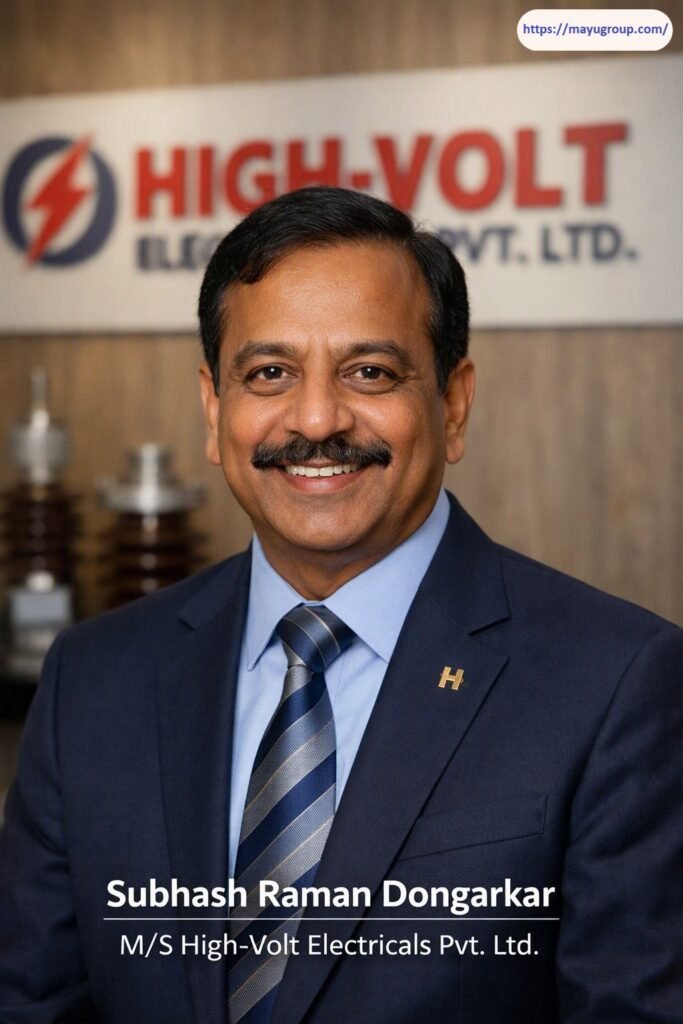
Subhash Raman Dongarkar Of M/S High-Volt Electricals Pvt. Ltd.
- Subhash Raman Dongarkar Of M/S High-Volt Electricals Pvt. Ltd.
- Chapter 1: The Beginning of a Quality-Driven Journey
- Chapter 2: Building Technical Competence and Process Discipline
- Chapter 3: Strengthening Welding Quality and Workplace Standards
- Chapter 4: Developing a Culture of Consistency and Customer Confidence
- Chapter 5: Turning Technical Qualification into Operational Excellence
- Chapter 6: Expanding Professional Capability Through Quality
- Chapter 7: Customer Trust, Reliability, and Sustainable Business Development
- Chapter 8: Continuous Improvement and Preparing for the Future
- Chapter 9: Leadership, Organizational Learning, and Long-Term Growth
- Chapter 10: The Legacy of Quality and the Road Ahead
- Take the Next Step Today
Chapter 1: The Beginning of a Quality-Driven Journey
At J 46-47, MIDC Tarapur, Boisar, Maharashtra, the industrial environment is defined by engineering, manufacturing, fabrication, precision, and continuous movement. In such an environment, quality is not simply a certificate displayed on a wall. It is reflected in the way people work, the way processes are controlled, and the way technical competence is developed and maintained. It was within this demanding industrial setting that Subhash Raman Dongarkar of M/S High-Volt Electricals Pvt. Ltd. began an important stage in his professional journey.
M/S High-Volt Electricals Pvt. Ltd. operated in an environment where welding competence could have a direct bearing on the reliability and acceptance of fabricated and welded components. Welding is a specialized activity. It requires suitable procedures, qualified personnel, appropriate materials, controlled parameters, trained supervision, and consistent inspection. A small variation in technique can influence the quality of a welded joint. Therefore, developing confidence in welding qualification was an important part of strengthening the company’s technical capabilities.
For Subhash Raman Dongarkar, the journey toward formal qualification represented more than completing a technical requirement. It was an opportunity to bring greater structure to an important area of industrial work. The objective was to demonstrate that welding activities could be performed by qualified personnel under defined technical conditions and that the resulting work could be evaluated against recognized requirements.
The company’s quality journey included a Welder Qualification Test, associated with EN 15085-2:2020 / ISO 15614-1 and EN 15085-2:2020 / ISO 9606-2:2004. The certification documentation recorded an issue year of 2022, with validity extending to 2024. These qualifications became an important reference point in the company’s professional development.
The significance of such qualification becomes clearer when considering the nature of welding work. A welding procedure establishes how a particular welding operation is expected to be performed, while welder qualification demonstrates the welder’s ability to produce acceptable welded joints within defined conditions. Both aspects contribute to process reliability. For a company working in an industrial environment, establishing this technical discipline can support consistency, traceability, inspection, and customer confidence.
Before formal qualification becomes part of an organization’s working culture, technical activities can sometimes depend heavily on individual experience. Experienced welders may possess considerable practical knowledge, but organizations need systems that make technical competence demonstrable and repeatable. Formal qualification provides a structured framework through which skills can be assessed and documented.
This was particularly relevant to Subhash Raman Dongarkar’s professional role. The qualification process encouraged attention to preparation, welding parameters, materials, workmanship, inspection, and documentation. Rather than viewing welding as only a production activity, the process encouraged a broader understanding of welding as a controlled technical operation.
The year 2022 therefore became an important milestone. The qualification documentation provided a formal record that could be used to demonstrate technical competence during the relevant validity period. For the company, this was useful not only from a compliance perspective but also as part of building a professional quality culture.
A certification or qualification, however, does not automatically create growth. Its real value depends upon how an organization uses the discipline behind it. If procedures are understood, records are maintained, personnel remain competent, equipment is controlled, and lessons from inspections are incorporated into future work, quality certification can become part of organizational improvement.
Subhash Raman Dongarkar’s journey can consequently be viewed as one part of a larger transformation. The qualification encouraged a mindset in which technical work was connected with documented requirements and measurable performance. This mindset could support better communication between production personnel, supervisors, quality teams, inspectors, and customers.
The industrial location at MIDC Tarapur also provided a significant setting for this development. Being surrounded by manufacturing and engineering activities creates an environment in which organizations must continually demonstrate reliability, technical capability, and responsiveness. Customers increasingly expect suppliers to provide not only products or services but also evidence that their processes are controlled.
For M/S High-Volt Electricals Pvt. Ltd., the welding qualification became a symbol of that commitment. It represented an effort to strengthen professional credibility through documented technical competence. The qualification associated with EN 15085-2:2020 and the relevant ISO welding standards gave the company a structured technical foundation for its welding-related activities during the applicable period.
The journey was therefore not simply about obtaining a document in 2022. It was about creating a stronger connection between individual skill and organizational quality. Subhash Raman Dongarkar’s qualification formed part of an evolving approach in which competence, procedure, inspection, documentation, and customer expectations could work together.
As the company moved forward, the challenge was to transform this qualification into everyday practice. The next stage would involve understanding the technical requirements more deeply, strengthening process discipline, improving documentation, and ensuring that quality remained consistent beyond the initial qualification activity.
The first milestone had been achieved. The certificate provided evidence of qualification, but the larger journey had only begun. For Subhash Raman Dongarkar and M/S High-Volt Electricals Pvt. Ltd., the period following certification would be an opportunity to convert formal recognition into practical improvement, stronger confidence, and a more systematic approach to welding quality.
In this way, the 2022 qualification became the beginning of a quality-driven chapter—one in which technical competence could become a foundation for professional growth and organizational development.
#SubhashRamanDongarkar
Chapter 2: Building Technical Competence and Process Discipline
The qualification journey of Subhash Raman Dongarkar and M/S High-Volt Electricals Pvt. Ltd. did not end with the completion of the Welder Qualification Test in 2022. In many ways, that milestone represented the beginning of a deeper commitment to technical discipline. A qualification document can establish formal evidence of competence, but its long-term value depends on how the knowledge, skills, and requirements associated with it are incorporated into everyday industrial operations.
For a company operating from J 46-47, MIDC Tarapur, Boisar, Maharashtra, maintaining technical consistency was particularly important. Industrial customers expect work to be performed with reliability and care. Welding activities, especially those connected with engineering and railway-related requirements, demand attention to procedure, materials, equipment, personnel competence, and inspection. The organization therefore had an opportunity to strengthen its working practices by treating qualification as an ongoing process rather than a one-time achievement.
The documented qualification covered the Welder Qualification Test associated with EN 15085-2:2020 / ISO 15614-1 and EN 15085-2:2020 / ISO 9606-2:2004. The issue date was recorded in 2022, with validity through 2024. These details became part of the company’s technical credentials and provided a reference for demonstrating qualified welding capability during the applicable period.
One of the most important outcomes of formal qualification was increased awareness among personnel. Welding quality does not depend on a single factor. It can be influenced by the welder’s technique, the welding process, joint preparation, material condition, consumables, equipment settings, environmental conditions, and inspection practices. When employees understand these relationships, they become more conscious of the consequences of deviations from approved practices.
For Subhash Raman Dongarkar, this created an opportunity to encourage a culture in which employees understood the importance of their individual responsibilities. A welder was not simply completing a production task. The welder was contributing directly to the quality and reliability of the finished component. Supervisors likewise had an important role in ensuring that work was carried out under appropriate conditions.
The qualification process also encouraged the company to appreciate the value of documentation. In a professional quality system, documentation provides evidence of what was planned, what was performed, and what was verified. Records can support traceability and help an organization investigate problems when they occur. They can also provide useful information when reviewing performance and planning future work.
This approach gradually changes the way employees think about quality. Instead of waiting until a completed component reaches inspection before considering quality, quality becomes part of every stage of the process. Preparation becomes important. Material identification becomes important. Equipment condition becomes important. Welding parameters become important. Inspection becomes important. Each activity contributes to the final result.
High-Volt Electricals Pvt. Ltd. could therefore use the experience gained through qualification to encourage greater consistency. When people follow clearly understood procedures, variations can be reduced and communication can become easier. Workers can understand what is expected, supervisors can monitor activities more effectively, and quality personnel can verify results against defined requirements.
Another important benefit was the strengthening of professional confidence. A formally qualified welder has evidence that his or her skills have been evaluated under specified conditions. This can encourage greater responsibility and pride in workmanship. For the organization, having qualified personnel can also support confidence when communicating technical capabilities to customers and business partners.
However, maintaining competence requires continuous attention. Welding technology, customer requirements, project specifications, and applicable standards can change over time. Personnel may require additional training, refresher learning, or qualification for different applications. Equipment also requires appropriate maintenance and control. Consequently, the qualification achieved in 2022 could serve as a foundation for continuing technical development rather than being treated as the final destination.
Leadership played an important role in this process. Subhash Raman Dongarkar could encourage employees to view qualification as part of professional growth. When management demonstrates that quality matters, employees are more likely to take procedures and documentation seriously. A strong quality culture is developed through repeated actions: following requirements, correcting problems, learning from mistakes, and recognizing good workmanship.
The company’s location within MIDC Tarapur also placed it within a broader industrial ecosystem. Industrial businesses operate through relationships among manufacturers, suppliers, contractors, inspectors, customers, and technical professionals. Within such an ecosystem, credibility can be strengthened when a company can demonstrate that its workforce possesses recognized qualifications and that its processes are managed responsibly.
The qualification therefore had significance beyond the individual welder. It contributed to the technical identity of M/S High-Volt Electricals Pvt. Ltd. It demonstrated an intention to align welding activities with recognized requirements and to develop competence through formal assessment.
The period from 2022 to 2024 could consequently be viewed as an important stage in the company’s quality development. During this period, the principles associated with qualification could be incorporated into practical work. Employees could become more familiar with controlled welding practices, supervisors could strengthen monitoring, and management could use documented information to support future decisions.
Growth in an engineering company is not always measured only by the number of customers or projects. It can also be reflected in stronger processes, better-trained employees, improved documentation, greater technical confidence, and the ability to meet increasingly demanding requirements. These internal improvements can provide a foundation for sustainable business development.
For Subhash Raman Dongarkar, the welding qualification journey represented a practical lesson in this broader understanding of growth. Technical competence and business development are closely connected because customers ultimately depend on the organization’s ability to deliver consistent results.
Thus, Chapter 2 of the company’s journey was about building upon the first milestone. The 2022 qualification provided formal recognition, while the following period offered an opportunity to turn that recognition into disciplined daily practice. Through qualified personnel, controlled processes, documentation, training, and leadership attention, M/S High-Volt Electricals Pvt. Ltd. could continue developing a culture in which quality was not treated as an occasional requirement but as an integral part of professional industrial work.
#HighVoltElectricals
Chapter 3: Strengthening Welding Quality and Workplace Standards
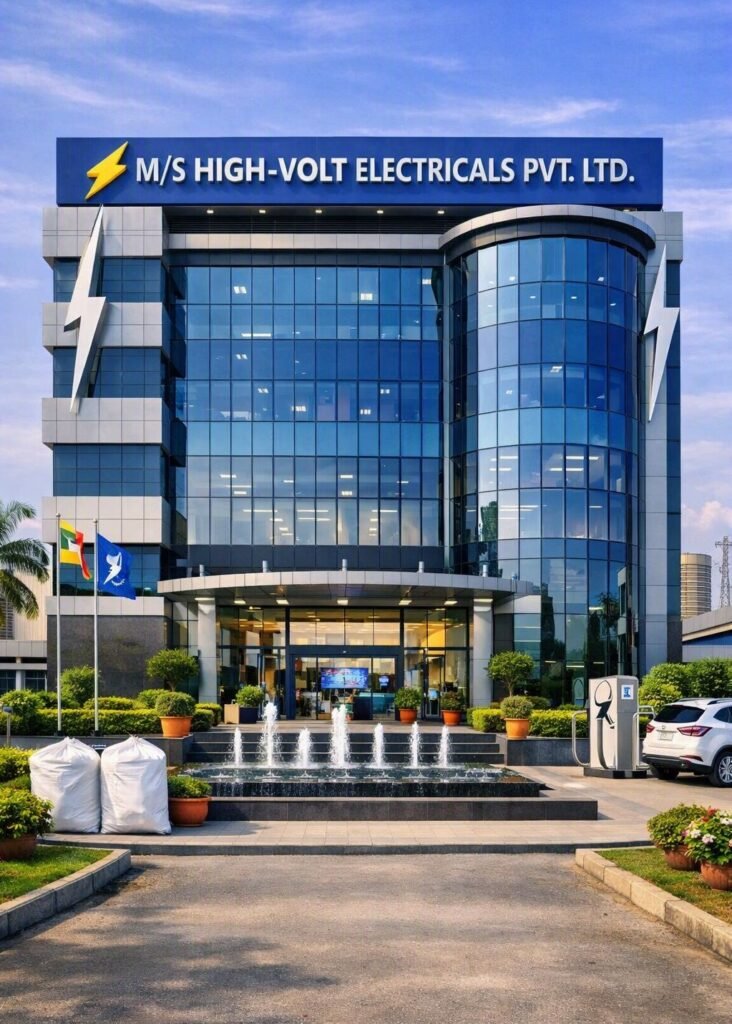
As the quality journey of M/S High-Volt Electricals Pvt. Ltd. developed after the 2022 Welder Qualification Test, the organization increasingly had an opportunity to connect technical qualification with practical workplace discipline. For Subhash Raman Dongarkar, the qualification was not simply a formal achievement. It represented an important step toward strengthening the way welding activities were understood, controlled, documented, and performed.
Welding is an activity in which the quality of the final joint depends on several interconnected factors. A skilled welder must understand the welding process, follow appropriate parameters, prepare the joint correctly, use suitable materials and consumables, and maintain consistent workmanship. Even when a welder possesses significant practical experience, formal qualification provides an additional framework for demonstrating competence under defined conditions.
The qualification documentation for High-Volt Electricals Pvt. Ltd. covered EN 15085-2:2020 / ISO 15614-1 and EN 15085-2:2020 / ISO 9606-2:2004, with an issue date in 2022 and validity through 2024. These documented qualifications became part of the company’s technical quality journey and provided a reference point for its welding-related capabilities.
One of the most important lessons from formal qualification was the importance of consistency. In industrial production, customers generally expect similar levels of workmanship from one job to another. Quality should not depend entirely on individual judgment or circumstances. Procedures and qualified personnel can help establish a more predictable working environment.
For Subhash Raman Dongarkar, this meant encouraging employees to understand that every welding operation contributed to the reputation of the organization. A weld that met expectations was not merely a successful production task; it was evidence of disciplined workmanship. Conversely, a defect could lead to additional inspection, rework, delays, increased costs, or customer dissatisfaction. Preventing such problems therefore became an important part of responsible production.
Workplace standards also became increasingly relevant. A quality-oriented workplace requires appropriate organization of tools, materials, equipment, records, and responsibilities. When workers can clearly identify the materials they are using and understand the requirements of the job, the likelihood of avoidable mistakes can be reduced. Good housekeeping and organized work areas can also support productivity and safety.
The qualification experience encouraged the company to consider these elements as connected rather than separate. Welding quality begins before the arc is struck. It begins with planning and preparation. Materials need to be appropriately identified and prepared. Welding equipment needs to be suitable for the work. Personnel need to understand the applicable requirements. Inspection and documentation need to support verification.
This process also created opportunities for communication. Supervisors could explain requirements to welders before work began. Welders could communicate practical difficulties encountered during production. Quality personnel could provide feedback based on inspection results. Management could use this information to identify areas where additional training or process improvement might be useful.
Such communication is particularly important in organizations where technical work involves multiple stages. A problem identified at one stage can provide useful information for another stage. For example, repeated defects may indicate a need for improved training, better preparation, clearer instructions, equipment maintenance, or closer supervision. Instead of treating every defect as an isolated mistake, an organization can use recurring problems as opportunities to improve its processes.
The qualification journey also strengthened the concept of personal accountability. When welders understand that their competence has been formally assessed, they may develop greater awareness of the importance of maintaining their skills. This does not mean that qualification replaces supervision or inspection. Rather, it complements those activities by establishing a stronger foundation of individual competence.
For Subhash Raman Dongarkar, leadership in this environment involved more than assigning responsibilities. It involved creating awareness about why those responsibilities mattered. Employees who understand the purpose behind a requirement are more likely to follow it consistently than employees who simply receive instructions without context.
The company could also use its qualification experience as a basis for future training. New employees could be introduced to established working practices. Experienced personnel could share practical knowledge with less-experienced workers. Where new requirements emerged, training could help the workforce adapt. Over time, this process could strengthen the organization’s collective technical knowledge.
Another important aspect of the journey was customer confidence. Industrial customers often evaluate suppliers on multiple factors, including technical capability, consistency, responsiveness, documentation, and quality performance. A company able to demonstrate qualified welding capability has an additional piece of evidence supporting its professional credentials.
The qualification did not, by itself, guarantee customer satisfaction or business expansion. Those outcomes depend on many factors, including actual performance, pricing, delivery, service, market conditions, and customer requirements. Nevertheless, formal qualification could contribute to a stronger professional foundation from which the company could pursue its business objectives.
The period covered by the qualification, from 2022 through 2024, therefore provided an opportunity for High-Volt Electricals Pvt. Ltd. to translate technical recognition into practical habits. The true value of the qualification could be reflected in the daily behavior of employees: following procedures, respecting technical requirements, maintaining equipment, recording relevant information, and taking corrective action when necessary.
For Subhash Raman Dongarkar, this stage represented a transition from qualification toward quality culture. The certificate was important, but the practices developed around it were even more significant for long-term organizational development.
As the company continued forward, the focus could increasingly shift toward continuous improvement. Every completed project, inspection result, customer interaction, and employee experience could provide information for learning. The organization could ask what worked well, what could be improved, and how future work could be made more consistent.
Thus, the third chapter of the High-Volt Electricals Pvt. Ltd. journey was about transforming technical qualification into workplace standards. Through disciplined welding practices, employee awareness, communication, documentation, and management involvement, the company could strengthen the foundation on which future technical and commercial growth would depend.
#WelderQualification
Chapter 4: Developing a Culture of Consistency and Customer Confidence
The journey of M/S High-Volt Electricals Pvt. Ltd. after its 2022 Welder Qualification Test entered another important stage as technical qualification began to influence the company’s broader approach to quality. For Subhash Raman Dongarkar, the experience was an opportunity to understand that sustainable industrial development requires more than skilled individuals. It requires a workplace culture in which quality expectations are understood and consistently followed.
Located at J 46-47, MIDC Tarapur, Boisar, Maharashtra, the company operates in an industrial environment where technical performance and reliability are important considerations. In such surroundings, businesses must continuously develop their capabilities to meet customer requirements. Welding competence can form an important part of this capability because the quality of welded work can influence the reliability, appearance, dimensional accuracy, and service performance of fabricated components.
The qualification associated with EN 15085-2:2020 / ISO 15614-1 and EN 15085-2:2020 / ISO 9606-2:2004 provided the company with documented evidence of welding-related competence during the stated validity period from 2022 to 2024. However, the larger objective was to ensure that the principles behind qualification became part of everyday working practices.
Consistency became a central theme in this development.
A customer expects that a company will deliver dependable work repeatedly, not only when a particular individual is present or when a particular project receives extra attention. Consistency requires systems. It requires people to understand their responsibilities, procedures to be available, equipment to be maintained, and inspections to be performed appropriately.
Subhash Raman Dongarkar could use the qualification experience to reinforce this understanding within the organization. Employees could be encouraged to approach each welding assignment with the same level of seriousness, regardless of its size. Preparation could become a standard part of the process rather than something performed only when circumstances demanded it.
This mindset also influenced the way employees could respond to defects. In a quality-oriented workplace, finding a defect should not automatically be viewed as a failure of an individual. It can also be an opportunity to understand why the problem occurred. Was the material properly prepared? Was the equipment functioning correctly? Were the required parameters followed? Was the worker adequately trained? Was the instruction clear?
By asking these questions, organizations can move from simply correcting individual defects toward improving the process that produced them.
For High-Volt Electricals Pvt. Ltd., this approach could support better control over welding activities. When employees understand the causes of potential problems, they can take preventive action. This can reduce unnecessary rework and contribute to better utilization of time and resources.
Customer confidence is also closely connected with consistency. Customers generally want assurance that their requirements will be understood and fulfilled. Technical qualifications can provide part of that assurance, particularly when customers are evaluating an organization’s competence. However, confidence ultimately develops through actual experience—consistent quality, communication, timely responses, and responsible handling of issues.
The welding qualification therefore became one component of the company’s professional identity. It demonstrated an effort to work according to recognized technical requirements and to establish evidence of competence. This could support the company’s conversations with customers and business partners when technical capability was being considered.
Another important development was employee confidence. Formal qualification can encourage workers to recognize the value of their own skills. When a welder’s competence is formally assessed, the individual may develop a stronger sense of responsibility toward maintaining those skills. This can contribute to pride in workmanship.
For management, the challenge was to support this confidence with appropriate resources. Training, equipment maintenance, suitable working conditions, technical instructions, and supervision all contribute to effective performance. A qualified worker still needs a suitable environment in which to apply that competence.
This understanding helped connect human capability with organizational capability. A company can possess talented employees, but without suitable systems and support, their skills may not be used consistently. Similarly, well-designed procedures are of limited value if employees do not understand or follow them. Sustainable quality depends on the interaction between people, processes, equipment, and management.
During the validity period of the qualification, High-Volt Electricals Pvt. Ltd. could therefore continue strengthening these connections. Daily operations could provide opportunities to reinforce lessons learned from the qualification process. Supervisors could observe work practices, employees could share practical feedback, and management could identify areas requiring improvement.
The process also encouraged a forward-looking approach. Industrial organizations cannot remain static. Customer expectations evolve, technology changes, and technical requirements may become more demanding. A company that develops a habit of learning is better positioned to respond to such changes.
For Subhash Raman Dongarkar, quality leadership could therefore involve creating an environment in which employees were encouraged to learn rather than simply follow instructions. Training could explain not only what needed to be done but why it mattered. This could help employees make better decisions when practical situations differed from routine conditions.
The company could also strengthen its internal communication by ensuring that technical expectations were understood before work began. Clear communication between management, supervisors, welders, and inspection personnel could help reduce misunderstandings and support smoother operations.
Another important benefit of this approach was the development of organizational memory. When lessons are documented and shared, they remain available to the company even when employees change roles. Records, work instructions, inspection findings, and training information can collectively create a valuable knowledge base.
This knowledge becomes particularly important for long-term growth. A company’s development is not only about acquiring new customers. It is also about building capabilities that remain useful as the organization expands. Technical knowledge, qualified personnel, controlled processes, and documented experience form part of that institutional capability.
By this stage of the journey, the 2022 qualification could therefore be viewed as more than a certification milestone. It had the potential to influence workplace culture, employee awareness, process discipline, and customer communication.
For High-Volt Electricals Pvt. Ltd., this was a meaningful step toward sustainable development. The organization had an opportunity to take the principles of welding qualification and apply them across its daily activities. For Subhash Raman Dongarkar, it represented an ongoing leadership responsibility: maintaining attention to quality while encouraging people to improve their skills and working methods.
The journey demonstrated an important principle of industrial growth: technical recognition becomes valuable when it is converted into consistent action. Qualification can open the door, but disciplined implementation, employee involvement, customer focus, and continuous learning determine how far an organization can progress.
#EN15085
Chapter 5: Turning Technical Qualification into Operational Excellence
The quality journey of M/S High-Volt Electricals Pvt. Ltd. continued to develop as the organization gained experience from its Welder Qualification Test. For Subhash Raman Dongarkar, the qualification obtained in 2022 was not simply a formal milestone. It offered an opportunity to strengthen operational discipline and encourage employees to connect technical requirements with the everyday objectives of the business.
The company’s documented scope involved Welder Qualification Test activities associated with EN 15085-2:2020 / ISO 15614-1 and EN 15085-2:2020 / ISO 9606-2:2004, with an issue date in 2022 and validity through 2024. These qualifications established an important technical reference for the organization. The next challenge was to ensure that the knowledge and discipline associated with qualification continued to influence actual work.
Operational excellence begins with controlled processes. In welding operations, consistency depends upon numerous details. Materials need to be identified and prepared correctly. Equipment must be suitable and maintained. Welding personnel must understand the applicable requirements. Work needs to be performed according to defined conditions, and completed joints may require appropriate examination or inspection.
Each of these activities contributes to the final outcome.
For Subhash Raman Dongarkar, this meant recognizing that quality could not be assigned exclusively to a quality department. Everyone involved in production had a role. Welders were responsible for workmanship. Supervisors were responsible for coordination and monitoring. Technical personnel could support process understanding. Management had responsibility for providing resources and establishing expectations.
When these responsibilities work together, quality becomes integrated into production rather than becoming a separate activity performed after production.
This approach could also improve efficiency. Poor-quality work can create rework, additional inspection, material wastage, delays, and customer complaints. By preventing problems at the source, an organization can potentially use its resources more effectively. The objective is not simply to inspect defects after they occur but to create conditions in which defects are less likely to occur.
The qualification experience encouraged this preventive way of thinking.
Instead of asking only whether a completed weld passed inspection, employees could also consider whether the conditions that produced the weld were properly controlled. Were the correct materials used? Was the equipment in suitable condition? Were the required parameters followed? Was the joint prepared appropriately? Did the welder understand the work instructions?
These questions help establish a more comprehensive approach to quality.
Documentation also played an important role. Technical records can provide evidence that activities were performed under appropriate conditions. They can help trace work, support internal reviews, and provide useful information when investigating problems. For an industrial organization, good documentation can also improve communication because information becomes available in a consistent form.
High-Volt Electricals Pvt. Ltd. could use the period of qualification validity to strengthen such practices. The experience gained from actual work could be recorded and used to identify recurring issues. If similar problems appeared repeatedly, management could investigate their underlying causes and consider appropriate corrective action.
This created a cycle of improvement.
A problem could lead to investigation. Investigation could lead to a corrective measure. The corrective measure could be implemented and monitored. The resulting experience could then be used to prevent similar problems in the future.
For Subhash Raman Dongarkar, this approach represented a practical way of converting certification into organizational learning. Instead of treating the qualification as an endpoint, it could become a source of information for improving the company’s operations.
Employee development was another important part of this process. Qualified welders require continued attention to their skills. As employees encounter different jobs and technical challenges, their experience grows. Sharing that experience can benefit the wider workforce. Senior employees can help less-experienced personnel understand practical aspects of welding, while formal training can reinforce technical principles.
Such knowledge-sharing can also strengthen teamwork. When workers understand how their activities affect the work of others, coordination improves. Welders, supervisors, inspectors, and management can work toward common objectives instead of viewing quality as the responsibility of a single department.
The company’s industrial environment at MIDC Tarapur provided opportunities to apply these principles in practical situations. Industrial work often involves deadlines, customer specifications, changing requirements, and coordination among different activities. Maintaining quality under such conditions requires discipline.
Operational excellence therefore does not mean working slowly or adding unnecessary procedures. It means organizing work so that people can perform their responsibilities correctly and efficiently. Clear instructions, appropriate planning, qualified personnel, suitable equipment, and effective communication can all contribute to this objective.
Customer expectations also influence operational excellence. Customers want their requirements to be understood and delivered consistently. When a company demonstrates technical competence and organized processes, it can strengthen its professional credibility. The 2022 qualification gave High-Volt Electricals Pvt. Ltd. documented evidence that could support this credibility during the relevant validity period.
At the same time, the company had to recognize that qualification alone does not guarantee customer satisfaction. Performance depends on many factors, including product or service quality, delivery, communication, responsiveness, commercial conditions, and the ability to meet specific project requirements. Qualification is therefore one component of a broader business system.
For Subhash Raman Dongarkar, this broader perspective was important. Technical quality and business growth should support each other. Reliable work can strengthen customer relationships, while customer feedback can help identify areas for technical improvement.
The qualification journey could also influence future business opportunities. When an organization develops stronger technical capabilities, it may become better prepared to respond to projects requiring documented welding competence. The ability to demonstrate qualified personnel can be relevant when customers evaluate suppliers or contractors.
Thus, the period following the 2022 qualification was a period of consolidation. High-Volt Electricals Pvt. Ltd. had the opportunity to take the technical recognition it had achieved and transform it into operational habits. The emphasis could increasingly move toward prevention, consistency, documentation, employee development, and continuous improvement.
For Subhash Raman Dongarkar, this stage of the journey demonstrated that sustainable growth is built through repeated actions. Every properly prepared job, every correctly performed weld, every maintained record, every trained employee, and every lesson learned contributes to organizational capability.
The qualification provided a foundation. Operational discipline gave that foundation practical meaning.
As High-Volt Electricals Pvt. Ltd. moved through its 2022–2024 qualification period, the company could continue developing a workplace in which technical competence and operational excellence worked together. This approach offered a path toward stronger processes, improved confidence, and continued professional development.
#ISO15614
Chapter 6: Expanding Professional Capability Through Quality
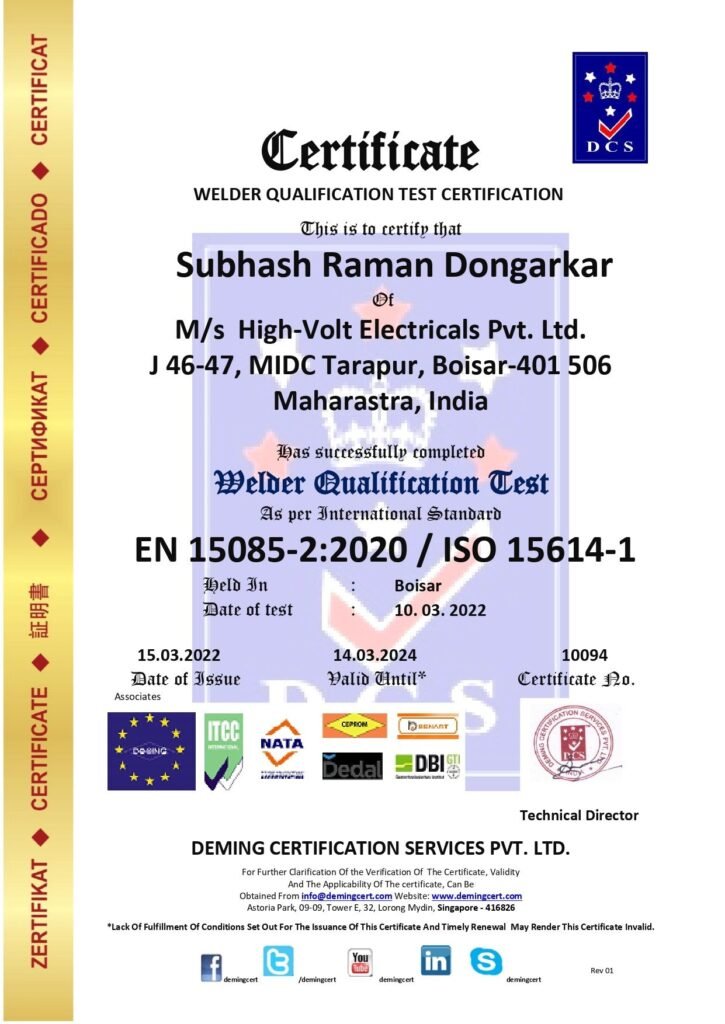
As M/S High-Volt Electricals Pvt. Ltd. continued its quality journey, the period following the 2022 Welder Qualification Test became an opportunity to transform technical recognition into broader professional capability. For Subhash Raman Dongarkar, quality was increasingly connected with the company’s people, processes, customer relationships, and long-term development.
The documented qualification covered Welder Qualification Test activities associated with EN 15085-2:2020 / ISO 15614-1 and EN 15085-2:2020 / ISO 9606-2:2004. The qualification was issued in 2022 and recorded as valid through 2024. Within that period, the company had an opportunity to strengthen the practices surrounding welding competence and develop a more systematic approach to technical work.
One of the most valuable outcomes of qualification was professional awareness. When employees work according to recognized requirements, they begin to understand that technical quality involves much more than the visible appearance of a finished weld. Quality includes preparation, process control, competence, inspection, documentation, and responsibility.
For a welder, this understanding can change the approach to daily work. Rather than simply completing a joint, the welder becomes conscious of the conditions required to achieve an acceptable result. Correct preparation, suitable equipment, appropriate technique, and adherence to defined requirements become part of the job rather than optional considerations.
Subhash Raman Dongarkar could use this awareness to encourage a stronger culture of responsibility within High-Volt Electricals Pvt. Ltd. Employees could be encouraged to ask questions when requirements were unclear and report difficulties before they became larger problems. This type of communication can help prevent mistakes and improve coordination.
Professional capability also depends on continuous learning. Industrial technology does not remain unchanged. Customers may introduce new specifications, projects may involve different materials or welding applications, and technical requirements may evolve. A workforce that remains willing to learn can respond more effectively to such changes.
Training therefore became an important complement to qualification.
A qualified worker may possess demonstrated competence for specified conditions, but continued development helps maintain awareness and adaptability. Training can include technical procedures, workplace safety, equipment operation, documentation, inspection requirements, and lessons learned from previous projects.
For management, supporting training represents an investment in organizational capability. The benefits may not always be immediately visible, but skilled and informed employees can contribute to more consistent work and better problem-solving.
Another area of professional development was supervision. Effective supervisors act as a connection between management expectations and practical production activities. They help employees understand priorities, monitor working conditions, identify deviations, and communicate issues. Strong supervision can therefore support both productivity and quality.
The qualification journey gave High-Volt Electricals Pvt. Ltd. an opportunity to strengthen this connection. Supervisors could use documented requirements as references when explaining expectations to employees. They could also encourage workers to maintain discipline even when production schedules were demanding.
This balance between productivity and quality is important in industrial operations. Meeting a deadline is valuable, but rushing work at the expense of quality can create larger problems later. Rework, delays, rejection, and customer dissatisfaction can consume more resources than careful preparation would have required.
Consequently, quality can be viewed as an element of productivity rather than an obstacle to it.
When work is performed correctly the first time, organizations can potentially reduce unnecessary repetition. Materials are used more efficiently, workers spend less time correcting errors, and production planning becomes more predictable. The qualification experience could help employees appreciate this relationship.
Customer relationships also benefited from a more professional approach to technical capability. A customer seeking engineering or welding-related services may want assurance that the organization has appropriate skills and understands relevant requirements. Documented qualifications can provide useful evidence during such discussions.
However, Subhash Raman Dongarkar could also recognize that professional credibility must be supported by actual performance. A certificate may establish a qualification, but customer trust develops through repeated experiences of satisfactory work, communication, reliability, and responsiveness.
This understanding encouraged a broader view of growth.
Growth was not necessarily only about increasing the number of projects. It could also mean developing the company’s ability to handle work responsibly, improving internal knowledge, reducing avoidable errors, strengthening documentation, and creating stronger relationships with customers.
The MIDC Tarapur location provided an industrial setting in which these capabilities could become particularly relevant. Companies operating in industrial clusters interact with other technical organizations and customers with varying requirements. Professional standards can therefore influence how a business is perceived within its commercial environment.
High-Volt Electricals Pvt. Ltd. could build on its qualification experience by maintaining organized technical information and ensuring that employees understood the significance of their roles. Documentation could provide historical information, while employee experience could provide practical knowledge. Combining these resources could strengthen organizational memory.
This became especially important when considering employee changes. If technical knowledge exists only in the minds of individuals, an organization can lose valuable experience when people leave or change responsibilities. Documenting procedures and lessons learned helps preserve institutional knowledge.
For Subhash Raman Dongarkar, leadership could therefore involve creating systems that allow knowledge to remain within the organization. Employees could be encouraged to share experiences, discuss technical problems, and suggest practical improvements.
Such an environment can also improve employee engagement. Workers who believe their observations are valued may be more willing to identify potential problems and participate in improvement activities. Over time, this can create a more collaborative workplace.
The qualification period from 2022 to 2024 thus represented more than a period of certificate validity. It provided a framework within which the organization could develop its technical and professional capabilities. Every project could become an opportunity to apply what had been learned.
The experience also reinforced an important management principle: quality improvement is a continuing process. There is always room to improve preparation, communication, documentation, training, supervision, and customer service.
For High-Volt Electricals Pvt. Ltd., the Welder Qualification Test was therefore one part of a broader professional development journey. It helped connect individual competence with organizational capability. Under the leadership and direction of Subhash Raman Dongarkar, the company could continue building upon this foundation through training, process discipline, communication, and continuous learning.
The result was not simply a stronger technical record. It was an opportunity to create a more mature quality culture—one in which employees understood their responsibilities, management supported improvement, and customers could experience the benefits through consistent professional performance.
#ISO9606
Chapter 7: Customer Trust, Reliability, and Sustainable Business Development
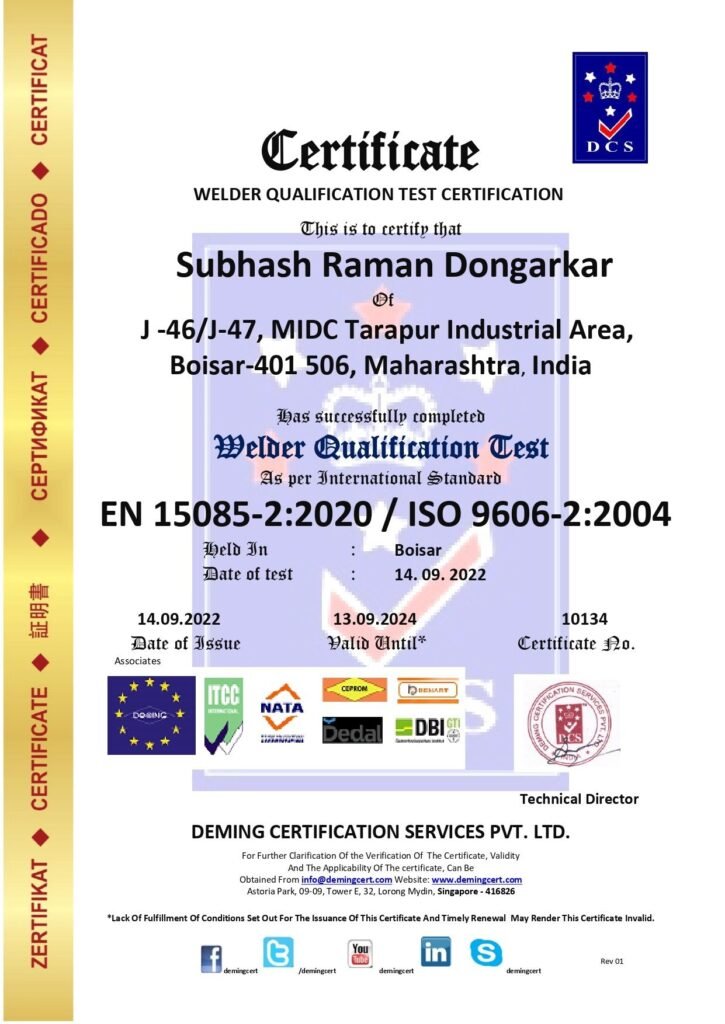
The quality journey of M/S High-Volt Electricals Pvt. Ltd. continued to mature as the organization gained practical experience from its welding qualification. For Subhash Raman Dongarkar, the significance of the 2022 qualification extended beyond technical documentation. It provided an opportunity to strengthen the relationship between technical competence, reliable execution, customer confidence, and long-term business development.
The company’s documented scope was Welder Qualification Test, associated with EN 15085-2:2020 / ISO 15614-1 and EN 15085-2:2020 / ISO 9606-2:2004, with the qualification issued in 2022 and stated as valid through 2024. These qualifications formed an important part of the company’s technical credentials during the applicable period.
In an industrial business, customer trust is developed through repeated experiences. Customers need confidence that a supplier understands requirements, employs competent personnel, controls its work, communicates clearly, and responds responsibly when difficulties arise. Technical qualification can support that confidence by providing documented evidence of competence, but the organization must demonstrate that competence through its actual work.
For High-Volt Electricals Pvt. Ltd., welding quality was therefore connected directly with professional reputation. A well-executed welded joint can contribute to reliable finished work, while inconsistent workmanship can result in rework, delays, additional inspection, or customer concerns. Maintaining consistent practices became an important part of protecting the company’s professional relationships.
Subhash Raman Dongarkar could encourage employees to understand that every completed job contributed to the company’s reputation. The customer might see only the finished product, but behind that product were numerous decisions and activities. Material preparation, welding technique, equipment condition, inspection, documentation, and communication all influenced the final result.
This understanding helped shift attention from short-term completion toward long-term reliability.
One important aspect of customer trust is transparency. If a technical difficulty occurs, communicating it early can allow the customer and supplier to work together toward a solution. Hiding problems may create greater difficulties later. A quality-oriented organization therefore benefits from encouraging employees to report deviations and management to respond appropriately.
The qualification experience could support this culture by reinforcing the importance of objective requirements. When work is evaluated against defined technical conditions, discussions about quality can become more structured. Employees can refer to documented requirements rather than relying entirely on personal opinion.
This also supports internal decision-making.
For example, if an inspection identifies a problem, the organization can investigate whether the cause involved materials, equipment, preparation, technique, instructions, or another factor. The objective is not merely to identify who was involved but to understand what happened and prevent recurrence where practical.
Such corrective thinking can strengthen reliability over time.
Another important element was maintaining employee competence. Qualifications and training provide a foundation, but employees also learn through experience. Every project can expose workers to new challenges. Sharing those experiences allows lessons from one job to benefit future work.
Subhash Raman Dongarkar could therefore encourage experienced personnel to support knowledge transfer within the organization. New or less-experienced employees could learn from established practices while still receiving appropriate technical guidance. This creates a stronger workforce and reduces dependence on a small number of individuals.
Customer service also became part of the quality discussion. A technically capable organization still needs to communicate effectively. Customers may have questions about technical requirements, schedules, documentation, or project status. Timely and professional communication can strengthen confidence.
This demonstrates that quality is not limited to production.
Quality can also be reflected in how a company receives an inquiry, understands a requirement, prepares a quotation, communicates progress, delivers work, and responds after completion. For an organization seeking sustainable growth, these activities should support one another.
The qualification journey therefore offered High-Volt Electricals Pvt. Ltd. an opportunity to view business development from a broader perspective. Growth could be supported by technical competence, but it also depended upon reliability, customer relationships, employee development, and effective management.
The MIDC Tarapur industrial environment provided a competitive setting in which these qualities could become important differentiators. Organizations serving industrial customers often need to demonstrate their ability to meet defined requirements. Documented qualifications can be useful evidence, especially when customers are assessing technical capabilities.
However, sustainable development requires continued improvement. A qualification valid through 2024 represented a defined period, and maintaining organizational capability beyond that period requires ongoing attention. The company could use the experience gained during the qualification period to determine future training requirements, technical priorities, and process improvements.
This forward-looking approach was particularly important for Subhash Raman Dongarkar. A business cannot depend permanently on past achievements. Technical credentials need to be supported by current competence and current practices. Lessons from earlier qualification activities can provide a foundation, but continued development is necessary.
The company could also strengthen its internal review processes. Management reviews, technical discussions, inspection findings, customer feedback, and employee observations can provide valuable information about performance. When such information is considered systematically, management can make better-informed improvement decisions.
In this environment, employees become contributors to organizational growth. A welder who identifies a recurring technical issue may provide information that helps prevent future defects. A supervisor who identifies a process weakness may suggest a better working method. A quality professional who analyzes inspection findings may identify a training need.
Each observation can contribute to the organization’s collective knowledge.
For High-Volt Electricals Pvt. Ltd., this represented an important transition from individual qualification toward organizational learning. The qualification of welding personnel provided a technical foundation, while the company culture determined how effectively that foundation was used.
Subhash Raman Dongarkar’s role was therefore closely connected with creating an environment in which quality and business objectives supported each other. Employees needed to understand that quality was not separate from growth. Reliable work can reduce avoidable costs, support customer confidence, strengthen reputation, and create opportunities for continued professional relationships.
The period from 2022 to 2024 could thus be understood as a stage in which technical qualification, workplace discipline, customer expectations, and organizational development came together.
The story of High-Volt Electricals Pvt. Ltd. was becoming a story not simply about obtaining welding qualification, but about using qualification as a foundation for responsible industrial development. Through competent personnel, controlled processes, transparent communication, and continuous learning, the organization could continue strengthening its professional capabilities.
For Subhash Raman Dongarkar, the lesson was clear: customer trust is built through consistency, and consistency is built through disciplined people and processes. The qualification provided an important starting point, while daily performance transformed that qualification into practical value.
#WeldingQuality
Chapter 8: Continuous Improvement and Preparing for the Future
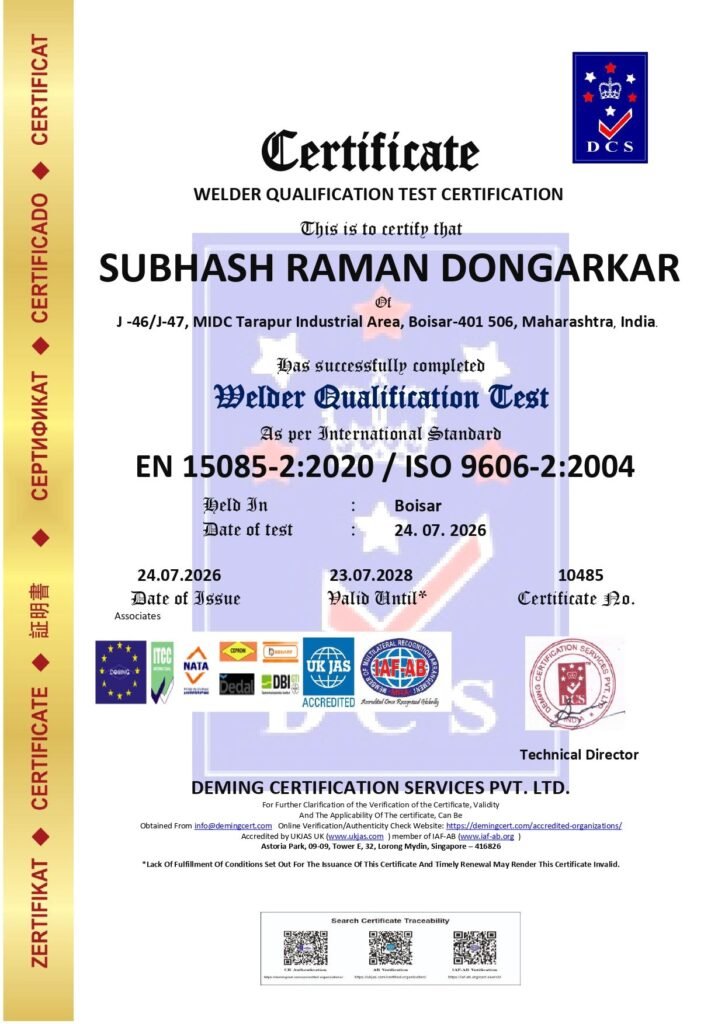
As M/S High-Volt Electricals Pvt. Ltd. progressed through the period covered by its welding qualification, the organization had an opportunity to look beyond the initial achievement and consider how technical competence could support continued improvement. For Subhash Raman Dongarkar, the qualification achieved in 2022 represented a foundation upon which future capabilities could be developed.
The company’s documented scope covered the Welder Qualification Test, with qualifications associated with EN 15085-2:2020 / ISO 15614-1 and EN 15085-2:2020 / ISO 9606-2:2004. The qualification was issued in 2022 and recorded as valid through 2024. During this period, the company could use the experience to strengthen its approach to welding quality, employee development, documentation, and operational control.
Continuous improvement begins with the recognition that no process is permanently perfect. Even when a welding operation produces acceptable results, there can be opportunities to improve preparation, efficiency, communication, safety, documentation, or consistency. An organization committed to long-term development regularly examines its working methods and considers whether better approaches are possible.
For High-Volt Electricals Pvt. Ltd., this philosophy could be applied to welding operations in several ways. Employees could review recurring defects and identify their possible causes. Supervisors could observe production activities and identify areas where instructions could be clearer. Management could review training requirements and equipment needs. Technical personnel could evaluate whether existing practices remained suitable for changing customer or project requirements.
This created a practical improvement cycle.
The first step was identifying an issue or opportunity. The next was understanding its cause. Once the cause was understood, an appropriate improvement could be introduced. The organization could then observe whether the change produced the intended result.
Such a cycle encourages employees to think beyond immediate problem-solving.
For Subhash Raman Dongarkar, encouraging this mindset could strengthen the company’s overall culture. Instead of waiting for customers or inspectors to identify problems, employees could be encouraged to identify potential issues themselves. Prevention is generally more efficient than correction because it seeks to address problems before they affect completed work.
Training played an important role in this approach. Welding personnel need practical competence, but they also benefit from continuing awareness of procedures, equipment, materials, inspection expectations, and safety practices. Training can help employees understand changes and reinforce existing knowledge.
The organization could also encourage experienced workers to share their practical knowledge. A senior welder may have encountered unusual joint configurations, material behavior, equipment challenges, or production situations that are not always captured in formal instructions. Sharing these experiences can strengthen the knowledge available to the wider workforce.
Documentation helps preserve this knowledge.
When important lessons are recorded, they can be referred to later. Work instructions, inspection findings, training records, qualification documents, and corrective-action information can create a useful organizational history. This information can help management identify patterns and make decisions based on evidence rather than memory alone.
For High-Volt Electricals Pvt. Ltd., maintaining such records could support future qualification and business activities. When a company has organized technical information, it can respond more efficiently to customer requests and internal reviews.
The qualification experience also highlighted the importance of maintaining competent personnel. Workforce development should not stop after an employee successfully completes a qualification. Skills need to remain relevant to the work being performed. If new welding applications or technical requirements arise, additional training or qualification may be necessary.
This forward-looking approach can help an organization remain prepared.
Another aspect of continuous improvement is equipment and resource management. Welding quality can be influenced by the condition and suitability of equipment. Regular maintenance, appropriate settings, and responsible use can contribute to consistent performance. Management therefore has an important role in ensuring that employees have suitable resources.
For Subhash Raman Dongarkar, this meant balancing investment with operational requirements. Not every improvement requires major expenditure. Sometimes improvements can come from better organization, clearer communication, improved documentation, or more effective training. Other improvements may require equipment, technology, or specialist expertise.
The key is identifying what will provide practical value.
Customer feedback can also support improvement. Customers may identify areas where communication, documentation, delivery, or technical performance could be strengthened. Rather than treating feedback only as criticism, a quality-oriented company can use it as information.
When feedback is analyzed objectively, it can help identify opportunities for improvement.
This approach can also strengthen customer relationships. Customers are more likely to have confidence in organizations that demonstrate a willingness to listen and improve. Responding constructively to feedback can show that the company takes its responsibilities seriously.
The industrial environment at MIDC Tarapur made continuous improvement particularly relevant. Engineering and manufacturing organizations operate in markets where customer expectations, technology, competition, and technical requirements can change. Companies therefore need to develop the ability to adapt while maintaining quality.
The qualification obtained in 2022 provided a structured starting point for this development. It gave High-Volt Electricals Pvt. Ltd. an opportunity to strengthen its understanding of welding competence and recognized requirements. The following period could then be used to apply those lessons in practical operations.
For Subhash Raman Dongarkar, this stage represented a shift from achievement to sustainability. Obtaining qualification is an important milestone, but maintaining a capable workforce and disciplined processes requires continuing effort.
The validity period through 2024 therefore offered valuable time for the organization to consolidate its practices. Employees could gain experience, management could evaluate performance, and the company could identify future priorities.
Looking toward the future, the organization could consider additional areas of development. These might include expanding employee training, strengthening technical documentation, improving internal communication, enhancing inspection practices, and pursuing relevant qualifications where business requirements justify them.
The objective would not simply be to collect additional certificates. Each qualification or improvement initiative should contribute to actual organizational capability.
This distinction is important. Sustainable growth comes from useful systems rather than paperwork alone. A certificate can provide evidence, but the underlying competence, process discipline, and organizational behavior create the real operational value.
For M/S High-Volt Electricals Pvt. Ltd., the journey of Subhash Raman Dongarkar demonstrated this principle. The 2022 welding qualification could serve as a foundation for continued learning and development. Through employee involvement, management commitment, customer feedback, technical discipline, and continuous improvement, the organization could strengthen its readiness for future challenges.
The eighth chapter of this journey therefore focused on sustainability. Quality was not something to achieve once and then forget. It was a continuing responsibility. Each project could provide new learning, each employee could contribute knowledge, and each challenge could become an opportunity to improve.
By adopting this perspective, High-Volt Electricals Pvt. Ltd. could carry forward the lessons of its 2022–2024 qualification period and use them as part of a longer journey toward technical maturity, professional reliability, and sustainable industrial growth.
#WeldingCertification
Chapter 9: Leadership, Organizational Learning, and Long-Term Growth
The development of M/S High-Volt Electricals Pvt. Ltd. during and after its 2022 Welder Qualification Test can be understood as a journey in which technical competence gradually became connected with organizational learning. For Subhash Raman Dongarkar, the qualification represented not only an achievement in welding competence but also an opportunity to strengthen leadership, employee responsibility, process discipline, and the company’s long-term approach to industrial work.
The documented qualification covered Welder Qualification Test activities associated with EN 15085-2:2020 / ISO 15614-1 and EN 15085-2:2020 / ISO 9606-2:2004. The qualification was issued in 2022 and recorded as valid through 2024. During this period, the company could use its qualification experience to develop stronger systems and a deeper understanding of quality-oriented operations.
Leadership is particularly important in any quality journey because employees take direction from the priorities established by management. When management demonstrates that technical competence, safety, documentation, customer requirements, and consistent workmanship matter, employees receive a clear message about organizational expectations.
For Subhash Raman Dongarkar, leadership could therefore involve more than supervising individual assignments. It could mean establishing an environment in which employees understood why quality requirements were important and how their individual actions contributed to the company’s reputation.
A welding operation may appear to be a single technical activity, but it involves multiple responsibilities. Someone prepares the material. Someone selects or verifies the required equipment and consumables. The welder performs the work. Supervisors monitor the activity. Inspection personnel verify results where required. Management provides resources and establishes the broader framework.
When these responsibilities are coordinated effectively, the organization becomes stronger.
This understanding also encouraged organizational learning. Every completed project contains information that can potentially be useful for future work. A successful job can reveal an effective method. A defect can reveal a weakness. A customer question can reveal an unclear instruction. An employee suggestion can identify an efficiency opportunity.
Organizations grow when they capture and use this information.
High-Volt Electricals Pvt. Ltd. could strengthen this process by encouraging employees to communicate their experiences. Regular discussions could help identify recurring issues and determine whether changes to procedures, training, supervision, or equipment were appropriate.
The objective would not be to create unnecessary meetings or paperwork. Rather, the purpose would be to ensure that useful knowledge does not disappear after a project is completed.
Documentation can play an important role in this process. Records provide evidence of activities and create a history that can be referred to later. Qualification documents, training records, inspection information, process instructions, and corrective-action records can collectively support organizational memory.
For Subhash Raman Dongarkar, this organizational memory could become particularly valuable as the company developed. A growing organization needs systems that allow knowledge to remain available even when individual employees change responsibilities.
Employee development was another important part of leadership. A company cannot depend indefinitely on a single qualified individual. Developing multiple competent employees can strengthen operational resilience. Training and mentoring can help less-experienced workers develop their abilities while experienced personnel can share practical knowledge.
The qualification process itself could serve as an example of the value of formal competence assessment. It demonstrated that welding capability could be evaluated against defined technical requirements. The same principle of structured learning could be applied to other areas of the organization where appropriate.
Leadership also involves making responsible decisions when problems arise.
Industrial operations can experience unexpected situations. Materials may not arrive as planned. Equipment may require maintenance. A customer may change requirements. Production schedules may become tight. A quality concern may emerge during inspection. The response to such situations can reveal the strength of an organization’s culture.
A mature organization does not simply seek the fastest solution. It considers the technical and customer implications before deciding how to proceed. Employees should feel able to raise concerns without hesitation when quality may be affected.
This approach can reduce the risk of problems being hidden until they become more difficult to resolve.
For High-Volt Electricals Pvt. Ltd., the welding qualification provided a useful framework for reinforcing this responsibility. When technical requirements are clearly understood, employees have a stronger basis for deciding when a situation requires attention or escalation.
Customer relationships also depend on this leadership culture. Customers expect suppliers to be transparent and responsible. If a problem occurs, timely communication and appropriate corrective action can help preserve professional relationships.
At the same time, long-term growth requires commercial awareness. Technical excellence must be balanced with cost, delivery, customer needs, workforce capacity, and business planning. Quality management should therefore support business objectives rather than operate independently from them.
Subhash Raman Dongarkar’s role in this environment could involve maintaining this balance. Investment in training and quality should produce practical value. Process improvements should ideally contribute to reliability or efficiency. Documentation should support decision-making rather than become unnecessary administrative work.
This practical approach can make quality systems more sustainable.
The company’s location in MIDC Tarapur, Boisar, also placed it within an industrial environment where professional credibility could influence business relationships. Organizations that can demonstrate technical competence and responsible practices may have more opportunities to participate in work where such capabilities are relevant.
However, long-term development remains dependent on actual performance. The qualification period from 2022 to 2024 provided a valuable foundation, but future growth would depend upon maintaining competence, learning from experience, responding to customers, and adapting to changing requirements.
For Subhash Raman Dongarkar, the most important lesson from the qualification journey could therefore be described as leadership through consistency. Leadership does not always require dramatic changes. It can be demonstrated through repeated attention to small but important activities: ensuring employees understand requirements, supporting training, reviewing problems, maintaining records, listening to customers, and encouraging responsible workmanship.
Over time, these actions can shape organizational culture.
A quality culture becomes visible when employees begin to take ownership without waiting for constant supervision. Workers check their own work. Supervisors address problems early. Employees share useful information. Management listens to technical concerns. Customers receive clear communication. Lessons are carried forward from one project to the next.
This is the type of organizational learning that can support sustainable development.
The 2022 qualification of M/S High-Volt Electricals Pvt. Ltd. therefore represented more than a technical credential. It provided an opportunity to strengthen the relationship between competence and leadership. Through the period of validity until 2024, the company could build experience and develop practices that supported future improvement.
For Subhash Raman Dongarkar, this journey illustrated that organizational growth is created collectively. Qualified personnel, responsible leadership, disciplined processes, employee learning, and customer confidence all contribute to the development of a professional industrial organization.
As the company looked beyond the qualification period, the lessons learned could remain valuable. The certificate had a defined validity period, but the knowledge gained from pursuing and maintaining technical qualification could continue to influence the organization’s approach to quality.
The ninth chapter of the journey was therefore about people and leadership. Technical standards establish requirements, but people bring those requirements to life. Through responsible leadership and organizational learning, High-Volt Electricals Pvt. Ltd. could continue developing the capabilities needed for its future.
#IndustrialWelding
Chapter 10: The Legacy of Quality and the Road Ahead
The journey of Subhash Raman Dongarkar and M/S High-Volt Electricals Pvt. Ltd. is a story of technical development, professional discipline, and a continuing commitment to quality. Located at J 46-47, MIDC Tarapur, Boisar, Maharashtra, the company experienced an important milestone in 2022 through its Welder Qualification Test activities associated with EN 15085-2:2020 / ISO 15614-1 and EN 15085-2:2020 / ISO 9606-2:2004.
The qualification documentation recorded an issue date in 2022 and validity through 2024. These qualifications provided documented recognition of welding competence during the applicable period. More importantly, the experience created an opportunity for the company to strengthen the principles of competence, process control, employee responsibility, documentation, and continuous improvement.
The final chapter of this journey is therefore not simply about looking backward. It is about understanding what the qualification experience could contribute to the future.
For Subhash Raman Dongarkar, one of the central lessons was that quality begins with people. Standards and procedures provide a framework, but qualified and responsible personnel are necessary to put those requirements into practice. Welding requires technical understanding, practical skill, concentration, and discipline. A qualified welder therefore becomes an important contributor to the organization’s overall performance.
The company could build upon this understanding by continuing to invest in employee knowledge. Training, experience sharing, technical discussions, and appropriate qualification activities can help maintain workforce competence. As technology and customer requirements develop, employees may need to acquire additional knowledge or qualifications relevant to their responsibilities.
Another important lesson was the value of process discipline.
A strong quality culture does not depend on occasional inspections. It develops through consistent preparation, controlled working methods, appropriate equipment, competent personnel, effective supervision, and suitable documentation. These practices can help reduce variation and provide greater confidence in the work being performed.
For High-Volt Electricals Pvt. Ltd., the 2022 qualification could therefore serve as a reference point for continuing improvement. The company could review the lessons learned during the qualification period and determine which practices should be maintained, strengthened, or developed further.
Documentation would continue to play an important role. Technical records preserve organizational knowledge. They can help demonstrate competence, support traceability, assist with audits or customer reviews, and provide information for future improvement activities. Well-maintained documentation can therefore become a business resource rather than simply an administrative requirement.
Customer relationships are another important part of the legacy.
Technical qualification may help establish professional credibility, but long-term customer confidence comes from actual performance. Customers judge organizations through their experiences with quality, communication, delivery, responsiveness, and problem-solving. A company that consistently listens to customers and responds responsibly can strengthen its professional relationships over time.
Subhash Raman Dongarkar could therefore continue to view customer feedback as a source of learning. Positive feedback can indicate which practices are working effectively, while concerns can identify opportunities for improvement. Both forms of information can contribute to organizational development.
The company’s industrial location at MIDC Tarapur, Boisar, places it within a wider environment of manufacturing and engineering activity. Such an environment can provide opportunities for organizations to develop specialized capabilities and establish professional relationships. Technical competence can become increasingly important as customers seek suppliers that understand quality expectations and can provide appropriate evidence of capability.
At the same time, future development should remain grounded in actual organizational needs. Pursuing a qualification should have a clear purpose. Training should address real competency requirements. Process improvements should provide practical value. Documentation should support operations. Investment decisions should consider customer needs and business objectives.
This practical approach can help ensure that quality initiatives contribute to sustainable development.
The qualification journey also demonstrated the importance of continuous improvement. Even when processes perform successfully, organizations can learn from experience. New projects may reveal new challenges. Employees may identify more efficient methods. Customers may introduce different requirements. Technology may create new opportunities.
A company prepared to learn can adapt more effectively.
For High-Volt Electricals Pvt. Ltd., the experience from 2022 to 2024 could therefore become part of an organizational knowledge base. The formal validity of a qualification has a defined period, but the principles learned through the process can remain useful beyond that date.
This distinction is important. A certificate has an issue date and validity period. Organizational learning can continue indefinitely.
The story of Subhash Raman Dongarkar also illustrates the relationship between individual achievement and organizational growth. A qualified individual can contribute technical competence, but the company creates greater value when that competence is integrated into its broader systems. Training, supervision, documentation, inspection, management support, and customer communication can transform individual capability into organizational capability.
That transformation is an important part of sustainable growth.
The company’s future can therefore be approached with the same principles that supported its qualification journey: competence, responsibility, consistency, learning, and customer focus. Each new project can provide an opportunity to apply these principles. Each challenge can provide an opportunity to improve. Each employee can contribute to the company’s technical culture.
For Subhash Raman Dongarkar, this represents a continuing leadership responsibility. Maintaining quality requires attention every day. It requires decisions that may not always be visible to customers but have a direct effect on the final result. Choosing appropriate training, supporting competent employees, maintaining equipment, reviewing problems, and encouraging honest communication are all examples of this responsibility.
The broader lesson is that professional growth is built step by step.
The Welder Qualification Test was one such step. The qualifications associated with EN 15085-2:2020 / ISO 15614-1 and EN 15085-2:2020 / ISO 9606-2:2004 provided a structured technical milestone in 2022. The period through 2024 offered an opportunity to apply the associated principles and develop further organizational experience.
As the company moved beyond that period, the knowledge and discipline gained could remain part of its professional foundation.
The story of M/S High-Volt Electricals Pvt. Ltd. and Subhash Raman Dongarkar is therefore best understood not as a story ending with a certificate, but as a continuing quality journey. The qualification marked a point in time, while the commitment to competence and improvement can continue into future projects and future generations of employees.
The legacy of the journey lies in the habits it encourages: doing work carefully, respecting technical requirements, developing people, learning from experience, listening to customers, and continuously seeking better ways to operate.
For an industrial organization, these principles provide a meaningful foundation for responsible development. The future will bring new requirements and new challenges, but the lessons of quality remain relevant.
The journey that began with formal welding qualification in 2022 can therefore continue as a broader journey toward technical maturity, professional credibility, and sustainable organizational growth.
For Subhash Raman Dongarkar and M/S High-Volt Electricals Pvt. Ltd., quality is not merely a historical achievement. It is an ongoing responsibility—and an opportunity to build a stronger future through knowledge, discipline, competence, and continuous improvement.
#QualityAssurance
#WeldingExcellence #TechnicalCompetence #QualityImprovement #RailwayWelding #ManufacturingQuality
Take the Next Step Today
Don’t wait to enhance your business’s quality and efficiency. Partner with Mayu Group Global and experience the transformation that comes with expert consultancy and training. Contact us today to learn more about how we can help you achieve your business goals. Reach out via phone at
+91-9322728183, visit our website at www.mayugroup.com, or email us at investor@mayugroup.com Let us be your guide on the journey to excellence and innovation.