Vrindawan Skill Development Center
- Vrindawan Skill Development Center
- Chapter 1 – The Beginning of a Quality Journey
- Chapter 2 – Building a Structured Management System
- Chapter 3 – Understanding Learner and Stakeholder Expectations
- Chapter 4 – Strengthening Documentation and Accountability
- Chapter 5 – Developing a Quality-Oriented Team
- Chapter 6 – Improving Operational Consistency
- Chapter 7 – Learning from Feedback and Corrective Action
- Chapter 8 – Expanding the Vision Across Locations
- Chapter 9 – The Promoter’s Growth Through Quality Leadership
- Chapter 10 – A Continuing Journey Beyond Certification
- Take the Next Step Today
Chapter 1 – The Beginning of a Quality Journey
Every successful organization begins with a vision. Before a name becomes recognized, before services reach a wider audience, and before a certificate appears on an office wall, there is usually a period of determination, experimentation, learning and hard work. The story of Vrindawan Skill Development Center can be viewed through this same journey—a journey in which the development of people, the strengthening of organizational processes and the pursuit of quality gradually became connected.
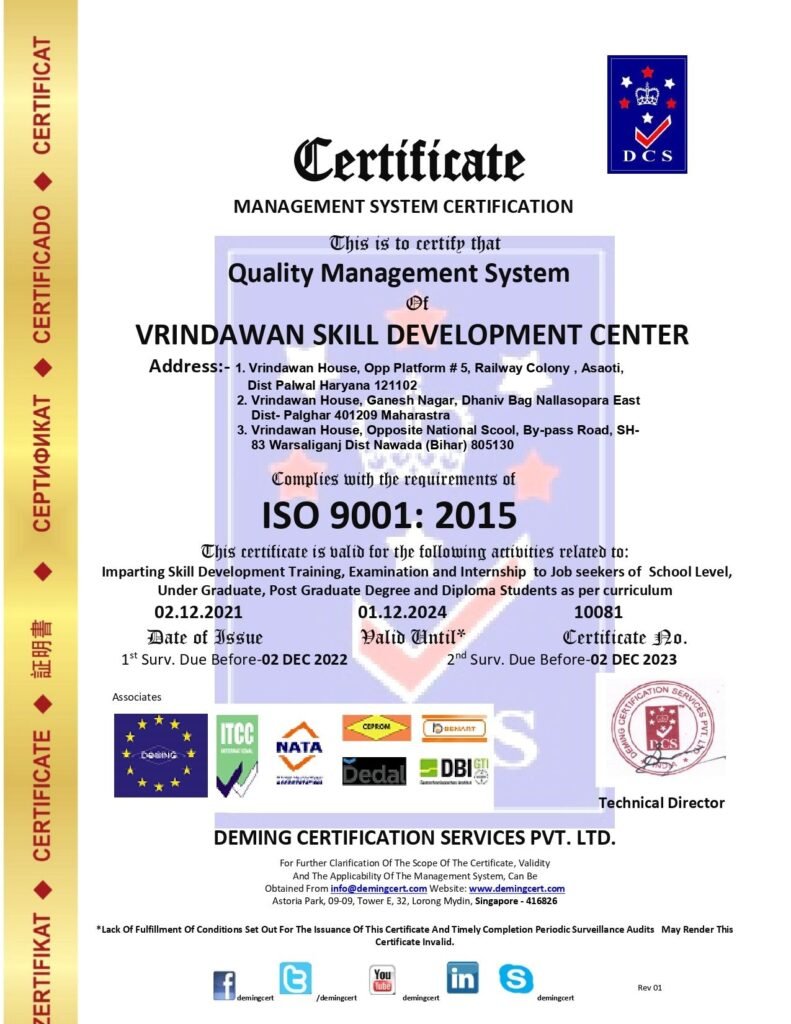
Vrindawan Skill Development Center developed its presence through locations in different parts of India, including Vrindawan House, Opp Platform #5, Railway Colony, Asaoti, District Palwal, Haryana – 121102; Vrindawan House, Ganesh Nagar, Dhaniv Bag, Nallasopara East, District Palghar, Maharashtra – 401209; and Vrindawan House, Opposite National School, By-pass Road, SH-83, Warsaliganj, District Nawada, Bihar – 805130. Operating across different locations created both opportunities and responsibilities. Each center served its surrounding community while contributing to the broader identity of the organization.
For a skill development organization, quality is closely connected with people. Learners come with different backgrounds, expectations and goals. Some may seek knowledge for employment, some may want to improve their practical capabilities, and others may be looking for structured training that can support their professional development. Meeting these expectations requires more than simply conducting training sessions. It requires organized processes, clear communication, competent people, proper documentation and a commitment to improvement.
This understanding became an important part of the organization’s quality journey.
As the organization developed, the need for a systematic management approach became increasingly relevant. Informal methods may work when an organization is small, but as activities expand, responsibilities increase and operations extend across multiple locations, consistency becomes more important. Management needs to know whether processes are being followed, whether responsibilities are understood and whether stakeholder expectations are being addressed.
This was the environment in which the ISO 9001:2015 Quality Management System became an important milestone for Vrindawan Skill Development Center.
The certification was issued in 2021 and was valid through 2024, covering the organization’s Quality Management System. The certification journey represented an opportunity to organize activities around a recognized quality-management framework. Rather than considering quality as a single department’s responsibility, the system encouraged a broader organizational approach.
For the promoter, this stage could be seen as a transition from simply managing day-to-day activities toward thinking about processes and systems. Leadership in a growing organization requires attention to many interconnected areas. Training activities, administration, communication, records, employee responsibilities and learner interactions all influence organizational performance.
ISO 9001:2015 introduced a structured way of looking at these activities.
The process approach encouraged the organization to understand how different activities connect with one another. For example, effective communication at the beginning of a learner’s relationship with the organization can influence enrollment, training expectations and overall satisfaction. Similarly, proper documentation can support accountability, while feedback can provide information for improvement.
The implementation of a quality-management system could therefore help the organization establish greater clarity.
Another important aspect was consistency between locations. Asaoti in Haryana, Nallasopara East in Maharashtra and Warsaliganj in Bihar are geographically different environments. Each location has its own local community and operational circumstances. At the same time, an organization working under one identity needs common principles and expectations.
A quality-management framework can provide that common foundation.
Employees and management can work with defined procedures, responsibilities and records while still responding to local requirements. This balance between standardization and practical flexibility is valuable for organizations that operate across multiple locations.
The certification journey also encouraged a different understanding of documentation. Records are not merely paperwork. When maintained properly, they provide evidence of activities and help management review what has happened. They can also support identification of gaps and opportunities for improvement.
For the promoter and team, this created an opportunity to develop a more disciplined organizational culture.
The journey toward ISO 9001:2015 certification was therefore not simply about obtaining recognition. It was about understanding how systematic quality management could support the organization’s long-term development. The certificate became a visible representation of a larger internal effort involving processes, people, responsibilities and management commitment.
The period beginning with certification in 2021 became an important chapter in the organization’s story. It represented a point at which growth and quality could be considered together.
For Vrindawan Skill Development Center, the objective was not only to continue providing skill-development services but also to strengthen the systems through which those services were organized and delivered.
The foundation established during this period created possibilities for future improvement. As the organization continued learning from experience, feedback and operational challenges, the principles of quality management could remain useful beyond the certification period.
The story was therefore only beginning.
The ISO 9001:2015 certification provided the framework, but the people behind Vrindawan Skill Development Center would determine how effectively that framework translated into everyday practices. The promoter’s leadership, employee participation, learner feedback and commitment to continual improvement would together shape the next stages of the organization’s development.
Thus, the beginning of the quality journey was also the beginning of a broader organizational transformation—a journey from individual activities toward systematic processes, from routine administration toward structured management, and from short-term operations toward a continuing culture of quality and improvement.
#VrindawanSkillDevelopmentCenter
Chapter 2 – Building a Structured Management System
After establishing the foundation for its quality journey, Vrindawan Skill Development Center entered an important stage in which the principles of ISO 9001:2015 could be connected with everyday organizational activities. The certification issued in 2021 was not merely an achievement to be displayed; it represented an opportunity to develop a more systematic approach toward management, training activities, documentation and stakeholder satisfaction.
For an organization involved in skill development, a structured management system can provide significant value. Training is ultimately a people-centered activity, but successful training also depends upon processes working behind the scenes. Admission-related activities, communication, scheduling, trainer coordination, learning support, records, feedback and administrative work all need to function together. If one process is weak, it can affect other activities.
Vrindawan Skill Development Center therefore had an opportunity to look at its operations as a connected system rather than as a collection of individual responsibilities.
The three listed locations—Asaoti in Palwal, Haryana; Nallasopara East in Palghar, Maharashtra; and Warsaliganj in Nawada, Bihar—made systematic management particularly important. Each location had its own local environment and day-to-day requirements, while the organization needed to maintain a consistent identity and quality orientation across its activities.
The Quality Management System provided a common framework through which responsibilities and processes could be understood.
One of the first important lessons of a structured management system is that every activity should have a purpose. Employees need to understand not only what they are expected to do but also how their work contributes to the larger organizational objective. A staff member handling documentation, for example, contributes to organizational control. A trainer contributes directly to learning outcomes. An administrative employee contributes to smooth coordination. Management provides direction and ensures that the overall system continues to function.
When these roles are clearly understood, an organization becomes less dependent on individual assumptions.
The promoter’s involvement was particularly significant at this stage. Quality management requires leadership because procedures alone cannot create a quality culture. Management needs to communicate expectations, allocate responsibilities and encourage employees to follow established practices.
The promoter could use the certification journey as an opportunity to encourage employees to think systematically. Instead of asking only whether a task had been completed, management could also consider whether it had been completed correctly, whether the relevant record was available and whether the process could be improved.
This change in thinking is important because quality management is not simply about completing activities. It is about controlling and improving processes.
Documentation became another important element of the system. A structured organization requires reliable information about its activities. Records can help demonstrate that processes have been carried out and can provide useful evidence during reviews.
For Vrindawan Skill Development Center, documentation could support areas such as learner-related information, training activities, internal communication, responsibilities and quality-related reviews. Proper documentation could also make it easier to identify gaps.
For example, if an activity did not produce the expected result, management could review available information to understand where the process may have weakened. This approach encourages decisions based on evidence rather than assumptions.
The implementation of a Quality Management System also encouraged a stronger focus on responsibility. When duties are clearly allocated, employees can understand what is expected from them and management can monitor whether processes are working effectively.
This accountability can be especially valuable when an organization operates across multiple locations. A common system allows different teams to work toward similar quality expectations while still responding to their local operating conditions.
Another important aspect was communication.
A skill development organization interacts with many stakeholders. Learners need accurate information. Trainers need appropriate coordination. Administrative staff need timely instructions. Management needs information about operational performance. Effective communication helps connect these groups.
The structured management approach encouraged the organization to consider communication as an important process rather than an informal activity.
Over time, these practices could contribute to greater operational discipline. Employees become more aware that their individual actions affect other processes. Management gains greater visibility into organizational activities. Stakeholders receive a more organized experience.
The promoter could also use the management system as a foundation for future growth. Expansion becomes easier to manage when an organization already understands its processes. New employees can be introduced to established procedures, responsibilities can be communicated more clearly and performance can be reviewed using defined expectations.
This was particularly relevant to Vrindawan Skill Development Center because its journey was not limited to one local operating environment. Its presence across Haryana, Maharashtra and Bihar meant that organizational systems could become an important foundation for maintaining consistency.
The ISO 9001:2015 framework also introduced the idea that improvement should be continuous. A management system should not remain unchanged simply because it has been documented. Processes can be reviewed, feedback can be considered and changes can be introduced when opportunities are identified.
This philosophy encouraged a forward-looking approach.
For the promoter, the development of a structured management system represented an important stage of professional growth. Instead of relying solely on experience and personal supervision, leadership could increasingly depend on processes, records and measurable organizational practices.
The team could also begin to understand quality as everyone’s responsibility.
As the organization moved forward, the Quality Management System became a framework through which its people and processes could work together. The objective was not to make operations unnecessarily complicated but to make important activities clearer, more consistent and easier to manage.
The certification journey therefore helped establish a stronger organizational foundation.
The year 2021 marked the beginning of the certified quality-management period, but the deeper value of the journey lay in the habits and systems developed around it. For Vrindawan Skill Development Center, this stage demonstrated that sustainable organizational development requires more than ambition. It requires structure, responsibility, communication, documentation and the willingness to improve.
With this foundation in place, the organization could move toward the next important stage: understanding the expectations of learners and stakeholders and connecting those expectations with the organization’s quality objectives.
#ISO9001
Chapter 3 – Understanding Learner and Stakeholder Expectations
The growth of a skill development organization is closely connected with the people it serves. Buildings, equipment, processes and certificates may provide an organizational foundation, but the true purpose of a training center is to create value for learners and other stakeholders. For Vrindawan Skill Development Center, the implementation of an ISO 9001:2015 Quality Management System created an opportunity to place greater emphasis on understanding expectations and improving the overall quality of its services.
Following the establishment of a structured management system, the organization could begin examining its activities from the perspective of the learner. A person approaching a skill development center may have several expectations. They may want clear information about available training, transparent communication, organized administration, knowledgeable trainers, appropriate learning support and reliable documentation. Meeting these expectations requires coordination between different functions.
The ISO 9001:2015 quality-management approach encouraged Vrindawan Skill Development Center to consider these requirements systematically.
The organization had its listed locations in Asaoti, Haryana; Nallasopara East, Maharashtra; and Warsaliganj, Bihar. Each location served people within its surrounding community. Although the local circumstances could differ, learners at every location could reasonably expect professionalism and consistency in their interactions with the organization.
This made customer and stakeholder focus an important part of the quality journey.
For the promoter, understanding stakeholder expectations meant looking beyond the completion of individual training activities. Quality could be considered throughout the learner’s relationship with the organization—from the first communication to enrollment, training, assessment, documentation and subsequent feedback.
The first interaction often creates an important impression. Clear communication can help learners understand what services are available and what they can expect. When information is incomplete or inconsistent, confusion can occur. A structured quality approach therefore encouraged attention to communication processes.
Employees could be encouraged to provide information in a clear and organized manner. Questions raised by learners could be recorded and addressed through appropriate channels. Administrative responsibilities could be defined so that important information did not depend entirely on one individual.
This approach could improve consistency and also make management more aware of recurring questions or concerns.
Training delivery itself remained at the center of the organization’s activities. A quality-focused approach encouraged attention to the suitability and consistency of training processes. Trainers needed to understand their responsibilities, while management needed to ensure that appropriate resources and coordination were available.
The organization could also recognize the importance of learner feedback.
Feedback provides an opportunity to understand how stakeholders experience a service. Positive feedback can identify practices that are working well, while concerns can reveal areas requiring improvement. Rather than viewing feedback as criticism, a quality-oriented organization can use it as information for learning.
For Vrindawan Skill Development Center, this could become part of a broader continual-improvement philosophy.
The promoter and management team could review feedback and identify patterns. If several learners experienced a similar difficulty, management could examine whether the underlying process needed to be changed. This could involve communication, scheduling, documentation, trainer coordination or another operational area.
Such an approach represents an important difference between temporary problem-solving and systematic improvement.
Another important element was stakeholder communication within the organization. Learner expectations cannot be addressed effectively if information does not reach the employees responsible for delivering services. Trainers, administrative personnel and management need to remain connected.
The Quality Management System could provide a framework for defining these communication responsibilities.
The organization’s multi-location structure made this particularly relevant. A learner visiting the Asaoti center should experience the same broad commitment to quality as someone interacting with the Nallasopara East or Warsaliganj center. Local conditions may vary, but organizational principles can remain consistent.
This consistency can strengthen trust.
The promoter could also use stakeholder information to support future organizational planning. Understanding the needs of learners can help management identify opportunities for developing services, improving communication and strengthening training processes.
Quality management therefore became connected with growth. A better understanding of stakeholder expectations could help the organization make more informed decisions.
The certification issued in 2021 provided recognition of the organization’s Quality Management System, but the deeper value came from applying quality principles to everyday interactions. Each learner interaction could be considered an opportunity to demonstrate professionalism.
The organization’s growth could consequently be measured not only through expansion or activity but also through improvements in the way it managed relationships.
For employees, this required a change in perspective. Their work was not simply a series of administrative or training tasks. Each activity contributed to the learner’s overall experience. A timely response, accurate information, organized documentation or helpful interaction could all influence stakeholder confidence.
This understanding could help create a stronger service culture.
The promoter also had an important role in reinforcing this culture. Leadership could communicate that learner satisfaction and process quality were shared responsibilities. Employees could be encouraged to listen carefully, communicate clearly and report recurring challenges.
When management responds to feedback constructively, employees are more likely to recognize quality as a continuous organizational activity.
The ISO 9001:2015 journey thus provided Vrindawan Skill Development Center with a structured way to connect its internal processes with external expectations. The organization could increasingly view quality from both sides: what management expected from its processes and what learners expected from the organization.
This balance became an important foundation for continued development.
As the quality journey progressed, the organization could strengthen its focus on documentation, accountability and evidence. Understanding expectations was the first step; creating reliable processes to meet those expectations would become the next major challenge.
For Vrindawan Skill Development Center, this stage demonstrated that quality begins with people. By listening to learners, understanding stakeholder requirements and connecting feedback with improvement, the organization could build a stronger relationship with the communities it served.
The journey toward quality was therefore becoming more than a management exercise. It was becoming a service philosophy—one in which every learner interaction, every training activity and every organizational process could contribute to a culture of trust, consistency and continual improvement.
#ISO9001Certification
Chapter 4 – Strengthening Documentation and Accountability
As Vrindawan Skill Development Center continued its journey after obtaining ISO 9001:2015 certification in 2021, an important area of organizational development was the strengthening of documentation and accountability. For a growing skill development organization, documentation is not simply a collection of papers or files. It can become a practical management tool that helps people understand responsibilities, maintain consistency, review activities and identify opportunities for improvement.
The Quality Management System encouraged the organization to look at information in a more systematic manner. Every important activity has a purpose, and evidence of completed activities can help management understand whether processes are functioning as intended.
For Vrindawan Skill Development Center, this principle was particularly relevant because the organization had its listed operations at Asaoti in Haryana, Nallasopara East in Maharashtra and Warsaliganj in Bihar. Multiple locations naturally require coordination. When different teams work in different places, clearly defined procedures and reliable records can help maintain common organizational expectations.
The promoter and management team could therefore place greater emphasis on establishing responsibilities and maintaining appropriate documented information.
In a skill development environment, several types of activities may require coordination. Learner-related information, training schedules, attendance, communication, administrative records, trainer responsibilities and feedback can all form part of an organization’s operational information. Maintaining these records systematically can provide management with a clearer picture of what is happening within the organization.
The objective is not documentation for its own sake. Good documentation should support effective work.
When responsibilities are clearly defined, employees understand their roles more effectively. A trainer knows the activities expected from the training function. Administrative personnel understand their responsibilities. Management can identify who is responsible for reviewing information and taking action when necessary.
This creates accountability.
Before a structured system is established, many organizational activities may depend heavily on individual experience. An experienced employee may know exactly how to complete a particular task, but this knowledge can become difficult to transfer when new employees join or responsibilities change.
A Quality Management System can help convert important organizational knowledge into defined processes.
For Vrindawan Skill Development Center, this could support continuity. New employees could learn established procedures rather than depending entirely on informal instructions. Existing employees could refer to documented requirements when questions arose.
The promoter could also use documentation as a management resource. Records provide information that can be reviewed during management meetings or internal evaluations. If a particular activity is not producing the expected result, available records can help identify possible reasons.
For example, if repeated learner concerns arise, management can examine the relevant process and associated records. The problem may relate to communication, scheduling, documentation, responsibilities or another factor. Evidence makes it easier to examine the situation systematically.
This encourages a culture based on facts rather than assumptions.
Accountability also became important at the organizational level. When people understand who is responsible for an activity, there is greater clarity about follow-up. Responsibilities can be reviewed, problems can be communicated to the appropriate person and actions can be monitored.
Such practices can become especially valuable when an organization operates across several locations.
At Asaoti, Nallasopara East and Warsaliganj, teams could work toward common quality expectations while managing their local responsibilities. The Quality Management System provided a framework for maintaining organizational consistency without requiring every local activity to be identical.
The promoter’s leadership remained important in ensuring that documentation was not treated as an administrative burden. Employees needed to understand why records were maintained and how those records benefited their work.
When employees recognize the purpose behind documentation, compliance becomes more meaningful.
The system could also support corrective action. If an activity did not meet an expected requirement, the organization could document the issue, investigate the reason and identify an appropriate action. Follow-up could then determine whether the action had been effective.
This created a cycle of learning.
An issue was no longer simply something to be corrected and forgotten. It could become information that helped strengthen the process.
This approach also contributed to organizational maturity. A mature organization does not rely only on individual memory or verbal communication. It creates systems that preserve knowledge and provide evidence of important activities.
For the promoter, this was an important lesson from the ISO 9001:2015 journey. Growth requires systems that can support increasing responsibilities. As an organization becomes larger or more geographically distributed, personal supervision alone becomes increasingly difficult.
Structured documentation helps management maintain visibility.
The certification period beginning in 2021 therefore became an opportunity to establish stronger habits around information management and accountability. The organization’s teams could gradually become more conscious of the importance of completing activities correctly and maintaining appropriate records.
This could also strengthen communication between management and employees. Instead of discussing organizational performance only through informal conversations, management could review documented information and use it as a basis for discussion.
The resulting environment could encourage greater responsibility among employees. People could see how their work contributed to larger organizational processes.
Documentation also supported continuity when employees changed roles. A well-defined process can remain available even when the person originally responsible for it moves to another responsibility.
For a skill development center, such continuity can be valuable because the quality of service should not depend entirely on one person’s presence.
The promoter could therefore view documentation as part of the organization’s long-term foundation.
The ISO 9001:2015 Quality Management System helped connect documentation with accountability, process control and continual improvement. The certificate itself represented external recognition of the system, but the daily value came from how employees applied its principles.
By strengthening documentation, defining responsibilities and encouraging evidence-based management, Vrindawan Skill Development Center could create a more organized working environment.
This stage of the journey prepared the organization for another important area of development: building a quality-oriented team. Systems can define processes, but people are the ones who ultimately make those processes work. The next chapter would therefore focus on employee involvement, awareness, responsibility and the development of a shared culture of quality.
#QualityManagementSystem
Chapter 5 – Developing a Quality-Oriented Team
A Quality Management System can provide an organization with processes, procedures and documented requirements, but its success ultimately depends on people. For Vrindawan Skill Development Center, the journey toward ISO 9001:2015 certification was therefore not only a journey of improving systems; it was also a journey of developing greater awareness, responsibility and participation among the people working within the organization.
The organization had its listed locations at Asaoti, District Palwal, Haryana; Nallasopara East, District Palghar, Maharashtra; and Warsaliganj, District Nawada, Bihar. With activities distributed across different locations, teamwork and communication became important elements of organizational consistency.
The promoter and management team had an important responsibility in creating an environment where employees understood that quality was everyone’s responsibility.
In a skill development center, different people contribute to the learner’s experience in different ways. Trainers are directly involved in learning activities. Administrative employees help coordinate information and records. Management provides direction and resources. Support personnel help ensure that daily activities run smoothly.
Although these responsibilities are different, they are connected.
A learner may initially interact with an administrative employee, later communicate with a trainer and subsequently require documentation or follow-up support. The quality of one interaction can influence the perception of the entire organization. This made teamwork particularly important.
The ISO 9001:2015 framework encouraged the organization to think about competence and awareness. Employees need to understand their responsibilities and recognize how their work contributes to organizational objectives.
For the promoter, this created an opportunity to develop a more participative management culture.
Instead of viewing quality as something controlled exclusively by senior management, employees could be encouraged to identify problems and suggest improvements. People working directly with learners often notice practical issues first. They may recognize repeated questions, communication gaps, scheduling difficulties or documentation problems before these become visible to management.
Giving employees an opportunity to communicate such observations can therefore become an important source of improvement.
The development of a quality-oriented team also required communication about organizational expectations. Employees needed to understand why procedures existed and how following them could support the organization’s objectives.
This is particularly important when implementing a management system. If employees see procedures only as additional paperwork, they may follow them mechanically. If they understand the purpose behind them, the system can become part of everyday work.
The promoter could therefore reinforce the connection between quality and service.
For example, maintaining accurate learner information was not merely an administrative requirement. It could help employees provide more organized support. Recording feedback was not simply a documentation activity. It could provide management with information for improvement. Following training processes was not merely procedural compliance. It could contribute to consistency.
This understanding helped connect individual responsibilities with organizational performance.
Training and awareness could also support employees when processes changed. Whenever an organization introduces new methods, employees need sufficient understanding to apply them correctly. A quality-oriented culture therefore encourages learning as a continuous activity.
For Vrindawan Skill Development Center, this approach could help employees adapt to changing requirements while maintaining the organization’s basic quality principles.
The multi-location structure made employee coordination particularly significant. Teams in Haryana, Maharashtra and Bihar might encounter different local circumstances, but they could still work within a common management framework.
The objective was not to eliminate local differences. Instead, the organization could maintain common expectations regarding professionalism, responsibility, documentation, communication and learner focus.
This balance could help preserve organizational identity while allowing individual centers to respond to their own operating environments.
Leadership played a central role in this process. The promoter could demonstrate commitment by participating in quality discussions, reviewing organizational performance and encouraging employees to take responsibility.
Leadership behavior often influences organizational culture. When management consistently emphasizes quality, employees are more likely to understand that quality is a long-term organizational priority rather than a temporary certification requirement.
The certification issued in 2021 therefore became an opportunity to reinforce this culture.
The team could learn to see quality as an ongoing process rather than a one-time achievement. An ISO certificate does not eliminate operational challenges. Instead, it provides a framework for identifying and managing those challenges.
This perspective could make employees more comfortable with reporting problems. If employees believe that mistakes will simply be ignored or hidden, management may never receive the information required for improvement. A constructive quality culture encourages people to identify issues and participate in finding solutions.
The promoter could also encourage recognition of good practices. When employees demonstrate effective communication, careful documentation or learner-focused behavior, acknowledging those practices can reinforce the organization’s values.
Over time, these small actions can contribute to a larger culture.
Teamwork also became important for continual improvement. Improvements do not always require major investments or dramatic organizational changes. Sometimes a clearer form, better communication method, improved scheduling practice or more organized record can make a practical difference.
Employees are often in the best position to identify such opportunities.
By involving the team, Vrindawan Skill Development Center could make its Quality Management System more dynamic. Employees could contribute knowledge from their daily experiences, while management could provide direction and resources.
This created a two-way relationship between leadership and employees.
For the promoter, the development of a quality-oriented team represented an important stage of personal and organizational growth. Leadership was no longer only about directing activities. It increasingly involved building a system in which other people could perform their responsibilities effectively.
The organization could become less dependent on individual supervision and more capable of operating through shared processes.
The experience also demonstrated that quality management is ultimately a human activity. Procedures can provide structure, but people create the actual experience received by learners and stakeholders.
The ISO 9001:2015 journey encouraged Vrindawan Skill Development Center to bring people and processes together.
As the organization moved forward, this quality-oriented culture could become a foundation for improving operational consistency. With employees aware of their responsibilities and involved in continual improvement, the organization could focus more effectively on strengthening its day-to-day processes.
Thus, the fifth chapter of the journey was not simply about employees following procedures. It was about creating a team that understood why quality mattered and recognized its own role in the organization’s future.
For Vrindawan Skill Development Center, this represented another step from certification toward a sustainable culture of quality, responsibility and continuous development.
#SkillDevelopment
Chapter 6 – Improving Operational Consistency
As Vrindawan Skill Development Center continued its quality journey after receiving ISO 9001:2015 certification in 2021, the organization reached another important stage: strengthening the consistency of its daily operations. A Quality Management System becomes meaningful when its principles are reflected in routine activities. For a skill development organization, this means creating organized processes that support learners, employees, trainers and management throughout the service cycle.
Vrindawan Skill Development Center had its listed locations in Asaoti, District Palwal, Haryana; Nallasopara East, District Palghar, Maharashtra; and Warsaliganj, District Nawada, Bihar. Managing activities across these locations created a practical need for common processes and clear responsibilities. While each center could respond to its local environment, the organization could work toward maintaining common quality expectations.
Operational consistency does not mean that every activity must be performed in exactly the same way. Different locations may have different circumstances, learner requirements and practical challenges. Instead, consistency means that important processes are understood, responsibilities are clear and the organization maintains a common commitment to quality.
The ISO 9001:2015 framework provided a foundation for this approach.
One of the first areas of attention could be the way activities were organized. A learner’s experience involves several interconnected stages. Initial communication, information sharing, registration, training coordination, documentation, feedback and follow-up can all influence the overall service experience.
If these activities are not coordinated, even a strong training program can face administrative difficulties.
A process-based approach helps management understand these connections. Employees can identify where one activity begins and another ends. Responsibilities can be allocated more clearly, and information can move between different functions with greater organization.
For the promoter, this represented a shift from managing individual tasks toward managing complete processes.
The organization could also focus on reducing unnecessary variation in routine activities. When similar tasks are performed differently by different employees, confusion can occur. Defined procedures and documented practices can provide employees with a common reference.
This is particularly useful when new employees join the organization.
Instead of learning every activity through informal instructions, employees can be introduced to established methods and responsibilities. This can help reduce dependency on individual memory and support continuity.
Operational consistency also depends on communication.
Management needs information from employees, employees need information from management and different functions need to communicate with one another. A structured communication approach can reduce the possibility of information being delayed, misunderstood or lost.
For a multi-location organization such as Vrindawan Skill Development Center, communication can become even more important. Teams working in Haryana, Maharashtra and Bihar need a way to remain connected to the organization’s broader objectives.
The Quality Management System provided a framework for strengthening this connection.
Another important element was resource management. Effective service delivery requires appropriate people, information, infrastructure and other resources. Management needs to consider whether employees have the knowledge and support required to perform their responsibilities.
The promoter could therefore use the quality-management approach to consider operational requirements in a more systematic manner.
If employees encountered recurring difficulties, management could investigate whether additional training, clearer instructions or better coordination was required.
This approach helped transform operational challenges into opportunities for improvement.
Monitoring also became important. Management could review whether activities were being completed according to defined expectations and whether stakeholders were receiving the intended level of service.
Monitoring does not have to mean excessive supervision. Its purpose is to provide information about how effectively processes are working.
When a process performs well, the organization can continue using it. When problems appear, management can investigate and make appropriate changes.
This creates a cycle of control and improvement.
The promoter could also use management reviews to look at broader organizational performance. Instead of focusing only on individual incidents, management could identify patterns and consider whether changes were needed at the process level.
For example, if similar communication issues appeared repeatedly, management could review the communication process rather than treating each incident as a separate event.
This type of thinking is one of the important benefits of a structured Quality Management System.
Operational consistency could also contribute to employee confidence. When responsibilities and processes are clear, employees know what is expected. They can spend less time trying to determine how routine activities should be handled and more time focusing on effective service delivery.
This clarity could be particularly useful in an organization where employees perform different functions.
Trainers could concentrate on learning activities, administrative personnel could focus on coordination and records, and management could focus on planning, monitoring and improvement.
Each role remained connected to the larger system.
The promoter’s role was to ensure that the system remained practical. A management system should support organizational work rather than create unnecessary complexity. Procedures and records should have a clear purpose and should help employees perform their responsibilities effectively.
This practical perspective could help the organization maintain employee participation.
As the ISO 9001:2015 certification period progressed, the experience gained through daily operations could provide valuable information for further development. The organization could learn which processes were effective, which required adjustment and where additional attention was necessary.
This learning process contributed to organizational maturity.
The importance of operational consistency also extended to the organization’s reputation. Learners and stakeholders interact with the organization through everyday experiences. Consistent communication, organized administration and reliable processes can contribute to a professional impression.
For Vrindawan Skill Development Center, maintaining this consistency across locations could support its broader identity as a skill development organization.
The promoter and team could therefore view the Quality Management System not as a separate activity but as part of normal organizational management.
The certification issued in 2021 provided a recognized framework, but the real work took place through everyday implementation. Employees followed processes, management reviewed performance, feedback was considered and improvements were introduced.
This transformed quality from an abstract concept into practical organizational behavior.
As the organization strengthened operational consistency, another important opportunity emerged: learning from problems and feedback. No organization operates without challenges. What matters is how effectively those challenges are identified, analyzed and addressed.
For Vrindawan Skill Development Center, the next stage of its journey would therefore involve corrective action, feedback and continual improvement.
Operational consistency provided the foundation; learning from experience would help the organization continue building upon it.
#QualityEducation
Chapter 7 – Learning from Feedback and Corrective Action
Every growing organization encounters challenges. No matter how carefully processes are designed, situations may arise in which a service does not meet an expected requirement, communication is misunderstood, documentation is incomplete or an operational activity needs improvement. For Vrindawan Skill Development Center, the ISO 9001:2015 Quality Management System created a structured framework for responding to such situations and using them as opportunities for organizational learning.
The certification issued in 2021 provided the organization with a quality-management structure, but maintaining quality required continuous attention. The organization had its listed locations in Asaoti, District Palwal, Haryana; Nallasopara East, District Palghar, Maharashtra; and Warsaliganj, District Nawada, Bihar. With activities distributed across different locations, identifying and addressing problems systematically could become an important part of maintaining consistency.
A quality-oriented organization does not simply ask whether something went wrong. It also asks why it happened and what can be done to reduce the possibility of recurrence.
This way of thinking became an important element of the organization’s development.
For a skill development center, feedback can originate from many sources. Learners may raise questions about communication, scheduling or training arrangements. Employees may identify difficulties in internal processes. Trainers may notice areas where coordination could be improved. Management may identify gaps through reviews or monitoring.
Each of these sources can provide valuable information.
The promoter and management team could encourage employees to communicate problems rather than allowing them to remain hidden. When employees feel responsible for quality, they are more likely to report issues and participate in finding solutions.
This creates an environment in which problems become learning opportunities.
Suppose a repeated issue occurs in an administrative process. A temporary response may solve the immediate problem, but the same issue could return later. A corrective-action approach encourages management to investigate the underlying cause.
The organization could ask whether the problem resulted from unclear instructions, insufficient communication, incomplete documentation, lack of awareness, unclear responsibility or another process-related reason.
Identifying the underlying cause can lead to a more effective solution.
For Vrindawan Skill Development Center, this approach could help connect individual incidents with wider process improvement.
Feedback also played an important role in understanding stakeholder experience. Learners interact directly with the organization’s services and may therefore provide information that management cannot obtain through internal reviews alone.
Feedback can highlight both strengths and weaknesses.
Positive feedback can help management understand which practices are effective and worth maintaining. Constructive feedback can identify areas where improvements may be necessary.
The promoter could encourage the team to treat feedback as information rather than simply as praise or criticism.
This attitude is particularly important for a learning-oriented organization. A skill development center exists to support learning, and the organization itself can also become a learning organization by examining its own performance.
The ISO 9001:2015 philosophy of continual improvement supported this mindset.
When an issue was identified, management could consider the appropriate response. The response might involve correcting the immediate problem, updating a procedure, clarifying responsibilities, providing additional awareness or making another process-level change.
After an action was taken, management could also consider whether the action had addressed the underlying issue.
This follow-up is important because an action is most useful when it produces an effective result.
The promoter’s leadership was again important. Corrective action requires an organizational culture in which people are willing to acknowledge problems and work toward solutions. If employees are concerned that reporting an issue will automatically result in blame, important information may not reach management.
A constructive quality culture focuses on improving processes while maintaining accountability.
The organization’s multiple locations made this approach particularly valuable. An issue identified at one location could potentially provide a learning opportunity for other locations as well. If a useful improvement was developed in Asaoti, for example, management could consider whether the same principle was relevant to Nallasopara East or Warsaliganj.
In this way, local experience could contribute to organizational learning.
This created an important connection between quality management and organizational growth.
As the organization expanded its understanding of processes, it could become better prepared to recognize risks and opportunities. Employees could become more alert to recurring problems, while management could use available information to make decisions.
The promoter could also use reviews to identify broader trends. Instead of looking only at isolated incidents, management could examine whether particular types of concerns were appearing repeatedly.
Such analysis could help identify opportunities for preventive improvement.
For example, if learners repeatedly asked the same question, the organization might improve the information provided at an earlier stage. If employees repeatedly encountered uncertainty about a procedure, management might clarify the documented process. If records were frequently incomplete, additional awareness or process changes might be appropriate.
Small improvements of this type can gradually strengthen an organization.
Corrective action also reinforced the importance of documentation. When issues and actions are recorded appropriately, management can review what happened and learn from previous experiences.
This contributes to organizational memory.
The knowledge gained from one situation does not have to disappear when the immediate problem has been resolved. It can become part of the organization’s continuing experience.
For Vrindawan Skill Development Center, this approach could support greater maturity in management. The organization could gradually move from reacting to individual problems toward identifying patterns and improving systems.
This represented an important stage in the promoter’s development as well. Effective leadership involves not only achieving objectives but also responding constructively when results differ from expectations.
The ISO 9001:2015 journey encouraged this mindset.
The certification period from 2021 to 2024 therefore provided an opportunity for the organization to strengthen its approach to feedback, corrective action and continual improvement. The lessons learned through operational experience could help the team become more disciplined and responsive.
Most importantly, the organization could understand that quality is not defined by the absence of every problem. Quality is also reflected in the ability to recognize problems, respond responsibly and learn from experience.
For Vrindawan Skill Development Center, every piece of feedback could become a source of knowledge, every challenge could reveal an opportunity for improvement and every corrective action could contribute to stronger processes.
This learning-oriented approach created a foundation for the next phase of the journey: expanding the organization’s vision across its different locations while maintaining a common commitment to quality.
#VocationalTraining
Chapter 8 – Expanding the Vision Across Locations
Growth becomes meaningful when an organization can expand its reach while maintaining the principles that define its identity. For Vrindawan Skill Development Center, the journey associated with ISO 9001:2015 certification provided an opportunity to consider how quality principles could support an organization working across different geographical locations.
The organization had its listed centers at Vrindawan House, Opposite Platform #5, Railway Colony, Asaoti, District Palwal, Haryana – 121102; Vrindawan House, Ganesh Nagar, Dhaniv Bag, Nallasopara East, District Palghar, Maharashtra – 401209; and Vrindawan House, Opposite National School, By-pass Road, SH-83, Warsaliganj, District Nawada, Bihar – 805130.
These locations represented different communities, environments and operational circumstances. At the same time, they were connected by the identity and objectives of the same organization. Maintaining a common quality philosophy across these locations could therefore become an important part of organizational development.
The ISO 9001:2015 Quality Management System offered a structured framework for achieving this objective.
For the promoter, operating across different locations required a shift in thinking. When an organization functions from one place, management can often remain closely involved in everyday activities. As locations increase, direct supervision becomes more difficult. Systems, communication and clearly defined responsibilities become increasingly important.
The quality-management approach could help address this challenge.
A common framework could establish expectations relating to documentation, communication, learner focus, responsibilities, process control and continual improvement. Each center could apply these principles while responding to the needs of its local environment.
This distinction was important.
Standardization did not mean that every location had to operate without flexibility. Local communities may have different needs, and operational conditions can vary. What remained common was the organization’s commitment to quality and systematic management.
For example, the way a learner’s specific concern was addressed might depend on the local circumstances, but the expectation that the concern should be communicated, considered and resolved appropriately could remain consistent.
Such principles could strengthen organizational identity.
The Asaoti location formed part of the organization’s presence in Haryana. Nallasopara East extended the organization’s presence into Maharashtra, while Warsaliganj represented its presence in Bihar. Each location could contribute local experience to the broader organization.
This created an opportunity for shared learning.
A challenge encountered at one location could potentially provide information useful to another. Similarly, an effective practice developed at one center could be considered for wider application.
The promoter could encourage communication between teams so that knowledge was not isolated within individual locations.
This approach could also support employee development. Staff members working in different centers could learn from each other’s experiences. Management could identify common training requirements and areas where additional awareness might be useful.
A quality system therefore became a mechanism for connecting people as well as processes.
The certification period beginning in 2021 provided an important foundation for this thinking. The organization could use documented procedures and management practices to create greater consistency while continuing to respond to local needs.
Another benefit of systematic management was organizational continuity.
When an organization expands, new employees may join and responsibilities may change. Without defined processes, the organization can become increasingly dependent on particular individuals. A documented quality system helps preserve important organizational knowledge.
For Vrindawan Skill Development Center, this could provide greater stability as its activities developed.
The promoter could also use information from different locations to support organizational planning. Management reviews could consider common issues, local challenges and opportunities for improvement. This broader perspective could help leadership make decisions based on experience from the organization as a whole.
Such information could be particularly valuable for future development.
Expansion is not simply about adding another location. Sustainable growth requires the ability to manage people, processes, communication and stakeholder expectations effectively. The ISO 9001:2015 approach encouraged the organization to think about these factors together.
The quality framework could therefore become part of the organization’s growth strategy.
For learners, consistency across locations could also contribute to confidence. A learner interacting with the organization should be able to recognize common standards of professionalism regardless of the center involved.
Communication, documentation and administrative practices could support this consistency.
The promoter’s role was to maintain the overall vision while allowing local teams to perform their responsibilities. Leadership could establish broad objectives, communicate expectations and review performance, while employees at each center could manage day-to-day activities.
This created a balance between central direction and local responsibility.
The experience also reinforced the importance of communication technology and organized information. When teams are geographically separated, timely communication becomes essential. Information about procedures, changes and organizational expectations needs to reach the relevant people.
A structured management system can provide channels for maintaining this connection.
The multi-location structure also provided the organization with a broader understanding of the communities it served. Different regions can bring different learner expectations, experiences and operational requirements. Learning from this diversity could help the organization develop a more responsive approach.
The promoter could therefore view geographical expansion not only as an organizational challenge but also as an opportunity to learn.
The ISO 9001:2015 journey helped create a foundation for this learning.
As the organization moved through the certification period from 2021 to 2024, its experience across locations could contribute to the development of a stronger organizational culture. Quality principles could become shared values rather than rules associated with a particular office.
This was an important stage of organizational maturity.
For Vrindawan Skill Development Center, expansion and quality were therefore interconnected. The broader the organization’s reach, the more important its internal systems became. At the same time, stronger systems could provide greater confidence in managing growth.
The promoter’s own development was also connected with this process. Managing multiple locations required greater attention to planning, delegation, communication and review. Leadership could increasingly focus on building systems that allowed teams to perform effectively.
The journey demonstrated that sustainable growth is supported not only by ambition but also by organizational discipline.
By establishing common quality principles across Asaoti, Nallasopara East and Warsaliganj, Vrindawan Skill Development Center could create a stronger foundation for future development.
The next stage of the journey would focus on leadership itself—the role of the promoter in maintaining the organization’s vision, strengthening its management approach and turning the lessons of certification into long-term organizational learning.
#SkillDevelopmentCenter
Chapter 9 – The Promoter’s Growth Through Quality Leadership
Behind every organization is a leadership team that shapes its direction, culture and priorities. For Vrindawan Skill Development Center, the journey toward ISO 9001:2015 certification was not only an organizational transformation; it was also an opportunity for the promoter and management to develop a more structured understanding of leadership, responsibility and continual improvement.
The ISO 9001:2015 certificate was issued in 2021 and remained valid through 2024. During this period, the Quality Management System provided a framework through which management could examine organizational activities from a broader perspective. Instead of concentrating only on daily operations, leadership could increasingly consider how different processes connected and how those processes contributed to long-term organizational objectives.
For the promoter, this represented an important change in management thinking.
A growing organization requires more than personal supervision. When activities take place across Asaoti in Haryana, Nallasopara East in Maharashtra and Warsaliganj in Bihar, leadership must rely on people, processes, communication and information. The promoter cannot personally handle every operational detail. Instead, leadership must create an environment in which employees understand their responsibilities and have the systems necessary to perform them.
The Quality Management System provided a framework for this approach.
Leadership began with establishing a clear commitment to quality. Employees need to understand that quality is not an activity performed only before an audit or certification assessment. It is part of everyday organizational management.
The promoter could reinforce this message through regular communication, participation in reviews and attention to process performance.
This leadership approach also required listening.
Employees working directly with learners may have valuable information about operational challenges. Trainers may understand learning-related concerns. Administrative personnel may identify documentation or communication issues. Management needs to create opportunities for this information to reach decision-makers.
By listening to employees and considering their suggestions, leadership can become more connected with everyday organizational realities.
The promoter’s role therefore expanded from directing activities to facilitating organizational learning.
Another important lesson was delegation.
As an organization grows, delegation becomes essential. Effective delegation does not mean simply assigning tasks. It means giving people clear responsibilities and establishing appropriate accountability.
The Quality Management System could support this by defining roles and processes.
Employees could understand what they were expected to do, while management could review whether responsibilities were being fulfilled effectively. This created greater clarity and reduced the need for constant individual supervision.
The promoter could then spend more time considering broader organizational matters such as planning, stakeholder expectations, employee development and continual improvement.
The multi-location structure made delegation particularly important. Teams in Haryana, Maharashtra and Bihar needed sufficient responsibility to manage local activities while remaining aligned with organizational objectives.
Leadership therefore required a balance between control and empowerment.
The ISO 9001:2015 approach also encouraged management to think in terms of evidence. Instead of relying entirely on assumptions, leadership could use records, feedback, monitoring information and review findings to understand organizational performance.
This could make management decisions more systematic.
For example, if a recurring issue was identified, the promoter could examine available information to determine whether the problem was isolated or part of a wider pattern. This could lead to more appropriate corrective or improvement actions.
Evidence-based thinking therefore became an important leadership skill.
Another aspect of leadership development involved understanding continual improvement. A successful organization cannot assume that existing processes will always remain appropriate. Learner expectations change, technology develops, employees change roles and operating environments evolve.
Leadership must therefore remain open to improvement.
For Vrindawan Skill Development Center, the certification journey provided an opportunity to establish this mindset.
The promoter could encourage the organization to ask questions such as: What is working well? Where are the recurring challenges? What do learners expect? Which processes need clarification? What can employees suggest? How can the organization become more consistent?
These questions can help transform quality management into an ongoing leadership practice.
The experience also highlighted the importance of organizational culture.
A certificate can recognize a management system, but culture develops through repeated behavior. If management consistently demonstrates attention to quality, employees are more likely to understand its importance.
The promoter’s actions could therefore influence how employees approached documentation, communication, learner feedback and process improvement.
Leadership could also reinforce the principle that problems should be addressed constructively. A healthy quality culture encourages employees to report issues so that they can be analyzed and corrected.
This helps prevent problems from being hidden or repeatedly overlooked.
The promoter’s personal growth could therefore be connected with the organization’s growth. As processes became more structured, leadership could become more strategic. As responsibilities were delegated, employees could become more independent. As feedback was considered, management could become more responsive.
The Quality Management System thus created opportunities for development at both organizational and leadership levels.
The period from 2021 to 2024 could be viewed as a chapter in which management gained practical experience in applying quality principles to organizational activities. The lessons learned could remain useful even beyond the specific certification period.
The promoter could carry these lessons into future planning, regardless of changes in services, locations or organizational structure.
One of the most important lessons was that quality leadership is not about demanding perfection. It is about establishing clear expectations, providing appropriate resources, listening to stakeholders, monitoring performance and encouraging improvement.
This philosophy can help an organization remain adaptable.
For Vrindawan Skill Development Center, leadership became increasingly connected with systems. The promoter’s vision could be translated into processes, responsibilities and organizational practices. Employees could understand their role within the larger structure, while management could maintain an overview of performance.
This relationship between leadership and systems provided an important foundation for sustainable development.
The organization’s listed locations in Haryana, Maharashtra and Bihar represented not only geographical presence but also an opportunity to apply a common quality philosophy in different environments.
The promoter’s journey through ISO 9001:2015 demonstrated how certification can encourage leaders to think more systematically about organizational growth.
The certificate itself represented a defined period of recognition, but the leadership lessons could continue beyond that period.
The final stage of the story would therefore not be about the end of certification. It would be about what the organization learned from the journey and how those lessons could become part of its continuing future.
For Vrindawan Skill Development Center, quality leadership became a bridge between past experience and future development—a bridge built through responsibility, communication, process discipline, stakeholder focus and a continuing commitment to improvement.
#ContinualImprovement
Chapter 10 – A Continuing Journey Beyond Certification
Every certification journey has a beginning, a period of implementation and a stage at which the organization looks back at what it has learned. For Vrindawan Skill Development Center, the ISO 9001:2015 Quality Management System certification issued in 2021 and valid through 2024 represented an important chapter in its organizational development. The significance of that period, however, extends beyond the dates printed on a certificate.
Certification can provide an organization with a structured framework, but the real value comes from the knowledge, discipline and management practices developed while applying that framework. For Vrindawan Skill Development Center, the quality journey created opportunities to strengthen processes, understand stakeholder expectations, improve documentation, clarify responsibilities and encourage continual improvement.
The organization had its listed locations at Vrindawan House, Opposite Platform #5, Railway Colony, Asaoti, District Palwal, Haryana – 121102; Vrindawan House, Ganesh Nagar, Dhaniv Bag, Nallasopara East, District Palghar, Maharashtra – 401209; and Vrindawan House, Opposite National School, By-pass Road, SH-83, Warsaliganj, District Nawada, Bihar – 805130.
These locations became part of a broader story of organizational development.
One of the most important lessons from the certification journey was the importance of systems. As an organization grows, informal methods may become difficult to manage. Defined processes help employees understand responsibilities, support continuity and provide management with greater visibility.
The promoter could therefore look at the organization not only as a collection of people and activities but as an interconnected system.
This way of thinking could continue to influence future organizational decisions.
Another important lesson was the connection between quality and stakeholder satisfaction. A skill development organization exists to serve learners and other stakeholders. Their expectations can change over time, which means that the organization must remain attentive and responsive.
Feedback can continue to provide useful information.
The organization could use its experience with the Quality Management System to maintain a habit of listening, reviewing and improving. Learner concerns could be considered opportunities to understand where processes might be strengthened. Positive experiences could identify practices worth maintaining.
This created the foundation for continual improvement.
The experience also demonstrated the importance of employees.
Processes can be documented, but people are responsible for putting those processes into practice. Trainers, administrative staff and management all contribute to organizational quality. When employees understand their responsibilities and participate in improvement, the Quality Management System becomes more meaningful.
The promoter’s leadership could continue to encourage this participation.
Another lesson involved documentation and organizational knowledge. Proper records can help preserve information and support decision-making. They can also make it easier for new employees to understand established practices.
For a multi-location organization, this can be particularly valuable.
The experience gained across Asaoti, Nallasopara East and Warsaliganj could contribute to the organization’s collective knowledge. Practices developed in one location could potentially provide learning opportunities for another. Common procedures could support consistency while local teams remained responsive to their own operating environments.
The certification journey therefore demonstrated that geographical growth and quality management can be closely connected.
The organization could also continue using corrective action as a learning mechanism. Problems are inevitable in any operating environment, but they can provide information about processes.
When a problem occurs, management can ask what happened, why it happened and what can be changed to reduce the possibility of recurrence.
This mindset helps transform individual problems into organizational learning.
For the promoter, perhaps one of the most valuable outcomes of the journey was a broader understanding of leadership. Quality leadership is not simply about maintaining standards. It involves setting direction, communicating expectations, supporting employees, reviewing performance and encouraging improvement.
These principles can remain relevant regardless of whether a particular certificate is currently active.
The period from 2021 to 2024 therefore became a valuable chapter in the organization’s history. It provided practical experience in implementing a recognized Quality Management System and encouraged the organization to connect quality with its broader objectives.
The story did not have to end with the end of the certificate’s stated validity period.
Instead, the lessons learned could become part of the organization’s continuing management philosophy.
Future development may bring new technologies, new training requirements, new learner expectations and new operational challenges. An organization prepared to review its processes and learn from experience can respond more systematically to such changes.
For Vrindawan Skill Development Center, this continuing mindset can be particularly relevant because skill development itself is connected with learning and adaptation.
An organization dedicated to developing skills can also develop its own organizational capabilities.
The quality journey can therefore be viewed as a cycle:
Understand → Plan → Implement → Monitor → Learn → Improve.
Each stage contributes to the next.
Understanding stakeholder requirements helps management plan appropriate processes. Implementation puts those processes into practice. Monitoring provides information about performance. Learning converts experience into knowledge, while improvement strengthens the system.
This cycle can continue regardless of specific certification dates.
The promoter and team could use this philosophy to maintain attention to quality in future activities. The objective would not simply be to achieve another certificate but to ensure that quality principles remain connected with everyday organizational decisions.
The story of Vrindawan Skill Development Center is therefore a story of organizational learning.
Its ISO 9001:2015 certification issued in 2021 represented an important milestone. The implementation of the Quality Management System provided a structured opportunity to examine processes, responsibilities and stakeholder relationships. The experience across its listed locations in Haryana, Maharashtra and Bihar contributed to a broader understanding of how systems can support organizational development.
Most importantly, the journey demonstrated that quality is not a destination.
A certificate can have an issue date and a validity date, but organizational learning can continue. Processes can be improved, employees can develop, stakeholders can provide new expectations and leadership can continue refining its approach.
For the promoter, this means carrying forward the lessons of systematic management into the organization’s future.
For employees, it means understanding that every responsibility contributes to the larger quality experience.
For learners and stakeholders, it means continuing to receive attention, communication and service through an organization committed to improvement.
The journey that began with the decision to establish a structured Quality Management System therefore became much larger than certification alone. It became an opportunity to strengthen the organization’s foundation and develop a culture of responsibility, consistency and learning.
Vrindawan Skill Development Center’s quality journey can consequently be remembered as an important chapter in its growth story—a chapter that began with ISO 9001:2015 certification in 2021, developed through years of implementation and learning, and created a foundation for continued organizational development beyond 2024.
The certificate marked a milestone.
The learning became the legacy.
And the commitment to quality remained a continuing journey.
#OrganizationalGrowth
#QualityDrivenGrowth #TrainingExcellence #ProfessionalSkillDevelopment #QualityAssurance #LearningAndDevelopment
Take the Next Step Today
Don’t wait to enhance your business’s quality and efficiency. Partner with Mayu Group Global and experience the transformation that comes with expert consultancy and training. Contact us today to learn more about how we can help you achieve your business goals. Reach out via phone at
+91-9322728183, visit our website at www.mayugroup.com, or email us at investor@mayugroup.com Let us be your guide on the journey to excellence and innovation.